Most writing about Knowledge Panels explains what one is. Very little of it tells you what actually gets built, in what order, and how you would know whether a given piece is finished. That gap is why so many builds stall: not because anyone was lazy, but because step seven was started before step five was true, and step seven cannot work in that state.
So this is the build manual. Twelve artefacts, in dependency order. For each one: what it is, what done looks like, how you measure it, and the specific way it usually gets built wrong. If you want the commercial version instead, the decision brief on the companion site covers cost, worth and when not to buy.
01The dependency chain, before anything else
The order is the whole method. Each artefact assumes the previous one is already true, and the assumptions are load-bearing rather than stylistic.
Source: Our own eight client records, read live from Google on 31 August 2026
Two examples of what that means in practice. The schema in artefact four contains a sameAs array listing your profiles, so it cannot be correct until artefact five has made those profiles agree with each other. And the witness work in artefact eight asks other people to repeat your identity line verbatim, which requires that artefact one has produced a line worth repeating.
02Artefact 01: the three sentences
Who you are. What you stand for. What result you drive, for whom. Three plain sentences, no adjectives, no positioning language.
Definition of done
- Each sentence survives being read aloud to somebody outside your industry
- The first names you, your role and your organisation, in that order
- None of the three contains the words passionate, innovative, or leading
- You can say all three the same way twice, a week apart, without checking
How it gets built wrong: it gets skipped, on the grounds that everyone knows who they are. Then artefact three has nothing to open with, artefact seven has no through-line, and artefact eight asks other people to repeat a sentence nobody ever wrote. Roughly a third of engagements pause here, and pausing here is much cheaper than pausing at month six.
03Artefact 02: the brand brain
One private file holding every fact anybody will ever state about you in public. Not a brand book. A reference file.
| Section | What goes in it | Why it exists |
|---|---|---|
| Identity | The three sentences, four bios at 1, 75, 150 and 350 words | So the same words appear everywhere without being rewritten |
| Hard facts | Founding dates, registration numbers, team size, service area | These are the facts a machine will state, so they must be stated once |
| Numbers | Every figure you will stand behind in public, with its source | Missing numbers here are where invented numbers come from later |
| Images | Master headshot plus a stack of a dozen in different contexts | Image similarity is one of the ways a machine confirms one person |
| Proof | Case studies with names, dates and results. Real reviews with sources | Corroboration you can hand to somebody who asks |
| Surfaces | Every profile, directory, author page and conference bio carrying your name | You cannot align what you have not listed |
How it gets built wrong: it becomes a folder of assets instead of a file of facts. Assets are easy to gather and they answer no questions. The test is whether somebody who has never met you could write an accurate 150-word bio from it in ten minutes.
04Artefact 03: the entity home
One canonical site on your own name, separate from the company site, linked both ways. This is the address every other record will point at, and the reason the record survives you changing jobs.
- It is on a domain carrying your name, not a subfolder of the company site
- The identity line is the first paragraph, in plain text, not inside an image or a hero graphic
- The master headshot is above the fold
- There are sections for Books, Media, Speaking, Press and Contact, and empty ones are fine
- There is a /links page on this domain, and the Linktree is gone
- It links to the company site and the company site links back
How it gets built wrong: the identity is put in a design element. A hero image containing your name and role is invisible to anything that reads text, which is everything that matters here. If the information exists only in a picture, it does not exist.
05Artefact 04: the structured data layer
Person JSON-LD on the entity home, Organization JSON-LD on the company site, wired to each other with founder and worksFor. This is the layer you fully control, and it quietly does most of what people wrongly hope Wikidata will do.
Definition of done
- Exactly one Person block, on the entity home, and it validates
- Exactly one Organization block, on the company site, and it validates
- founder on the Organization points at the Person's @id, and worksFor points back
- sameAs lists only live profiles that are genuinely yours, in canonical URL form
- Every field is either true or deleted. No placeholder survives to production
How it gets built wrong, two ways. First, sameAs gets padded with directory listings on the theory that more is better. It is not: twenty listings do not beat six real profiles, and the padding is visible. Second, and more expensively, schema gets sold as an AI visibility deliverable.
Source: Ahrefs, 1,885 pages that added JSON-LD against 4,000 controls, four methods
Be clear about what that chart says. Adding JSON-LD was followed by a small, statistically significant decline in AI Overview citations across 1,885 pages measured against 4,000 controls with four independent methods. Ship schema, because rich results and machine-readability are real and separate benefits. Never bill it as AEO. The reason the myth persists is that 53 percent of AI-cited pages carry schema, which is what competence looks like, not what causes citation.
06Artefact 05: profile alignment
Six fields, made identical across every surface you own. Two hours of unglamorous work with the highest return in the entire build.
| Field | Rule | The usual failure |
|---|---|---|
| Name string | Character for character, including spacing and capitalisation | Bhavik Sarkhedi in one place, B. Sarkhedi in another, three weak entities instead of one |
| Headshot | The same image file, not a different crop of the same session | Six different photos, removing a signal for no benefit |
| Headline | Same first eight to ten words everywhere | Rewritten per platform, so the role reads differently in four places |
| City | Written the same way, every time | Ahmedabad here, Ahmedabad Gujarat there, Remote on the third |
| First bio line | Identical, taken from the brand brain | Written fresh each time, which is how job titles drift |
| Primary link | Your own /links page, never an aggregator on somebody else's domain | A Linktree, which hands the hub to a third party |
How it gets built wrong: it is done once and then never re-run. This is the most common silent regression in the whole build. Somebody updates LinkedIn in month nine, and the set quietly disagrees again. The quarterly cadence exists mostly for this.
07Artefact 06: instrumentation
Search Console verified on the entity home, using an account the subject will still control in five years.
This one is short and it is the one people most often get wrong in a way that costs them the panel two years later. The same Google account is required to claim the panel and to submit every future edit. Verifying with an agency address, a shared inbox, or an account created for the project means that when the relationship ends, so does the ability to edit.
08Artefact 07: the proof engine
Two cornerstone pieces a month, one case study a month, weekly video clips. Published to the entity home first, then mirrored outward with the first link pointing back home.
- Publish to your own domain first. Always. Mirroring a piece that lives on somebody else's platform makes their copy canonical.
- Say your canonical name out loud in the first fifteen seconds of every video, and put the same string in the captions.
- Shoot landscape. A vertical clip lives on one surface and dies there; a landscape one can be embedded on the site, in a guide, in a newsletter and on the channel.
- Case studies carry names, dates and results, or they are paragraphs rather than records.
- One piece a month that a stranger could verify beats four that only assert.
How it gets built wrong: volume replaces verifiability. Four posts a week of opinion produce less usable evidence than one case study a month with a named client and a checkable outcome. And on length specifically, the reflex is wrong: correlation between word count and AI citation is 0.04, and over half of cited pages are under a thousand words.
09Artefact 07 in detail: what actually corroborates
The proof engine is the artefact people spend the most effort on and get the least out of, because effort goes into volume and corroboration comes from verifiability. Here is the difference, by content type.
| Content type | Corroboration value | Why |
|---|---|---|
| A case study naming a client, a date and a result | Highest | Somebody else can check it. That is the entire definition of corroboration. |
| An interview on a domain with a publishing history | Highest | A third party made an editorial decision to name you, which is the signal Google is looking for |
| A book with an ISBN | Highest, and the most durable | It creates a record class Google already models, and other people cite it without being asked |
| A conference or podcast bio that names you | High | It sits on somebody else's domain and stays online for years |
| A contributed piece under your byline | Medium to high | Depends entirely on whether the publication has its own authority |
| A long-form video with your name in the first fifteen seconds | Medium | YouTube is one of the two universal citation surfaces, so this is worth more than it used to be |
| A post on your own site | Low on its own | It is your claim about yourself. Necessary as the canonical version, insufficient as evidence. |
| A social post | Very low | Ephemeral, rented, and rarely crawled in a way that attributes it to an entity |
| A paid directory listing | Near zero, sometimes negative | Volume without editorial judgement, and it is visible as such |
The practical consequence: one case study a month with a named client beats four opinion posts a week, and it is less work. The reflex to publish more is an SEO habit that does not transfer. On length specifically, the correlation between word count and AI citation is 0.04, and over half of cited pages are under a thousand words.
The video rule that most people get wrong: shoot landscape. A vertical clip lives on one surface and dies there. A landscape one can be embedded on your site, in a guide, in a newsletter, in a press page and on the channel, which means one recording produces five records instead of one. Say your canonical name out loud in the first fifteen seconds and put the identical string in the captions, so the transcript carries the entity.
Publish home first, always. A piece that appears on somebody else's platform before it appears on yours makes their copy canonical, and you have handed away the one thing the whole build is trying to establish. Publish to the entity home, wait for it to be indexed, then mirror outward with the first link pointing back.
10Artefact 08: the corroboration web
The part that takes the months and the part that cannot be bought. Three to five independent witnesses on each of two axes, every one naming you and linking home.
Vertical is your trade: peers, suppliers, associations, conferences, industry podcasts. Geographic is your place: local press, chambers, allied trades, charities, civic bodies. The intersection is the pattern that cannot be faked, because faking it costs more than earning it.
How it gets built wrong in India specifically: the standard playbook for this step is written for American local-service businesses, where the geographic axis is dense with crawlable pages. Here it is thin. The substitution is industry associations, trade bodies, regional business press, university and conference pages, and Indian-language publications that Google crawls and most agencies never look at.
Source: Ahrefs Brand Radar, 1.9 to 4 million queries per platform, read 25 Aug 2026
One more thing that chart settles. Content that lives only on your own site earns very little of the citation share. Reddit and YouTube are the two universal surfaces across almost every assistant, and traditional press underperforms its reputation badly: the New York Times sits 35th on AI Overviews at 0.4 percent mention share. A tier-one placement bought specifically for AI visibility is buying prestige, not citations.
11Artefact 09: the durable accelerators
In descending order of power, and the order matters because the later ones have eligibility gates the earlier ones do not.
- FirstAuthorship with an ISBN
A book with an ISBN, plus Author and Book pages on the entity home, is the single most durable accelerator available. It creates a record class Google already models well.
- SecondWikidata, conditionally
Only if the notability bar is honestly cleared. It is a much lower bar than Wikipedia and it is still a bar. Attempting it early is not neutral.
- ThirdPeer proximity
Five or more podcast appearances alongside people the systems already understand. Being seen next to known entities is itself a signal.
- FourthGrokipedia and equivalents
Once every claim in the record is independently verifiable, and not before.
How it gets built wrong: somebody starts with Wikipedia. A deleted article leaves a public deletion record and leaves the subject worse off than never trying. We do not write, buy or place Wikipedia articles, and we will argue about it if asked.
12Artefact 10: the claim
Ten minutes of work with one field that decides the outcome. The field asks why you are claiming the panel, and almost everybody answers a different question than the one being asked.
Rejected
- I am the subject of this panel and I would like to manage it
- This is my personal brand and I want to control what it says
- A long paragraph about who you are with nothing checkable in it
Approved
- Named records already in Google's index that identify you
- The identity line verbatim, matching what those records say
- Three or four sentences of evidence, not of introduction
Prepare the statement early, even before there is a panel to claim. Writing it tells you precisely which records you are still missing, which makes it a diagnostic as well as a deliverable.
The hard line: this artefact is produced by the subject, from the subject's own account, with the subject's own documents. We prepare the packet and rehearse the field. We do not take identity papers and we do not log in. Anyone willing to do those things is a risk being hired.
13Artefact 11: the lock
Four pillars have to hold at once: the entity home, the structured identity, the corroboration web, and Google surface alignment. Locked means Google has stopped second-guessing.
- The panel appears for brand-only queries, not just name-plus-qualifier
- Verified edits land in days rather than weeks
- Off-brand and wrong images are gone from the panel and the image results
- You consistently beat namesakes on the bare name, across days, not just once
Two or more of those failing means not locked, whatever the panel looks like on the day you check. The most common state we find on inbound enquiries is a panel that appears about half the time, which reads as instability rather than as a win.
Source: Our own eight client records, read live from Google on 31 August 2026
14Artefact 12: the cadence
The build has an end. The record does not. Drift is silent, and the whole point of a cadence is to catch it in weeks rather than at the point where a client mentions it.
| Interval | What you run | Time |
|---|---|---|
| Weekly | Search your name signed out. Note anything new on page one, good or bad. | 30 min |
| Monthly | The three-assistant baseline: nine prompts across ChatGPT, Claude and Perplexity, same wording every time, answers saved with the date. | 45 min |
| Quarterly | The nine-query audit: name alone, name plus city, name plus role, name plus company, name plus two topics, and three namesake variants. | 1 hr |
| Quarterly | One new third-party record that names you and links home. One is enough. Consistency beats volume. | Varies |
| Quarterly | Re-run the profile alignment check. This is where the silent regression lives. | 30 min |
The monthly baseline is the measurement that actually matters, and it only works if the wording never changes. Twenty-seven readings, scored, compared against last month. The delta is signal. A single month's score in isolation is not, because the prompts contain your own name and field and are therefore not comparable to anybody else's.
15The image stack, which almost nobody ships
Image similarity is one of the ways a machine confirms that six profiles describe one person, and it is the artefact most often reduced to a single headshot. A dozen images, shot deliberately, is a better use of one afternoon than most of what people spend that afternoon on.
| Shot | What it is for | The common miss |
|---|---|---|
| Master headshot, plain background | The file used identically on every profile | Six different crops of the same session, which removes the signal |
| Working shot | Shows the thing you actually do | Staged stock-photo energy, which reads as filler |
| Speaking or stage shot | Corroborates the speaking claim in your bio | Claimed in the bio, never evidenced in an image |
| With other people | Peer proximity, visible | Only solo shots, which makes the record feel closed |
| Environment or workplace | Anchors the geographic half of the record | Skipped entirely by remote-first people |
| Product, book or artefact | Ties you to the thing with an ISBN or a name | A cover mockup instead of the real object |
| Candid, mid-conversation | Used by publications that need something other than a headshot | Not supplied, so publications use a screenshot instead |
| Horizontal and vertical crops of each | Different surfaces demand different ratios | One ratio, so half the surfaces crop your face badly |
How it gets built wrong: the whole stack is treated as a branding exercise rather than a corroboration one. The question is not whether the photographs are flattering. It is whether a machine and a journalist can both get what they need without asking you.
16The entity home, page by page
Artefact three in more detail, because a one-line spec produces a one-line site. What a finished entity home contains, and what each page is doing.
| Page | What it holds | What it is for |
|---|---|---|
| Home | Identity line as the first paragraph, master headshot, links out to every profile | The canonical statement. Everything else on the web points here. |
| About | The 350-word bio in third person, chronological, with links to the records that prove each claim | The page a journalist copies from and a machine reads for facts |
| Books | One page per title, with ISBN, publisher, date and a buy link | Authorship is the most durable accelerator and it needs somewhere to live |
| Media | Every interview, podcast and article that names you, with outbound links | The corroboration web, listed in one place a crawler can follow |
| Speaking | Past and upcoming, with event names and dates | Evidences a claim most bios make and never support |
| Press | Downloadable headshots, the four bios, the identity line | So the next publication states the same facts as the last one |
| /links | Every profile, on your own domain | Replaces the Linktree and keeps the hub on a domain you own |
| Contact | One route, that works | The one page people reach when the rest of it has done its job |
Empty sections are fine and honest. A Books page saying nothing is published yet is better than no Books page, because the absence is then a stated fact rather than a gap. A missing section reads as an unanswered question.
17The nine-query audit, as an instrument
The quarterly audit is nine specific queries, and each one exposes a specific defect. Run them signed out, in the same order, and record the result rather than the impression.
| # | Query | Defect it exposes | Where the fix lives |
|---|---|---|---|
| 1 | Full name | The headline state of the whole record | Everywhere |
| 2 | Name plus city | The geographic axis is missing | Artefact 08 |
| 3 | Name plus role | Job title written differently across profiles | Artefact 05 |
| 4 | Name plus company | Person and organisation not linked in a machine-readable way | Artefact 04 |
| 5 | Name plus topic one | Publishing exists but is not attributed to you | Artefact 07 |
| 6 | Name plus topic two | One topic passing is coincidence, two is a category signal | Artefact 07 |
| 7 | Name in quotes | The namesake count, exactly | Artefact 08, or a different plan entirely |
| 8 | Name plus namesake's field | Google is currently blending you with somebody else | Escalate, do not publish more |
| 9 | Name, in Google Images | The wrong face is coming back | Artefact 05, the image file |
That last column is the point of running them. A query failing is not information on its own. A query failing that maps to an artefact you have not finished is a work instruction.
18The measurement: scoring the monthly baseline
Nine prompts, three assistants, 27 readings, scored the same way every month. Without a scoring rule the baseline becomes a feeling, and feelings do not show a delta.
| Result | Score | What it means |
|---|---|---|
| Named accurately, with a citation to a page you control | 2 | The strongest outcome. There is a source the model trusts and it resolves to you. |
| Named accurately, no citation or a third-party citation | 1.5 | Working normally. Somebody else's page is doing the corroborating, which is the expected state. |
| Named, but a detail is wrong | 1 | The record disagrees with itself somewhere. Find the surface carrying the wrong fact. |
| Not named, but competitors are | 0 | The category question is answered from sources that do not include you. The most common Tier 2 result. |
| Confused with a namesake | -1 | Worse than absence. Escalate rather than publish. |
| Refused, or said it does not know | 0 | Neutral, and common for private individuals. |
Divide the total by 54 for a share-of-voice figure. It is comparable to your own previous months and to nothing else, because the prompts contain your own name and field. Treating it as a benchmark against a competitor is a category error.
19The failure-to-fix matrix
What we look at first when something is not working, in the order we look at it. This is the debugging list, and it is ordered by how often each cause turns out to be the real one.
| Symptom | Most likely cause | First thing to check |
|---|---|---|
| Nothing at all after six months | Artefact 08 never really started | Count the third-party records that name you AND link home. If it is under three, that is the answer. |
| Entity exists, panel never fires on the bare name | The name is contested, or the record is thin on one axis | Query 7, the namesake count in quotes |
| Panel appears sometimes, not always | The record is at the boundary of Google's confidence | Whether the newest third-party record is more than a quarter old |
| Panel shows the wrong photo | The master headshot is not consistent across profiles | Query 9, images, then artefact 05 |
| Panel description is wrong | The web says it, so Google says it | Which surface carries the wrong phrasing, then change that surface |
| Assistants describe you wrongly | A stale profile or an old bio is the most-crawled source | Search the wrong phrase in quotes to find its origin |
| Everything passes, no business effect | This was probably never a visibility problem | Be willing to say so. Not every problem is this one. |
That last row matters more than it looks. A meaningful share of enquiries we get are from people whose search results are fine and whose actual problem is somewhere else entirely. Telling them that costs us the sale and is still the right answer.
20The four you cannot buy
Of the twelve, four can only be produced by the subject. Knowing which four tells you exactly what any engagement, ours included, can and cannot buy.
| Artefact | Why it cannot be delegated |
|---|---|
| 01, the three sentences | Nobody can decide what you stand for. Wording can be sharpened; the decision cannot be outsourced. |
| 06, the Search Console account | It has to outlive every vendor relationship you have, including this one. |
| 07, the raw material | A ghostwriter can shape a case study. They cannot have run the project or formed the opinion. |
| 10, the claim | It requires your identity verification. Anyone offering to do it is asking for documents nobody should hand over. |
Everything else is execution, and execution is where hiring somebody who has done it fifty times genuinely compresses the calendar. The four above do not compress. Budget about thirty-five hours a year for them and plan the rest around that.
21What this costs and how it runs
$3,000 flat for the twelve-month build. Half at intake, half the day there is an entity identifier or a live card to show. No retainer, no monthly, no upsell ladder. Four builds at a time, because artefact eight cannot be parallelised by hiring.
| Claim you will hear elsewhere | What the evidence actually says |
|---|---|
| Schema markup gets you cited by AI | A controlled study found AI Overviews -4.6% after adding JSON-LD. Ship schema for rich results, never bill it as AI visibility. |
| 76% of AI Overview citations come from the top 10 | Superseded. The figure is 37.9%, from a sample roughly twice the size. |
| Write a listicle putting yourself first | When a brand's own listicle was cited, the brand was left out of the recommendation 69% of the time. |
| Longer articles get cited more | Correlation between word count and citation is 0.04. Over half of cited pages are under 1,000 words. |
| A knowledge panel takes 90 days | Our build window is 60 to 90 days. The panel tends to fire on the bare name at 6 to 12 months. |
And the refund clause, stated plainly: full refund if nothing is live at twelve months. That is a promise about our conduct, not about Google's, and the difference is the point. We cannot promise a panel because Google offers no application, no guarantee and no service level. What we can promise is that you do not pay for an outcome that did not arrive.
22Our own record
| Name | Entity ID | Stage reached |
|---|---|---|
| Sandeep Tiku | /g/11n88rs3s0 | Stage 2 — panel fires on the bare name |
| Harsh Pamnani | /g/11f0z6v3zr | Stage 2 — panel fires on the bare name |
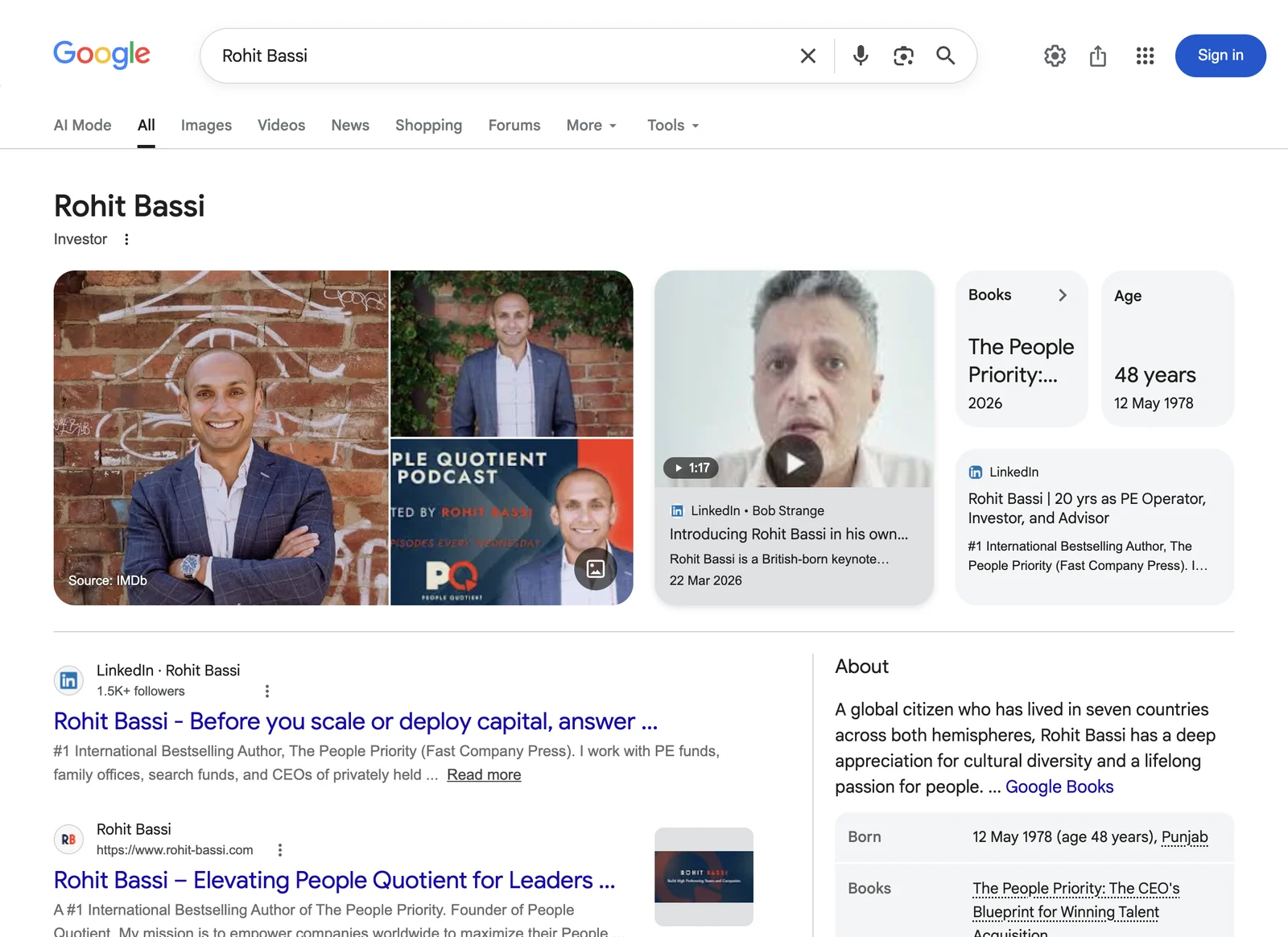
| Rohit Bassi | /g/11gbh01wq4 | Stage 2 — panel fires on the bare name |
| Wanuri Kahiu | /m/09gps9j | Stage 2 — worked on, not built |
| Himani Kankaria | /g/11rggfbxt1 | Stage 1 — entity record live |
| Katerina Khramova | /g/11f0zrgtrz | Stage 1 — entity record live |
| Sagar Kathrotiya | /g/11ld4h_jsy | Stage 1 — entity record live |
| Ramesh Pattni | /g/11kpwvj02p | Stage 1 — entity record live |
Four at stage two, four at stage one, published together on purpose. One is labelled worked on rather than built because that person already had a partial record when we started. A ninth client is excluded because his entity is in a live namesake collision with an academic of the same name, and unstable proof is not proof.
23What we will not build, and why
Five things get asked for often enough to be worth stating. Each is refused for a reason that costs us money, which is the only kind of refusal worth publishing.
| The request | Why we refuse | What we do instead |
|---|---|---|
| Write or place a Wikipedia article | A deleted article leaves a public deletion record and leaves the subject materially worse off than never trying | Wikidata, if and only if the notability question has an honest yes |
| Handle the identity verification for the claim | It requires documents nobody should hand to a vendor, and no engagement is worth holding them | Prepare the packet, rehearse the field, hand it over |
| Buy high-authority backlinks | Relevance beats raw authority for entity work, and bought links are a risk carried by the client not the vendor | Earned records at the geo-vertical intersection |
| Guarantee a panel by a date | Google offers no application, no guarantee and no service level. A date is a guess dressed as a commitment | A refund clause, which is a promise about our conduct |
| Start the build when the entity is not ready | A panel will not trigger and will not stick on a near-zero record. Taking the money is the expensive mistake for both sides | Say wait, and say what would change the answer |
The last one is the one that matters commercially. Roughly a third of enquiries get told to wait, and telling somebody to wait is cheaper than an eighteen-month refund conversation. It is also the single fastest way to find out whether the person you are talking to is selling a method or selling hope.
24Handover: what you own at the end
The engagement ends. The record does not, and neither does your ability to run it. Everything below is yours, in a form you can use without us.
- The brand brain, as a file, with every fact and bio in it
- The entity home, on your own domain, with your own hosting and your own registrar
- The structured data layer, documented, so your next developer does not break it
- The Search Console property, on your own account, which it was on from day one
- The full corroboration list: every record, who published it, and when
- The claim packet, including the rehearsed statement
- The measurement set: nine queries, nine prompts, the scoring rule, and every dated reading we took
- The quarterly cadence, written as a checklist somebody else in your team could run
There is no proprietary tool to be locked out of and no account of ours in the chain. That is deliberate: an entity record that depends on a vendor relationship is a record with a single point of failure, and the whole point of this work is durability.
25Where to start
- Run the diagnosis: your name in a private window, then a Knowledge Graph lookup. Ninety seconds, and it decides which of three routes you are on.
- If an entity identifier already exists, your job is correction rather than construction, which is a shorter and cheaper project.
- If you are building yourself, artefact one is an afternoon and everything else quotes it. The day-by-day calendar and the copy-paste toolkit are both free.
- Set the monthly baseline now, before anything is built. Without a dated starting point, nothing you do afterwards is measurable.
- If you want it built, the intake is an email rather than a form, because the first thing needed is your name spelled the way it appears on things.
Flat, for the twelve-month build. Half at intake, half the day there is an entity identifier or a live card to show you. No retainer, no monthly, no upsell ladder. Full refund if nothing is live at twelve months.
What to remember
- Twelve artefacts in dependency order. The order is load-bearing, not stylistic.
- Every artefact has a gate. Unmeasured is not finished, it is claimed.
- Profile alignment is two hours with the highest return in the build, and the most common silent regression.
- Ship schema for rich results and machine-readability, never as an AI visibility product.
- Artefact eight is where the months go, and in India its geographic axis needs a different source list.
- Four artefacts stay yours whatever you pay. Budget about 35 hours a year for them.
Questions people actually ask
What exactly do I receive at the end?
Twelve artefacts, all of which you own and keep: the identity file, the brand brain, the entity home on your own domain, the structured data layer, an aligned profile set, verified instrumentation, a published proof archive, a corroboration web of third-party records, whichever accelerators applied, a rehearsed claim packet, a locked entity, and a documented cadence you can run yourself afterwards.
Can you start at artefact eight? I already have a site.
Almost never, and it is worth understanding why rather than taking it as an upsell. Artefact eight asks other people to name you and repeat your identity line. If artefacts one, three and five are not true, they will repeat something inconsistent, and inconsistent corroboration is worse than none. We do audit what exists and skip what genuinely passes its gate.
How is progress measured before anything is visible?
By gates rather than by feelings. Each of the twelve has a definition of done that can be checked by somebody who is not us. On top of that, the monthly three-assistant baseline gives a dated, comparable number from month one, which is why we set it before building rather than after.
What happens if the entity does not appear?
Full refund at twelve months if nothing is live. Before that, at roughly month six, we re-run the diagnosis honestly. If the underlying record is not accumulating, the correct advice is usually to change the corroboration strategy rather than to keep publishing, and occasionally it is to stop.
Do you handle the Google account and the claim?
No, deliberately. The Search Console account must be one you will still control in five years, and the claim requires your own identity verification. We prepare the packet and rehearse the field that causes most rejections. You submit it. We do not accept identity documents and we do not log into client accounts.
Is a book really necessary?
Not necessary, and it is the most durable accelerator available, which are two different statements. A book with an ISBN creates a record class Google already models well and that other people cite without being asked. Plenty of entities resolve without one. If you are choosing between a book and six months of podcast appearances, the book compounds harder.
What about Wikidata?
Worth doing once the notability question has an honest yes, and it is a much lower bar than Wikipedia. It is not a shortcut and it does not substitute for the corroboration web. An item created for an entity with no independent sources behind it is a thin item, and thin items do not do much.
Why does the corroboration step take months rather than weeks?
Because it depends on other people's publishing calendars, not on ours. An association newsletter comes out quarterly. A conference bio goes up when the programme is finalised. A journalist writes when they have a story. You can compress the asking. You cannot compress the publishing.
What if my name is very common?
Then expect the panel to fire on name-plus-qualifier long before it fires on the bare name, and expect the whole timeline to run longer. If there is already a live collision, where Google serves a different person's panel for your name on different days, that is a separate and harder project and we will say so before taking money.
Do you work with companies or only people?
Both, and they are two different entities that need two different records. An organisation panel does not transfer to its founder and a founder's panel does not transfer to the company. Where both are wanted, the person is usually built first, because the person's record is what makes the founder relationship legible to Google in the first place.
Can I run this myself using this page?
Yes. Everything above is the actual method with the actual gates, and there is no withheld step. The free day-by-day calendar and the copy-paste toolkit fill in the mechanics. What an engagement buys is the execution hours and the pattern recognition from having run it before, not access to anything secret.
How do I know you have actually done this?
Eight named records, four at stage two and four at stage one, each with its Google entity identifier, published on this site and re-checkable by you right now. The stage-one four are the honest half and they are published deliberately.