More AI, more value in being human
9:16 · 1:51
Those two are directly proportional.
Don't let AI run your personal brand. Let it speed up everything that isn't you.
I use AI to research faster, to edit tighter, and to check what Google and ChatGPT say about the people I work with. The thinking, the voice and the first draft stay human. Full automation does not work, and this page shows you exactly where I draw the line.
I'm Bhavik Sarkhedi: a 3x entrepreneur and best-selling author, featured in The New York Times, Forbes, Fast Company, HuffPost and Entrepreneur.
Editing should be kept with AI. Research should be kept with AI. But the first draft should be written by you.
Featured in








What changed
When someone hears your name, they Google you, they open your LinkedIn, and more and more often they ask ChatGPT or Perplexity who you are. Posting feeds one of those. What decides the deal is what all three say back, and that is the part I build for you.
Posting is one input. What Google and AI tools say about you is the output people act on.
More than 40% of LinkedIn posts over 250 words were flagged as fully AI-generated. Volume is now the cheapest thing on the internet.
Source: Pangram Labs, July 2026, 1,002,627 posts across five platforms
Across 75,000 brands, web mentions correlated with Google AI Overview visibility at 0.664. Backlinks correlated at 0.218.
Source: Ahrefs, May 2025
ChatGPT links to a brand it names about 27% of the time. Being named is the result, and the link is a bonus.
Source: Ahrefs, November 2025
So the job is no longer to make more posts. The job is to become the name that keeps getting said, on sites that search engines and AI tools already trust. AI can make that work faster. It cannot make it true.
The hybrid method
I am not against AI. It runs inside every engagement I take on. I also refuse to let it pick your position, write your first draft, check its own facts or build your relationships. Here is the full split, task by task, so you know what you are paying a human for.
| Task | What AI does | What a human does |
|---|---|---|
| Research | Reads sources, transcripts and competitor pages in minutes | Checks every number against the original before it goes anywhere |
| Positioning | Sorts interview notes into themes | Decides the one idea you will be known for |
| First draft | Nothing | You or me, in your words, from a real conversation |
| Editing | Flags repetition, tightens sentences, checks reading level | Has the final say on every line |
| Repurposing | Turns one piece into a post, a newsletter and a video outline | Approves each version before it goes live |
| Search and schema | Drafts structured data and spots gaps in what Google knows about you | Decides what is true and publishes it on your site |
| Press and mentions | Finds the podcasts, lists and journalists that fit | Earns the mention through a real relationship |
| Tracking | Asks ChatGPT, Perplexity and Gemini the same questions every month | Reads what changed and decides the next move |
Nobody books a call with a bot, and AI tools have no reason to name a brand that sounds like every other brand.
Slide it and watch what happens to a personal brand as more of it is handed to AI.
AI handles research, formatting and tracking. You and I handle the thinking, the first draft and the relationships. Fast enough to keep going, and human enough to be believed.
An illustration of the trade-off, not a measurement.
Recorded, not ghostwritten
Each one plays right here. They are the arguments I will make on our first call, so you can decide early whether you agree with me.
9:16 · 1:51
Those two are directly proportional.
9:16 · 2:42
It's not just you are popular on socials. It's not just that you're popular on web search. It's a mix of everything.
9:16 · 1:34
When people take a discovery call with you, they know all about you before they even get into it.
vertical · 2:36
Not with just one platform, because it will kill your personal identity later.
How ranking works now
There are two results to win, and they are not the same. Ranking puts you on page one when someone searches your name or your field. Being named puts you inside the answer when someone asks ChatGPT, Perplexity or Gemini who to hire. The first runs on your own site and good search work. The second runs on mentions: how often trusted sites say your name, and what they say next to it.
Mentions of your name sit at the top. Backlinks, the old favourite, sit in the bottom half.
Source: Ahrefs, May 2025, Spearman correlation across 75,000 brands. Correlation, not proof of cause.
Most of the time you are named with nothing to click. Being named is the result that counts.
Source: Ahrefs, November 2025, 31,000+ brand mentions across six AI platforms.
Read the two charts together and the job becomes clear. Your website has to be the centre that every mention points back to, and the mentions have to exist in the first place. That is why I start with your site and your press, never with a posting calendar.
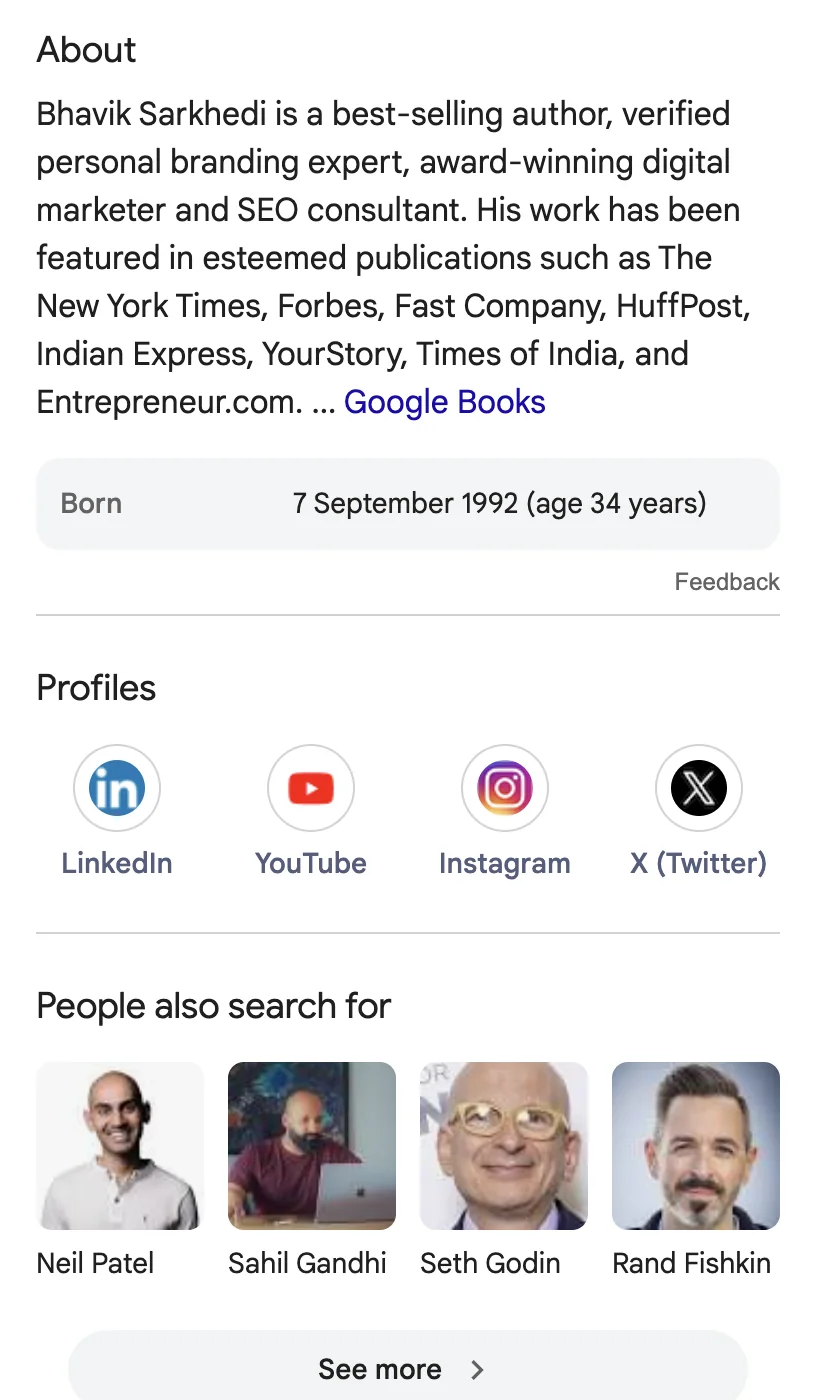
I can't promise you a panel, and nobody honest can. I build the pieces I have seen panels form around, including mine.
The first 90 days
| When | What happens | Who does it |
|---|---|---|
| Weeks 1 to 2 | I check what Google, LinkedIn, ChatGPT and Perplexity say about you today, then we agree on the one thing you want to be known for. | Me, with AI running the checks |
| Weeks 3 to 4 | Your website becomes the centre: a clear bio, your proof in one place, and the structured data Google reads. | Me, with AI drafting the code |
| Weeks 5 to 8 | We talk, I shape those conversations into first drafts in your words, and AI helps with editing and formatting. | You and me, with AI editing |
| Weeks 6 to 12 | I pitch you to podcasts, lists, guest columns and journalists on sites that already rank. A mention runs when an editor says yes. | Me and my relationships |
| Every month | The same questions go to ChatGPT, Perplexity and Gemini. The answers are saved and compared with last month. | AI runs it, I read it |
Search moves in months, not weeks. Rankings usually take six to nine months to settle, depending on how competitive your field is, which is why the plan starts with the pieces that compound.

Who you would be working with
I'm Bhavik Sarkhedi: a 3x entrepreneur and best-selling author, featured in The New York Times, Forbes, Fast Company, HuffPost and Entrepreneur.
I started in 2014 in content and SEO, built and sold companies, and moved into personal branding after that. Across those twelve years I have worked with more than 1,200 clients. My own name runs on the same pieces I would build for you: a website at the centre, press that agrees with it, and the recordings on this page. Google added a Knowledge Panel on top, which I have since verified. Whether it does the same for you is Google's decision.
Off camera
No studio, no stock photos. These are the same pictures on my homepage: between calls, between meetings, and still talking at midnight.





Check the work
Who I have built for, what they said, and where the work was published. Every page is public and every claim links to its source.
Questions
AI personal branding is building your reputation with AI tools inside the workflow: research, editing, repurposing, and tracking what search engines and AI assistants say about you. Done well it is hybrid. The judgment, the voice and the first draft stay human, and AI makes everything around them faster.
No. A fully automated personal brand has no person in it, so there is nothing to trust, nothing for a journalist to feature, and nothing that sounds different from thousands of other automated accounts. Use AI for speed and keep a human in charge of what you say.
Keep the first draft yours. Talk an idea through on a recording or write it rough, then let AI help with research, editing and formatting. After ten or twenty fully generated posts the pattern starts to show, and readers notice it before you do.
Search rankings usually take six to nine months to settle, depending on how competitive your field is. Mentions and press compound, so the work done in month two keeps paying in month twelve. That is why the plan starts with your website and your press, not with a posting calendar.
On Google you need a site you own at the centre, consistent profiles that point to it, and pages that answer what people search about you. In ChatGPT and other AI tools you need to be mentioned often on sites they trust, described the same way each time, with something recent. In an Ahrefs study of 75,000 brands, web mentions correlated with visibility in Google's AI Overviews at 0.664, against 0.218 for backlinks.
A good one decides what you should be known for and then makes the internet agree: your website, your search results, your LinkedIn, your press and, now, what AI tools say about you. A weak one sells you a number of posts a month. Ask which of the two you are buying before you sign.
No. I work with founders, consultants, executives and independent experts. Anyone whose name is part of how they win work needs the same things: a clear position, a site at the centre, and enough published proof that a stranger finds an answer instead of a gap.
Keep reading
Being good at your work is half the job.
The other half is making sure Google, LinkedIn and every AI tool say so. That is the work.
Contact me