
Why Is Professional Founder Reputation Management Critical for Growth?
Imagine your company is a high-performance sports car. You have the best engine (product), the most aerodynamic design (business model), and premium fuel (capital). But if the driver is unknown or, worse, known for reckless driving, no one will get in the passenger seat.
The most powerful asset you can build as a founder or CEO is not your product, your technology, or even your market position. It is your reputation.
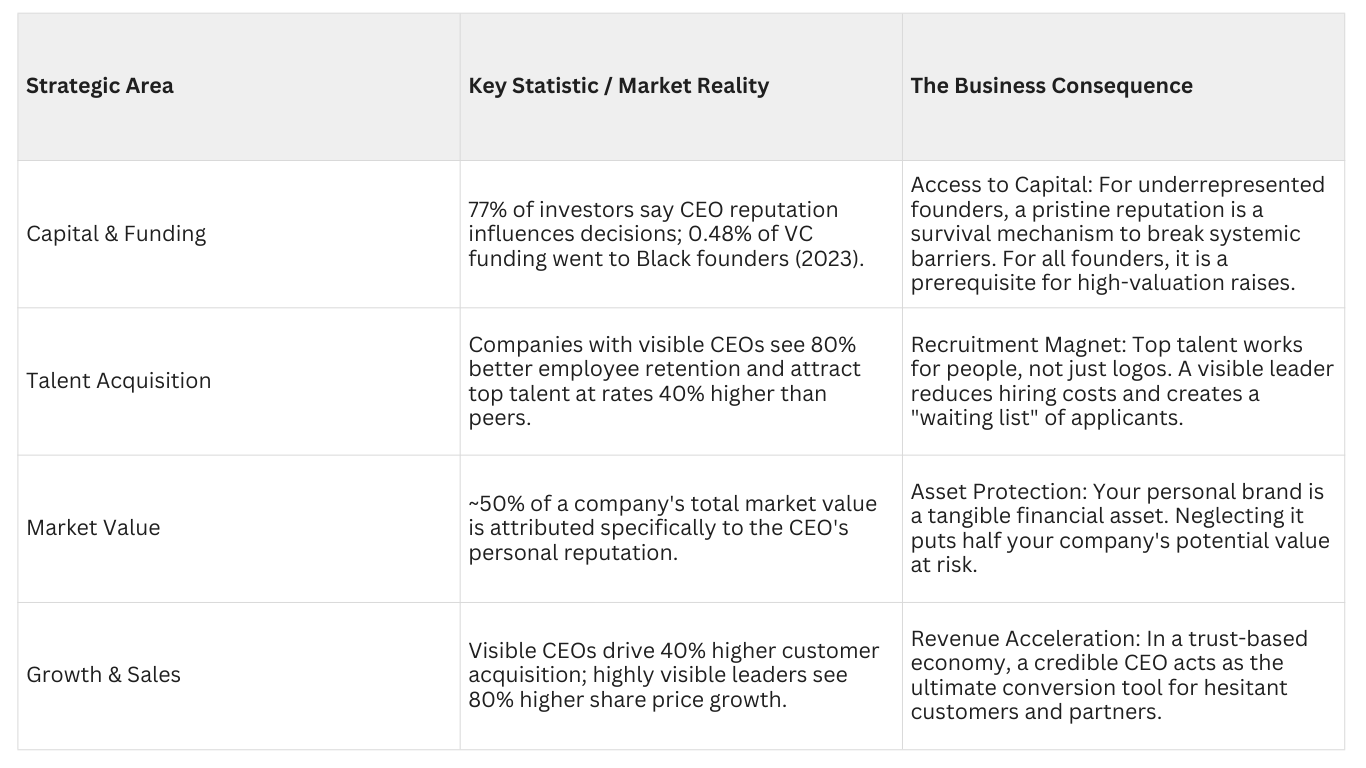
Consider this: 77% of adults say a CEO’s reputation directly influences their willingness to invest in a company. Half of your company’s market value is attributed to your personal reputation. When visible CEOs engage consistently with their audiences, companies experience 40% higher customer acquisition. They attract top talent at rates 40% better than competitors and enjoy 80% improved employee retention.
However, the playing field is not level. Data from 2023 reveals that Black founders received only 0.48% of all venture capital investment in the U.S. This staggering statistic underscores that for underrepresented groups, a pristine, visible, and strategic reputation is not just a bonus. It is a survival mechanism to break through systemic barriers.
As Warren Buffett famously said, “It takes 20 years to build a reputation and five minutes to ruin it.” Yet most founders treat their personal brand as something to address later. They wait until after the product ships, after funding rounds close, or after growth stabilizes. By then, they have missed critical windows where their visibility could have accelerated every business outcome that matters.
Professional founder reputation management is not a vanity exercise or a PR stunt. It is a direct growth lever. It attracts investors, secures top talent, generates customer trust, and unlocks media coverage. It positions you for board roles and speaking opportunities. In a competitive market where stakeholders evaluate founders as much as they evaluate business plans, reputation management is the strategic differentiator. It is the difference between founders who merely survive and those who scale with momentum.
This guide walks you through what founder reputation management really means. We will explore why it is critical to your growth trajectory, the costly mistakes most executives make, and a proven framework to build and protect your reputation strategically.
What Does Professional Founder Reputation Management Mean for CEOs and Founders?
Professional founder reputation management is the deliberate, sustained practice of shaping how your key stakeholders perceive you. This is not just as a leader but as a credible, visionary, and trustworthy force in your industry. It is distinct from corporate communications because it centres exclusively on you, your voice, your values, and your ability to influence.
This is not about crafting a false persona or creating social media vanity metrics. It is about taking control of your narrative. It ensures that what people find, read, and hear about you aligns with who you actually are and where you are taking your company. This is the essence of personal branding through storytelling.
For a SaaS founder raising Series B, this means visible thought leadership that demonstrates you understand market disruption better than competitors. For a manufacturing CEO navigating industry consolidation, it means being quoted in trade publications as an expert voice on operational transformation. For an early-stage founder, it means building your personal brand alongside your company brand. When investors research you, they must find evidence of deep expertise, clear vision, and leadership credibility.
Why Professional Reputation Management Matters Right Now
Three market forces make founder reputation management non-negotiable in 2026.
First, the decision-maker research landscape has transformed. Before meeting you in a pitch room, investors have already Googled you. They have reviewed your LinkedIn profile and assessed your media presence. Employees research CEOs before joining companies. 80% do this explicitly. Partners and customers evaluate your credibility based on your visible expertise and thought leadership. You are being evaluated based on what you have published, what others say about you, and how you show up online. This happens whether or not you are actively managing it.
Second, trust is increasingly personal. In a market saturated with corporate messaging, stakeholders trust people, not logos. When a CEO demonstrates genuine expertise, transparency, and vision, it creates a halo effect that extends to the entire company. Your personal credibility becomes the company’s most valuable asset during capital raises, competitive battles, and organizational scaling. Think of it as Conversion Rate Optimization for your personal trustworthiness.
Third, visibility compounds advantage. A visible CEO attracts business opportunities that passive CEOs never see. Partners approach you. Speaking invitations arrive unsolicited. Journalists quote you as an expert, which naturally aids in organic Backlink Building for your digital profile. Top candidates apply specifically because they have seen you in action online. Investors move faster because your reputation has already done significant work. This compounds over time. Each piece of visible expertise generates opportunities that create more visibility.
Without active reputation management, you are leaving all this potential on the table while competitors build theirs.
The Common Mistakes Founders and Executives Make With Their Reputation
Before building a strong reputation, it is worth understanding where most executives stumble. These mistakes often cost founders years in their timeline and millions in missed opportunities.
Mistake #1: The Invisibility Trap
The most damaging mistake is remaining invisible. Founders worry about saying the wrong thing. They fear making a mistake on social media or sounding less polished than competitors. So they stay silent. They focus entirely on building the business, assuming the business will speak for itself.
But silence creates a vacuum. Without your voice, others define you. Journalists write narratives without your input. Competitors position themselves as the thought leaders in your space. Decision-makers have no evidence of your expertise. Passive visibility compounds over time, but not in your favour.
Visible CEOs experience 80% higher average annual share price growth compared to their peers. Companies led by CEOs with strong LinkedIn presence are 50% more likely to attract top talent. The cost of invisibility is not staying safe. It is ceding influence and opportunity to competitors who show up.
Mistake #2: Emotional, Unfiltered Responses
The opposite problem is posting reactive, emotionally charged content that damages credibility. A CEO responds to criticism defensively. Another shares an inflammatory take on industry politics. A third makes an off-the-cuff comment that gets misinterpreted across social media.
Once it is published, it is discoverable forever. Potential investors see it. Employees question your judgment. Partners reconsider relationships. Recovery is slow and painful.
Professional reputation management means having a filtering system. Before you publish, ask yourself these questions. Does this reflect my leadership values? Will this be understood the same way in six months? Does this position me as someone investors, customers, and talent want to work with? If the answer is no, do not publish it. This isn’t about being inauthentic. It is about being intentional. Your reputation is built on consistency, not virality.
Mistake #3: Inconsistent Messaging Across Platforms
You tell one story on LinkedIn. You tell another in a podcast interview. You tell a third in your company’s internal communications. Your website says you prioritize innovation, but your recent posts focus entirely on cost management. You talk about company culture publicly while employees describe a different reality internally.
Stakeholders notice these gaps. They signal that either you are not clear on your message or you are managing optics rather than addressing reality. Both destroy credibility.
One example is Netflix. They faced significant reputation challenges when conflicting statements about subscriber numbers came from different executives at different times. The company was not lying, but misalignment created the perception of dishonesty. Proper message alignment could have prevented the credibility damage entirely.
Professional reputation management requires alignment. Your personal brand should reinforce your company’s mission. Your LinkedIn Marketing content should reflect your actual values. Your media interviews should be consistent with your internal leadership. This coherence is what builds trust over time.
Mistake #4: Overlooking Your Personal Brand Entirely
Many successful founders build their company’s brand aggressively while ignoring their own. They assume the company is the asset and the founder is interchangeable. This is a strategic error.
Research shows that 84% of employees acknowledge that a CEO’s personal credibility impacts funding decisions. Board positions, partnership opportunities, and speaking engagements flow to founders with strong personal brands. When you eventually exit or transition, your personal brand becomes your most valuable asset for your next venture. Personal branding is not egotistical. It is strategic. When your personal brand is strong, the company benefits. When it is neglected, the company suffers.
Mistake #5: Failing to Take Accountability When Things Go Wrong
The fastest way to destroy a reputation is to dodge responsibility when problems emerge. Companies face crises like product failures, customer service lapses, employee issues, or market challenges. How a CEO responds defines whether the company recovers or spirals.
CEOs who acknowledge mistakes quickly, communicate transparently about root causes, and take visible action to resolve problems rebuild trust faster. CEOs who deflect blame, minimize the issue, or go silent lose stakeholder confidence rapidly.
Uber recovered from a serious culture crisis because new CEO Dara Khosrowshahi took accountability immediately. He communicated transparently about what needed to change and implemented systematic improvements. Starbucks recovered from a racial incident because leadership responded within 24 to 48 hours with transparency and concrete policy changes. Both leaders rebuilt their personal reputations through accountability.
A Strategic Step-by-Step Approach to Building Professional Founder Reputation
Building a strong professional reputation does not require reinventing yourself. It requires strategic intentionality. Here is the framework that works, utilizing proven frame works to built personal brands.
Step 1: Define Your Reputation Foundation
Before you publish anything, you need clarity on three things: your core values as a leader, your expertise and unique perspective, and the specific outcomes you want your reputation to drive. This defines your Personal brand purpose.
Core values: What do you genuinely believe about leadership, business, and the change you are creating? These should be authentic. They are not the values you think sound good, but the values that actually guide your decisions. A founder who genuinely believes in radical transparency should lead with that. A CEO who prioritizes people should not pretend to be purely metric-driven.
Expertise and perspective: What do you know better than most people in your field? What patterns have you observed that others miss? What unconventional approaches do you use to solve problems? Your reputation should be built on real expertise, not generic leadership platitudes.
Outcomes you are driving: Are you building a reputation to raise capital more easily? To attract world-class talent? To position yourself for board roles? To establish yourself as the authority in your space? Different outcomes drive different strategies. A founder raising Series A needs different reputation positioning than a CEO managing a public company.
This foundation becomes your north star. Every piece of content, every interview, and every speaking engagement should reinforce these core elements.
Step 2: Build Your Platform Architecture
Your reputation lives across multiple platforms, and each serves a different purpose. Do not try to be everywhere. Be strategic about where your key stakeholders live and what each platform enables.
LinkedIn is essential for founder’s reputation. It is where investors, partners, customers, and top talent look for evidence of your expertise. Your profile should be clearly written, visually professional, and include recent activity. Companies with socially active CEOs are 40% more likely to be seen as great places to work and 50% more likely to attract top talent.
Your company blog or owned platform gives you a place to develop ideas without algorithm constraints. Long-form thought leadership that educates your audience builds authority faster than social media soundbites.
Speaking engagements position you as an expert while reaching concentrated audiences of decision-makers. Industry conferences, podcasts, webinars, and panel discussions are powerful visibility channels.
Media coverage offers third-party credibility that self-published content cannot match. Journalists quote you as an expert, which positions you as an authority to audiences who would not otherwise find you.
Your personal network remains the most powerful platform. Relationship capital with investors, customers, and peers drives opportunities that algorithms cannot create. Build your platform systematically rather than trying to dominate everywhere. Depth on the platforms where your stakeholders are concentrated beats shallow presence everywhere.
Step 3: Develop Your Content and Messaging Strategy
This is where many founders get stuck. They understand they should be visible, but they do not know what to say.
Start with three to five content pillars. These are themes that connect to your expertise and the outcomes you are driving. For a SaaS founder, these might be product strategy, engineering culture, AI disruption in your space, hiring and retention, and founder lessons learned. For a manufacturing CEO, they might be industry consolidation, operational excellence, supply chain innovation, workforce development, and sustainable operations.
Within each pillar, develop a Content & Storytelling strategy that educates first and promotes second. The most effective thought leadership teaches your audience something valuable, then demonstrates why your company or approach is the answer.
LinkedIn content that works does not lecture. It tells stories. It shares frameworks. It raises counterintuitive questions. It acknowledges problems honestly. CEO Stephen Mostrom, who ghostwrites for multiple executives with massive followings, notes that the most common mistake is using overly formal, corporate language that sounds like lectures. Relatable LinkedIn content generates up to 40% more engagement than dry, impersonal updates.
Your content should also be evidence-based. Do not make claims you cannot back up. Include data, reference sources, and provide proof points. In an era of AI-generated content, authenticity and substance stand out. Utilizing a Content system from book based strategies can help structure this effectively, as Authors make better personal brand strategists due to their grasp of narrative arcs.
Step 4: Choose Your Execution Model
You have three primary options for executing this strategy.
Self-execution: You write your own posts, pitch yourself for speaking engagements, and manage your brand directly. This offers maximum authenticity but requires significant time investment. Most busy founders cannot sustain this.
Ghostwriting partnership: You partner with a professional ghostwriter or agency like Ohh My Brand, which specializes in CEO positioning, ghostwriting, LinkedIn growth, and thought leadership. They capture your voice and insights and publish consistently on your behalf. This removes the time barrier while maintaining authenticity if done correctly. The ghostwriter should spend time understanding how you think, not just publishing generic executive content.
Agency partnership: A full-service personal branding agency manages your entire reputation platform. This includes strategy, content, media relations, speaking opportunities, and crisis management. This approach offers the most comprehensive support but requires higher investment and less direct involvement. You might also consult a Personal Branding Consultant or an SEO Consultant to ensure your digital footprint is optimized.
Most successful founder reputation management uses a hybrid approach. You stay visibly involved in speaking, high-stakes media interviews, and strategic direction, while a professional partner handles consistent content creation and platform management.
Step 5: Measure and Optimize Based on Results
Your reputation management should drive measurable business outcomes. Track metrics like media mentions and share of voice. Are you getting quoted in relevant publications? Are media mentions increasing? Is the sentiment positive?
Track speaking invitations. Are you receiving more opportunities to speak at conferences and on podcasts? Monitor professional network growth. Is your LinkedIn following growing with engaged professionals in your target audience?
Assess talent acquisition. Is your visibility generating inbound candidate applications? Are top candidates citing your visibility as a reason they want to join? Check investor interest. Are you getting inbound investor inquiries? Are funding conversations progressing faster?
Look for board and advisory opportunities. Are you receiving offers for board positions, advisory roles, or other high-profile engagements? Evaluate customer trust signals. Are customers more confident in your company because of your visible leadership?
Do not get distracted by vanity metrics like total followers or likes. Focus on outcomes that actually drive business growth. If your reputation management is not generating leads, attracting talent, or building investor confidence, the strategy needs adjustment.
Real-World Founder Reputation Management Scenarios
Let’s walk through how this plays out in different situations.
Scenario 1: The Early-Stage SaaS Founder Raising Series B
Maya founded a data analytics platform two years ago. Product-market fit is clear, but she is competing against well-funded competitors for the same investors. Her Series A was a struggle because she was unknown.
For Series B, she decides reputation matters. She uses Frame works to built personal brands to identify her three content pillars: data democratization, engineering culture at startups, and lessons from early-stage fundraising. She starts publishing LinkedIn posts weekly, sharing frameworks she has developed and insights from her fundraising journey. She pitches herself for industry podcasts and lands three guest appearances. She writes a feature article for a well-known founder publication about building engineering teams without burning them out.
Six months into this visibility push, something shifts. Investors begin the Series B conversations already familiar with her thinking. They reference her LinkedIn posts. They have heard her on podcasts. They know her perspective. The conversations move faster because she has already established credibility. Her visibility does not guarantee funding, but it materially accelerates the process.
Scenario 2: The Manufacturing CEO Managing Industry Consolidation
James runs a mid-market manufacturing company. The industry is consolidating, and larger players are making acquisition offers. He wants to position his company as a strategic growth partner, not a distressed acquisition. He also wants to attract top operational talent who understand transformation.
He develops a reputation strategy focused on sustainable manufacturing, supply chain innovation, and leadership during industry change. He starts contributing to industry publications. He speaks at manufacturing conferences about supply chain resilience. He publishes insights on his LinkedIn about the future of the industry.
Within a year, his visibility shifts how the industry sees his company. Acquisition offers improve because he has positioned his company as a strategic player, not a passive target. Top operational talent starts reaching out because they have seen him speak and want to work for someone with a clear vision. His reputation becomes a negotiating asset.
Scenario 3: The Founder Who Made Mistakes
Chris built a successful app company, but his public persona includes some problematic posts from earlier years. These include reactive tweets during industry controversies, overly aggressive competitive positioning, and a few comments that now seem insensitive. He has changed and grown, but his reputation is partially defined by this history.
He develops a reputation recovery strategy. Rather than ignoring the past, he acknowledges growth explicitly. In interviews, he talks about learning from mistakes. He demonstrates through recent behaviour and content that his perspective has evolved. He focuses on new content on values-driven leadership and building inclusive teams. He takes on mentorship roles that demonstrate his commitment to lifting others.
Recovery is slower than if he had never made mistakes, but consistent, authentic repositioning works. His reputation gradually becomes defined by his current thinking and behaviour, not historical missteps.
Where Professional Personal Branding Agencies Support Founder Reputation Management
This is where specialized expertise makes a difference. Building a strong reputation requires strategic thinking, consistent execution, and platform relationships that most busy founders do not have time to develop.
Agencies like [Ohh My Brand specialize in CEO positioning, founder branding, and executive reputation management. They provide several critical services.
Strategy and positioning: Rather than generic thought leadership, they develop Bestselling frameworks for personal brands that differentiate you from competitors and align with your business goals. They identify white space in your industry where you can establish unique authority.
LinkedIn ghostwriting and content: They capture your voice through interviews and conversations, then publish consistent, engaging content that drives visibility. This removes the time barrier while maintaining authenticity.
Thought leadership development: They help you develop deeper insights and frameworks that position you as a forward-thinking leader. They place those ideas in prestigious platforms where they reach high-level decision-makers. They may even offer Ebook Writing Services to help you publish comprehensive guides.
Speaking opportunity sourcing: They leverage relationships with conference organizers, podcast hosts, and event planners to create speaking opportunities that build your visibility with target audiences.
Media relations: They pitch you to journalists as an expert source, securing coverage that would take years to develop independently.
Personal PR and crisis management: When reputation challenges emerge, they develop response strategies that protect and rebuild your credibility.
Executive visibility measurement: They track how your reputation changes over time, measuring impact on media mentions, speaking invitations, talent attraction, and investor interest.
The ROI is significant. Companies with visible CEOs experience measurable improvements in hiring, customer acquisition, and investor confidence. When you factor in the business value of faster capital raises, better talent, and more customer trust, professional reputation management investment pays for itself many times over.
Implementation Checklist for Executives
Use this checklist to start building your reputation strategically.
Foundation (Complete first)
- Define your three to five core leadership values.
- Articulate your key areas of expertise.
- Identify specific business outcomes you want reputation to drive.
- Audit your current online presence. Google yourself and review your LinkedIn profile.
- Identify your target audiences. This includes investors, customers, talent, partners, and media.
Platform Architecture
- Optimize your LinkedIn profile with a professional photo, clear headline, compelling bio, and recent activity.
- Establish a platform for longer-form content such as a blog, Medium, Substack, or LinkedIn newsletter.
- Identify three to five relevant speaking platforms or podcast shows.
- List ten to twenty relevant journalists and publications in your space.
- Map your professional network, including investors, partners, and peers you want to deepen relationships with.
Content and Messaging
- Develop three to five content pillars connected to your expertise.
- Create a messaging framework for each pillar with key points, supporting examples, and relevant data.
- Identify existing insights, frameworks, or lessons learned you can share.
- Plan the first month of content ideas across platforms.
- Establish a consistent publishing schedule. LinkedIn: weekly. Blog: bi-weekly. Speaking: quarterly target.
Execution Model
- Decide whether to self-execute, hire a ghostwriter, or partner with an agency.
- If ghostwriting, have initial conversations and clarify what voice/style you are trying to achieve.
- If agency, define scope, outcomes, and success metrics in writing.
- Set calendar reminders for the content approval/review process.
- Establish a feedback loop to refine what is working.
Measurement and Optimization
- Set baseline metrics: current LinkedIn following, media mentions, speaking invitations.
- Define primary KPIs. Is it media mentions? LinkedIn engagement? Speaking offers? Inbound investor interest?
- Set up a monthly tracking spreadsheet or dashboard.
- Schedule a quarterly review to assess progress and adjust strategy.
- Connect reputation metrics to business outcomes. Has hiring improved? Is the investor pipeline stronger?
Frequently Asked Questions About Founder Reputation Management
Q: How long does it take to build a strong professional reputation?
A: Most executives see meaningful traction within 3 to 6 months of consistent effort. Media coverage, speaking invitations, and business impact typically follow 6 to 12 months of visibility building. Long-term compounding benefit builds over the years. Start now, even if you are not expecting immediate results.
Q: What if I don’t have time to manage this myself?
A: That is actually the norm. Most successful founders delegate reputation management to professionals while staying involved in strategy and major speaking/media opportunities. Your time is better spent building the business. Professionals can build your visibility more efficiently.
Q: Should I focus on LinkedIn, personal blog, or speaking?
A: Start with LinkedIn because that is where decision-makers research you. Add one other platform based on your audience. Use speaking for B2B thought leadership, Twitter/X for real-time industry conversations, or a blog for deeper ideas. Do not try to be everywhere.
Q: What if I’ve made mistakes publicly that hurt my reputation?
A: Reputation recovery is possible through consistent, authentic repositioning. Focus recent content on your evolved thinking and demonstrated behaviour. Use media interviews to acknowledge growth. Do not hide the past, but do not dwell on it either. Time and new behaviour gradually redefine how people see you.
Q: How do I balance authenticity with strategy?
A: The best reputation management is both authentic and strategic. You are not creating a fake persona. You are being intentional about which authentic parts of yourself you share. Share genuine insights, real challenges, and honest perspectives. Just be thoughtful about how you frame them.
Q: What’s the difference between self-promotion and thought leadership?
A: Thought leadership educates, challenges, and provides value to your audience first. It builds authority through substance, not by talking about yourself constantly. Self-promotion is all about your company’s features and your accomplishments. Lead with what you know and what your audience should learn. Your credibility follows naturally using Book frameworks for linkedin brand building.
Q: Should my personal brand be separate from my company brand?
A: They should be complementary. Your personal brand should reinforce your company’s mission without being identical. You can have personal interests and perspectives that are not directly company-related. But your core values and professional positioning should align.
Q: How do I respond to criticism or negative coverage?
A: Do not respond emotionally or reactively. Take 24 to 48 hours to process. If the criticism is factually incorrect, address it factually with evidence. If it raises a legitimate concern, acknowledge it and explain what you are doing about it. If it is an opinion you disagree with, you usually do not need to respond at all. Staying composed and evidence-based is more powerful than arguing.
Q: What’s the ROI of reputation management?
A: That depends on your goals. For capital raising, a strong reputation can accelerate funding timelines by 6 to 12 months and improve deal terms. For talent, visible CEOs attract better candidates and improve retention by 15% to 30%. For customers, reputation builds trust and improves customer acquisition and lifetime value. For partnerships and opportunities, visibility opens doors that do not otherwise exist. The compounding ROI is significant if you measure against real business outcomes.
Q: How do I get media coverage when I’m not famous?
A: Start by being a resource. Build relationships with journalists in your space. Share relevant expertise without expecting coverage. Pitch yourself as a source for upcoming trends or challenges in your industry. Guest post for established publications. Appear on podcasts. These activities build relationships and credibility that eventually lead to direct media coverage.
Conclusion: Make Your Reputation Your Competitive Advantage
In a market where every founder claims to be visionary and investors evaluate leadership as much as business models, professional founder reputation management is the concrete differentiator. It is not optional. It is essential for any founder serious about scaling with speed and attracting the best people, capital, and opportunities.
The founders winning in 2026 understand that their personal reputation is a business asset, as important as their product, team, and market position. They are intentional about how they are perceived. They build visibility strategically. They invest in professional support to execute at scale. They measure impact on business outcomes.
You do not need to be famous to build a powerful reputation. You need to be strategic, consistent, and authentic about sharing your expertise and leadership perspective. You need to show up where your stakeholders are looking. You need professional support to scale this beyond your personal capacity.
If you are ready to transform your reputation into a competitive advantage, Ohh My Brand specializes in exactly this work. As a leading global personal branding agency, we partner with CEOs and founders to develop strategic positioning, execute consistent visibility building, place thought leadership in prestigious platforms, and measure impact on your business outcomes. We have helped founders accelerate fundraising timelines, attract world-class talent, secure speaking opportunities, and build the credibility that compounds into lasting advantage.
Founder reputation management is not a luxury. It is a growth lever. Let’s build yours. Connect with Bhavik Sarkhedi to explore a structured, results-driven approach to executive personal branding.

