
How Can CEOs Improve Visibility and Authority in Their Market?
Imagine you are the captain of a massive, state-of-the-art ship. You have the best engines and the most skilled crew. However, if you sail in the dead of night with your lights off, no one will know you are there until they crash into you. In the modern business landscape, being the best CEO is no longer enough. You must also be the most visible one.
Think of your visibility as the lighthouse that guides investors, talent, and customers safely to your shores. Your personal brand has become your company’s most powerful asset. It influences how investors evaluate your business, how talent chooses to work with you, and how customers decide to trust your brand. Yet, most CEOs remain hidden behind their companies. They let their leadership impact go unrecognized while competitors build public authority that attracts opportunities, funding, and talent.
As Warren Buffett famously said, “It takes 20 years to build a reputation and five minutes to ruin it.” In the digital age, it also takes strategic effort to ensure that reputation is actually seen.
The challenge is real. You are running a business. You do not have time for vanity projects, influencer tactics, or generic thought leadership that adds no real value. What you need is a strategic, business-focused approach to CEO visibility and authority. This approach positions you as an undisputed leader in your field while driving measurable business outcomes. This is not about getting famous. It is about becoming undeniable.
This is precisely where modern executive branding comes in. Agencies like Ohh My Brand specialize in helping CEOs and founders build visibility and authority that translates into real business leverage. This includes attracting investors, securing top talent, earning media coverage, and opening doors to speaking opportunities. But before diving into agency support, let’s explore the complete strategic framework for CEO visibility and authority development.
What Does CEO Visibility and Authority Mean for Executives and Founders?
CEO visibility is not about personal vanity or ego. It is a business strategy with measurable returns. When you are visible as a leader, three critical things happen. First, your market recognizes you as an authority worth listening to. Second, key stakeholders actively seek your insights and perspective. Third, your company gains a competitive advantage through the credibility and trust you have personally established.
Authority is the perception that you do not just have opinions but proven expertise backed by results, data, and real-world success. An authoritative CEO is someone journalists call for expert commentary. They are someone investors listen to during pitches. They are someone talented professionals want to work for and someone customers trust at higher price points.
Here is what makes this matter strategically:
Statistics showing 44% of a company’s market value is attributed to CEO reputation vs 56% other factors
Investor Confidence and Fundraising
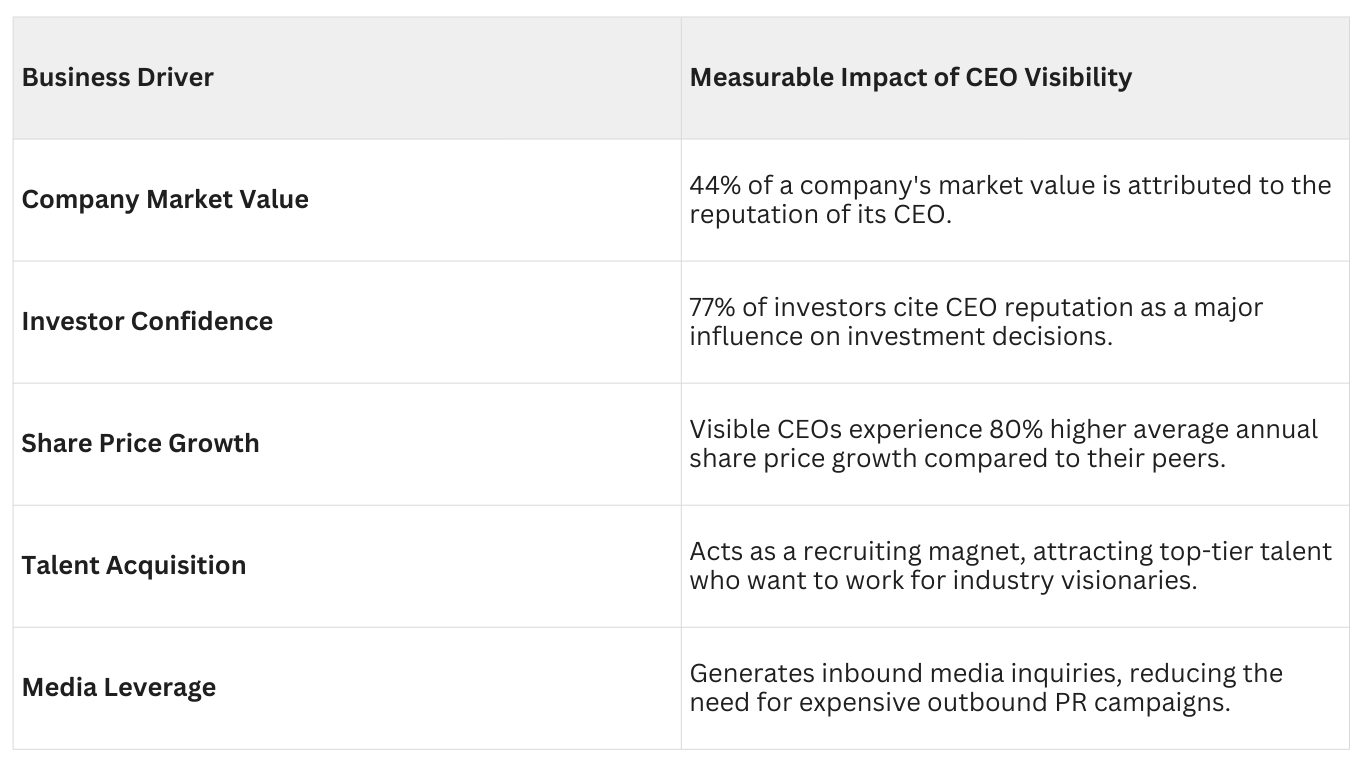
Data supports the need for visibility. According to a Weber Shandwick study, 44% of a company’s market value is attributed to the reputation of its CEO. Furthermore, 77% of investors say a CEO’s reputation influences their decision to invest in a company. When you are a visible, authoritative CEO, you dramatically improve your ability to raise capital. Investors are not just evaluating spreadsheets. They are evaluating you.
A CEO with a strong public presence signals vision, strategic thinking, and the ability to execute. This translates into better terms, faster fundraising cycles, and higher valuations. Additionally, visible CEOs experience 80% higher average annual share price growth compared to their peers.
Talent Acquisition and Retention
The war for talent is fierce. A CEO with industry authority becomes a recruiting asset. Exceptional talent wants to work for leaders they respect and learn from. When your CEO brand is strong, you attract top-tier employees who view working with you as an opportunity to grow alongside a visionary. Beyond recruitment, employees who see their CEO actively engaged in thought leadership feel more connected to the company’s mission. This leads to higher engagement and retention.
Market Positioning and Customer Trust
In crowded markets, trust is your most valuable currency. A CEO known for deep expertise builds customer loyalty that advertising simply cannot buy. Your personal authority becomes a trust marker for your products and services, acting as a form of high-level Conversion Rate Optimization for your brand’s reputation. Customers are more likely to invest in companies led by CEOs they perceive as credible, knowledgeable, and aligned with their values.
Media Coverage and PR Amplification
Media outlets constantly seek expert voices for stories, interviews, and commentary. When you are a visible, authoritative CEO, journalists reach out to you instead of you chasing them. This inbound media attention provides third-party validation of your expertise. It offers massive visibility amplification at virtually no cost. One feature in a major publication reaches thousands of potential customers, partners, and investors.
Speaking Opportunities and Industry Leadership
Visible CEOs get invited to speak at major conferences, participate in industry panels, and lead prestigious events. These speaking platforms further amplify your authority. They expand your network exponentially and position you as a leader who shapes industry conversations rather than simply following them.
Board Positions and Strategic Partnerships
As a CEO with proven visibility and authority, you become attractive for board positions at other companies. You open doors to advisory roles and high-level strategic partnerships. These opportunities expand your influence network and create additional revenue or strategic value streams.
The business case is undeniable. CEO visibility and authority directly drive business growth, competitive advantage, and long-term wealth creation.
Common Mistakes Executives Make in Building Their Visibility
Before we discuss what works, let’s examine what doesn’t. Most CEOs fail at building visibility and authority because they make preventable mistakes. These errors either prevent them from starting or derail their efforts once underway.
The Invisibility Trap: Thinking You Don’t Have Time
The most common mistake is the belief that visibility is a luxury when you are busy running a business. This could not be further from the truth. The CEOs who are “too busy” to build a public brand are making a strategic error that costs them millions in lost opportunities.
Visibility does not require 10 hours a week. It requires strategic focus, often supported by a Personal Branding Consultant or services like LinkedIn ghostwriting. One well-crafted LinkedIn post per week, one speaking engagement per quarter, and one media placement per month can completely transform your positioning.
The Authenticity Pretense: Fake Authority Building
CEOs sometimes attempt to build authority through exaggeration, borrowed insights, or generic “thought leadership” that adds no real value. This backfires spectacularly. Today’s audiences are sophisticated. They can smell inauthenticity instantly. The most powerful authority comes from personal branding through storytelling, sharing genuine insights from your real experience, your actual failures, and your authentic perspective on your industry. This is harder than claiming false expertise, but it is the only sustainable approach.
Inconsistent Messaging Across Platforms
A CEO who says one thing on LinkedIn, something different in interviews, and contradictory information in company meetings destroys credibility faster than silence would. Your personal brand messaging must align with your company’s brand values. All communication channels must reinforce a consistent narrative. This consistency extends to ethics, values, and business practices. If your company claims to value sustainability while your personal investments prioritize extraction, stakeholders will notice.
Neglecting the Right Channels and Formats
Not all visibility is created equal. Some CEOs invest time in platforms where their audience does not gather. LinkedIn is essential for B2B CEOs and enterprise founders. Twitter/X works for tech leaders and thought commentators. Industry conferences matter for manufacturing and industrial CEOs. Podcasts reach niche audiences. You do not need to be everywhere. You need to be dominant where your stakeholders actually spend time.
Overpromising and Underdelivering
When you build a public visibility platform, every promise you make publicly is scrutinized. The gap between what you say you will do and what you actually deliver is a trust destroyer. CEO visibility amplifies both your credibility and your failures. This is why authentic, grounded communication matters more than ambitious claims.
Treating Visibility as a Marketing Campaign Rather Than a Business Practice
The biggest mistake of all is approaching CEO visibility as a short-term campaign. Leaders often say, “Let’s do three months of social media and see what happens.” Real CEO authority is built over years through consistent, strategic effort. Think of it as part of your job as CEO, not an additional project. This mindset shift changes everything about how you approach it.
Ignoring the Reputation Risk Landscape
In 2026, the stakes of visibility are higher than ever. AI-generated deepfakes, cancel culture, and misinformation create new risks for visible leaders. Many CEOs neglect reputation management until a crisis hits. Proactive reputation management must happen continuously, not reactively. This involves monitoring mentions, managing online reviews, addressing issues quickly, and building a strong positive narrative.
The Strategic Approach to CEO Visibility and Authority
Building CEO visibility and authority requires a structured, multi-layered approach. This is not about doing one thing. It is about orchestrating a coherent strategy across multiple channels and formats that all reinforce your positioning as an authoritative leader.
Step 1: Establish Your Authentic Positioning and Unique Perspective
Before you do anything public, you must first do the internal work of clarifying who you are. You must define what you believe and what unique perspective you bring to your industry.
Start with radical self-assessment. What are you genuinely expert at? Not what you wish you were expert at, but what you actually know deeply because of real experience. What lessons have you learned that others in your industry haven’t? What do you believe about the future of your market that goes against conventional wisdom? What Personal brand purpose drives your decision-making as a leader?
This positioning must be authentic. The most compelling CEO brands are not built on manufactured personas. They are built on honest expressions of who someone actually is. Richard Branson’s brand works because it authentically reflects his adventurous personality and values-driven approach. Satya Nadella’s authority comes from genuinely deep technical understanding combined with authentic belief in inclusive leadership. Sheryl Sandberg’s thought leadership resonated because she was speaking from lived experience.
- Your positioning should clarify:
- Your genuine area of expertise: What specific domain can you speak authoritatively about?
- Your leadership philosophy: What principles guide your decision-making as a CEO?
- Your point of view on industry trends: What do you see happening in your market that others miss?
- Your values: What causes, principles, and outcomes matter most to you?
- Your audience: Who specifically do you want to influence?
This positioning becomes the anchor for everything else. Understanding frame works to built personal brands helps ensure every piece of content, every speaking engagement, and every media interview connects back to this core positioning.
Step 2: Optimize Your Foundational Digital Presence
Your digital presence is the home base where all your visibility efforts converge. It must be optimized to immediately establish credibility and authority.
LinkedIn Profile Optimization
For most CEOs, LinkedIn is your primary platform. Effective LinkedIn Marketing starts with your profile doing more than listing your job title. It should immediately communicate your unique value and authority.
This includes:
- A professional but personable profile photo that conveys approachability and confidence.
- A compelling headline that goes beyond your title (“CEO at X” is weak; “Building the Future of Enterprise Software Through AI” is stronger).
- A summary that tells your story, communicates your point of view, and explains why people should care about your insights.
- Evidence of expertise: articles written, speaking engagements, media appearances, awards.
- Clear calls-to-action for people who want to connect or learn more.
- Your LinkedIn presence should not look like a resume. It should look like the public face of a thought leader.
Company Website Leadership Section
Your company website should feature you prominently, not as a footnote. Many prospects and investors visit company websites. The CEO bio section should communicate your experience, vision, and unique perspective. Include a professional photo, your leadership philosophy, key achievements, and media appearances.
Media Kit Development
Create a professional media kit that includes high-resolution photos, your biography (short and long versions), key credentials, areas of expertise, and previous media appearances. When journalists are researching you for an interview or feature, they should be able to find everything they need on one easy-to-download document. This removes friction from media placements.
Step 3: Build Your Thought Leadership Content Engine
Content is the fuel of CEO visibility. You need a consistent stream of valuable insights that establish your expertise, provide real value to your audience, and keep you top-of-mind with key stakeholders.
Determine Your Content Format Mix
Not all CEOs should be writing long-form blog posts. Not all should be on every social media platform. The key is choosing content formats that:
Play to your strengths. Some CEOs are natural writers, while others are dynamic speakers or excel in long-form conversation.
- Reach your target audience where they spend time.
- Can be sustained consistently over time.
- For most B2B CEOs, the content foundation looks like:
- LinkedIn posts: 2-4 per week, sharing insights, perspectives, lessons learned, and industry observations.
- Long-form content: A monthly article (1,500-3,000 words) on your company blog or Medium.
- Speaking engagements: 4-6 speaking opportunities per year at industry conferences, webinars, or exclusive forums.
- Media appearances: Regular interviews, commentary, and contributions to high-authority publications.
- Podcast appearances: Guest appearances on industry-relevant podcasts (one every 1-2 months).
Content Production Approach
Here is the hard truth: most CEOs cannot produce this volume of quality content themselves while running a company. This is where professional support like Ohh My Brand’s LinkedIn ghostwriting service becomes invaluable. A ghostwriter works with you to understand your authentic voice, your unique perspective, and your strategic goals. They then produce Content & Storytelling that sounds exactly like you but eliminates the time burden. This allows you to maintain a powerful content presence without neglecting your core CEO responsibilities.
Whether you use a ghostwriter, a content agency, or your own content team, the key is that your content must:
- Reflect genuine insight: Share what you actually know. This might be lessons from failures, unconventional perspectives on industry trends, or breakthroughs you have discovered.
- Provide real value: Avoid self-promotional content. Your content should educate, inform, or provoke thought in your audience. When you focus on value first, authority naturally follows.
- Be consistent: The compounding effect of consistent content over months and years is what builds real authority. A single viral post does not create lasting influence, but years of valuable insights do.
- Encourage engagement: Ask questions, invite diverse perspectives, and actively engage in comments. This builds community around your thought leadership.
- You might even consider Ebook Writing Services to compile your methodology into a comprehensive guide, further cementing your status as an expert using a Content system from book based strategies.
Step 4: Secure High-Authority Media Placements and Speaking Opportunities
Content you create is important, but third-party validation through media coverage and speaking invitations is what truly establishes authority. When journalists, conference organizers, and podcast hosts seek you out, it signals that your expertise is recognized and valued.
Strategic Media Relations
Building media visibility requires a strategic approach:
- Identify target publications: Where does your target audience read? Where do decision-makers in your industry gather for insights? Create a list of 20-30 high-authority publications that matter for your market.
- Build relationships with journalists: Do not pitch immediately. Build relationships first. Follow journalists who cover your space on LinkedIn and Twitter, engage thoughtfully with their content, and share their articles. Offer helpful information without asking for anything. Over time, as you become a trusted resource, they will reach out to you.
- Develop compelling story angles: Journalists are not interested in your company press releases. They are interested in stories that matter to their audience. What is a novel perspective you have on an industry trend? What is a contrarian take that challenges conventional wisdom? What data or insights do you have that would surprise their readers?
- Pitch with precision: When you do pitch, personalize every email. Reference a specific article the journalist wrote. Explain exactly why your story is relevant to their beat and their audience. Include a compelling “hook” to explain what makes this newsworthy.
High-authority media placements, Forbes, Harvard Business Review, Wall Street Journal, industry-specific publications, provide massive credibility amplification and are a prime form of Backlink Building for your digital footprint. Even one feature article in a top-tier publication dramatically enhances your authority profile.
Speaking Engagement Strategy
- Speaking at industry conferences and exclusive forums is one of the fastest ways to build executive authority. Conference organizers specifically seek speakers who have demonstrated expertise and visibility. Once you start speaking, opportunities multiply.
- Target strategic conferences: Focus on conferences where your decision-making audience gathers. For SaaS CEOs, this might be industry-specific events. For manufacturing leaders, trade shows. For corporate innovators, leadership summits.
- Apply for speaking slots: Most major conferences have open calls for speakers. Submit proposals that position you as speaking on areas of genuine expertise.
- Leverage speaking success: Each speaking engagement becomes content. Record it, share clips, add it to your media kit and LinkedIn profile, and use it to attract more speaking invitations.
Step 5: Master LinkedIn Growth and Engagement
For most CEOs, LinkedIn is the primary visibility platform. It is where business decision-makers spend time, where media professionals find experts, and where your professional network gathers.
Strategic LinkedIn Growth
Growing your LinkedIn network strategically matters because:
- More connections equal a larger audience for your thought leadership content.
- A larger audience equals more opportunities for your content to reach decision-makers, investors, and journalists.
- Visibility in LinkedIn’s algorithm means your posts reach further.
Growth happens through:
- Consistent, valuable content: Posts that get engagement increase your visibility in LinkedIn’s algorithm.
- Authentic networking: Connecting with people in your industry, other founders and CEOs, investors, and journalists.
- Engagement on others’ content: Like, comment on, and share other leaders’ content. This builds visibility and relationships.
- Profile optimization: A strong profile that communicates your authority attracts connection requests.
- The goal is not vanity metrics. It is building an audience of people who matter for your business: potential investors, media professionals, potential customers, and industry peers.
LinkedIn Content Strategy
Successful LinkedIn CEOs typically post:
- Perspective pieces: Your viewpoint on industry trends, market shifts, or future direction.
- Lessons learned: Both victories and failures. Vulnerability creates connection.
- Data and insights: Share research, data points, or observations that inform your industry.
- Company and team wins: Celebrate achievements without being self-promotional.
- Questions and provocation: Ask your network what they think about emerging trends.
- Personal dimension: Share aspects of your leadership philosophy, your values, and why certain issues matter to you.
The combination creates a compelling feed that demonstrates expertise, builds trust, and creates opportunities.
Real-World CEO Visibility Scenarios
Theory is useful, but real-world application is what matters. Here are three distinct scenarios showing how different CEOs might approach visibility and authority building based on their situation and market.
Scenario 1: The B2B SaaS Founder Seeking Series B Funding
The Situation: Sarah is the CEO of a growing B2B SaaS company. She has raised a successful Seed round and is preparing for Series B fundraising. Her company has strong product-market fit and growing revenue. However, venture capital investors tell her they need to see more founder visibility and thought leadership before committing to larger investment rounds.
The Challenge: Sarah is spending 80% of her time on product, fundraising, and operations. She has zero time for thought leadership and no background in marketing or PR.
The Strategy:
Sarah starts by working with a ghostwriter to establish a LinkedIn presence that positions her as a thought leader in her specific domain, perhaps AI-enabled customer operations. She does not claim to be an AI expert. Instead, she positions herself as someone solving real customer problems using AI, with insights from her users’ actual experiences. She uses Bestselling frameworks for personal brands to structure her narrative effectively.
She commits to 2-3 LinkedIn posts per week that share:
- Lessons learned from building her company.
- Insights from customer conversations about how businesses are using AI.
- Her perspective on where the customer operations market is heading.
- Key hiring and company-building lessons.
Within 3 months of consistent, authentic content, her LinkedIn engagement grows. Industry peers start engaging with her posts. A journalist covering AI in business reaches out after seeing her perspective on a trend. She lands a guest article in a respected tech publication.
For speaking, she targets emerging founder platforms and industry conferences. She submits a proposal to speak on the panel “Building Sustainable SaaS Companies in Uncertain Economies,” positioning herself as an experienced founder, not just a new company.
Within 6 months, her founder visibility has shifted. When she enters Series B discussions with investors, they have seen her LinkedIn presence, read her published article, and potentially heard her speak. This changes the dynamic. She is no longer unknown. She is a founder with proven thought leadership in her market.
The outcome: Stronger Series B negotiations, higher valuations, and easier investor meetings because the groundwork of visibility is already done.
Scenario 2: The Manufacturing CEO Building Authority in a Traditional Industry
The Situation: Robert is the CEO of a 40-person manufacturing company specializing in industrial components. His market is traditional, and his audience is other manufacturing executives and supply chain decision-makers. He is considered credible within his network but virtually unknown nationally. He wants to position himself as a thought leader in sustainable manufacturing and modern supply chain optimization.
The Challenge: Manufacturing is not known as a “content-native” industry. LinkedIn is used in manufacturing, but podcast culture and traditional media coverage are less common. Robert has limited time and is skeptical about social media as a business tool.
The Strategy:
Robert’s visibility strategy focuses on the channels where manufacturing decision-makers actually spend time:
- Industry conferences and trade shows: He commits to sponsoring and presenting at 2-3 major manufacturing and supply chain conferences per year. He positions himself as speaking on “Balancing Efficiency and Sustainability in Modern Manufacturing Supply Chains.”
- Industry publications: Manufacturing has long-standing, highly respected publications that decision-makers read. He targets these with thoughtful, substantive articles on supply chain challenges and solutions.
- LinkedIn, but focused: Rather than obsessive daily posting, he posts 1-2 times per week with content specifically relevant to manufacturing leaders—industry trends, supply chain insights, and sustainability challenges.
- Hosting events: He hosts an annual manufacturing roundtable forum where 30-40 key executives discuss pressing industry challenges. This positions him as a community leader and creates owned-media opportunities.
- B2B PR: He works with a PR firm experienced in manufacturing to place stories about his company’s innovations in industry media.
Within a year, Robert becomes known within manufacturing circles as a thought leader on sustainable supply chain practices. This leads to board opportunities, speaking invitations at other forums, consulting inquiries, and stronger customer positioning.
Scenario 3: The Healthcare Executive Building Trust and Authority in a Regulated Market
The Situation: Dr. Maya is the CEO of a healthcare company operating in a regulated, compliance-heavy space. Her market demands deep expertise and absolute trust. Her customers are healthcare institutions and government agencies. Traditional PR is limited because of healthcare regulations around marketing and claims.
The Challenge: Healthcare is heavily regulated. False claims or missteps can create legal and reputational problems. Her customer base is highly specialized. Generic thought leadership does not resonate.
The Strategy:
Maya’s visibility strategy is highly specialized and compliance-aware:
- Speaking at healthcare forums: She focuses exclusively on speaking at healthcare-specific conferences, medical associations, and health system leadership forums. Her speaking positions her as an expert in her specific healthcare niche.
- Published research and whitepapers: Rather than general thought leadership, Maya publishes research on specific healthcare challenges her company addresses. These whitepapers provide value to healthcare institutions while demonstrating her expertise.
- Peer relationships and referrals: In healthcare, relationships between CEOs and institutional leaders are crucial. She invests heavily in building peer relationships through selective networking, advisory boards, and speaking forums.
- LinkedIn thought leadership, carefully crafted: Her LinkedIn posts focus on lessons learned, healthcare leadership insights, and evidence-based perspectives. All content is reviewed for regulatory compliance before posting.
- Industry association leadership: She takes a leadership role in a healthcare-focused industry association, increasing her visibility and credibility within the healthcare ecosystem.
Over time, Maya becomes known as a trustworthy, expert-level leader within healthcare circles. This leads to board positions, consulting inquiries, speaking invitations, and customer referrals from peer institutions.
Where Executive Branding Agencies Support This Strategy
The visibility strategies outlined above are powerful, but they require execution. This is where professional support becomes invaluable. Ohh My Brand and agencies like it specialize in helping CEOs and founders execute CEO visibility and reputation management strategies without diverting leaders from core business responsibilities.
LinkedIn Ghostwriting and Content Creation
One of the most impactful services is professional LinkedIn ghostwriting. Here is what this actually means: You work with an expert writer who understands your voice, your expertise, and your strategic goals. This ghostwriter produces your LinkedIn content, manages your profile, and handles the day-to-day content publication. You review and approve content, providing input and direction, but the actual creation and posting happens without consuming your time.
The benefit is profound. Instead of spending 5-10 hours per week trying to create content, you spend 30 minutes per week reviewing ghostwritten content. Your LinkedIn presence remains active, authentic, and strategically aligned, but at a fraction of the time cost. Since Authors make better personal brand strategists, using a professional writer ensures your narrative is compelling.
Thought Leadership Positioning and Strategy
Agencies like Ohh My Brand help CEOs clarify their positioning, identify their unique perspective, and develop a strategic thought leadership plan. This strategic foundation is critical because without it, content creation becomes random and ineffective.
Media Relations and PR
Professional PR teams have relationships with journalists, understand which media outlets matter for your industry, and know how to package your expertise in ways that create coverage opportunities. This dramatically increases your chances of landing high-authority media placements.
Reputation Management
In an era of misinformation, cancel culture, and AI-generated deepfakes, proactive reputation management is essential. This includes monitoring your online mentions and sentiment, addressing negative content, building positive narratives, and managing crises when they emerge.
Speaking Engagement Coordination
Agencies can help identify speaking opportunities that matter for your positioning, prepare you for speaking engagements, and amplify speaking content across multiple channels. They manage logistics so you can focus on delivering great presentations.
Executive Brand Building
Comprehensive brand-building services help CEOs develop a complete executive brand presence. This ranges from LinkedIn optimization to media kit development to positioning statements to strategic narrative development.
The key insight is that professional agencies are not replacing your thought leadership. They are amplifying your authentic voice and making it possible to maintain visibility without consuming your life. You might even consult an SEO Consultant to ensure your personal brand ranks well in search results.
Implementation Checklist for CEOs
Ready to build visibility and authority? Here is what to actually do, in priority order:
Phase 1: Foundation (Month 1)
- Conduct positioning work: Document your genuine expertise, unique perspective, and key messages.
- Optimize your LinkedIn profile completely: Update headline, summary, photo, and experience section.
- Create or update your media kit with professional photos and biography.
- Identify 20-30 target publications where you want to appear.
- Research 10-15 journalists covering your industry and topics.
- List 5-10 speaking opportunities you will pursue in the next 12 months.
Phase 2: Content and Engagement (Month 2-3)
- Establish LinkedIn content calendar (commit to 2-4 posts per week).
- Hire a ghostwriter or begin content creation process.
- Start engaging on LinkedIn: comment on 5-10 peer posts daily.
- Develop 3-5 expert media pitches for target publications.
- Reach out to 5-10 journalists to begin relationship building.
- Begin preparing for first speaking engagement.
Phase 3: Speaking and Media (Month 4-6)
Deliver first speaking engagement.
Publish first media placement.
Continue consistent LinkedIn content.
Build relationships with 10+ journalists.
Identify next speaking opportunities.
Record and repurpose speaking content.
Phase 4: Amplification (Month 6+)
- Maintain consistent content cadence.
- Continue pursuing media placements.
- Speak at 2-3 events per quarter.
- Build thought leadership through longer-form content (monthly articles).
- Expand into podcast appearances.
- Evaluate and optimize based on what is working.
Ongoing
- Monitor reputation: Set up Google Alerts and LinkedIn monitoring for your name.
- Track media mentions and amplify coverage.
- Update media kit as achievements accumulate.
- Measure impact: Track LinkedIn engagement growth, media placements, speaking invitations.
Frequently Asked Questions About CEO Visibility and Authority
Q: How long does it take to build real CEO authority?
A: Meaningful authority typically takes 12-24 months of consistent effort. You might see initial LinkedIn engagement growth in 2-3 months and early media interest within 6 months. However, real, recognized authority in your market takes 18-24 months of consistent, authentic thought leadership. The good news is that CEOs who commit to this timeline see measurable business results within 2 years.
Q: What if I don’t have time to manage content creation?
A: This is the exact problem ghostwriting solves. You do not need to be a writer. You need to work 30-45 minutes per week reviewing and approving content that a professional has created based on your insights. This is a non-negotiable time investment that pays enormous returns.
Q: Does CEO visibility really impact fundraising and investor relations?
A: Absolutely. Research shows CEOs with strong public visibility experience dramatically better outcomes in fundraising. They get better terms, higher valuations, and faster processes. Investors are betting on you as much as your business model. Visibility demonstrates strategic thinking, market understanding, and execution capability.
Q: What if I make a mistake or say something controversial?
A: This is a risk of visibility, which is why consistency and authenticity matter. If you stand for something meaningful, you will occasionally invite disagreement. That is fine as it means you have a real perspective. The key is to not make false claims, not contradict your company’s values, and address mistakes quickly and honestly if they happen.
Q: Should I post on every social media platform?
A: No. Focus on one or two platforms where your decision-making audience actually spends time. For most B2B CEOs, this is LinkedIn. Some technology leaders use Twitter/X. Some industries have unique platforms. It is better to dominate one platform than be mediocre on five.
Q: What if my industry isn’t “trendy” or native to social media?
A: Non-traditional industries still benefit enormously from thought leadership and visibility. Manufacturing, healthcare, finance, and other “less trendy” industries absolutely have active communities of leaders seeking insights. You just might skew more toward industry conferences, publications, and associations than toward social media.
Q: How do I handle my personal brand while protecting my company’s brand?
A: Your personal brand should reinforce, not conflict with, your company brand. Share your authentic values, perspectives, and insights, but ensure your public persona aligns with what your company represents. This consistency builds trust across both personal and company brands.
Q: What metrics should I track to know if visibility building is working?
A: Track LinkedIn following and engagement growth, media mentions and placement quality, speaking opportunities (inbound vs. outbound), journalist relationship development, and ultimately business impact. Business impact includes customer inquiries mentioning you, investor meetings where they reference your thought leadership, and talent applications mentioning your visibility.
Q: Is CEO visibility important for private company CEOs?
A: Absolutely. Whether you are raising venture capital, planning an acquisition, attracting talent, or building customer relationships, visibility and authority matter. Private company CEOs benefit from all the same advantages of visibility as public company CEOs.
Q: How do I start if I’m an introvert or uncomfortable with public visibility?
A: Many successful thought leaders are introverts. The key is playing to your strengths. If speaking is not your forte, focus on written thought leadership (LinkedIn, articles, whitepapers). If large audiences terrify you, focus on intimate speaking forums or one-on-one media interviews. Authenticity and genuine expertise matter far more than personality type.
Q: What role does Ohh My Brand play in CEO visibility building?
A: Ohh My Brand specializes in comprehensive CEO positioning, ghostwriting, reputation management, and PR strategy. They help CEOs clarify their positioning, develop thought leadership content (often through ghostwriting services), secure media placements, manage reputation, and build complete executive brands. Rather than doing the CEO work for you, they amplify your authentic voice and handle execution so you can focus on running your business.
Conclusion: Your Visibility is Your Leadership Responsibility
CEO visibility and authority are not vanity projects. They are strategic responsibilities that directly impact your ability to attract capital, recruit talent, earn customer trust, and lead your industry. The market rewards visible, authoritative leaders with opportunities, relationships, and financial outcomes that hidden CEOs simply do not access.
The path forward is clear: clarify your authentic positioning, commit to consistent thought leadership, build relationships with journalists and speaking platforms, and execute with professional support where it amplifies your impact without consuming your time.
The CEOs winning in their markets right now are not the ones working hardest behind closed doors. They are the ones who have strategically built visibility and authority in ways that position their companies as industry leaders and attract the opportunities, talent, and capital that fuel growth.
If you are ready to build serious CEO visibility and authority without sacrificing the time and energy required to run your business, consider partnering with Ohh My Brand. They specialize in helping CEOs and founders develop positioning, build thought leadership, secure media coverage, manage reputation, and execute comprehensive visibility strategies that drive real business results. The visibility you build today becomes the authority and opportunity you access tomorrow.
Ready to transform your visibility into a business asset? Connect with Bhavik Sarkhedi to explore a structured, results-driven approach to executive personal branding.

