
The modern boardroom has glass walls. Two decades ago, a CEO could operate largely in the shadows. They emerged only for quarterly earnings calls, the occasional press release, or a carefully curated profile in a major industry magazine. The reputation of the executive was almost entirely synonymous with the reputation of the corporation.
That era is dead.
Today, we live in the economy of the personal brand. Before an investor signs a check, before a top-tier engineer accepts an offer letter, and before a potential partner agrees to a merger, they do one thing: they Google the CEO.
What they find, or failing to find anything at all, dictates the future of the company.
For C-suite executives and founders, online reputation management (ORM) is no longer a vanity project. It is a critical asset class. It is digital equity. Yet, many leaders still treat their digital presence as an afterthought, delegating it to junior marketing staff or ignoring it until a crisis hits.
Think of your online reputation like the foundation of a skyscraper. You can build a magnificent company on top of it, but if that foundation is cracked or invisible, the structure is unstable. A specialized Personal Branding Consultant understands that this foundation must be built intentionally, not accidentally.
This comprehensive guide explores the strategic necessity of CEO reputation management. We will dissect the risks of invisibility, the mechanics of building executive branding, and why partnering with a specialised personal branding agency like Ohh My Brand is often the difference between a legacy that commands respect and a digital footprint that becomes a liability.
What Does “Reputation” Actually Mean for the Modern CEO?
To understand why professional management is necessary, we must first redefine what “reputation” looks like in the algorithmic age. It is not just about having a clean criminal record or a positive biography on the company website.
CEO visibility is the aggregate of every digital touchpoint associated with your name. It includes:
Search Engine Results Pages (SERPs): When someone types your name into Google, do they see your thought leadership? Or do they see a ranting Glassdoor review from a disgruntled employee from three years ago? An expert SEO Consultant knows that controlling the first page of Google is controlling the narrative.
- Social Media Authority: Is your LinkedIn profile a stagnant résumé? Or is it a dynamic hub of thought leadership that engages with industry trends?
- Visual Narrative: Do Google Images show professional headshots and speaking engagements, or blurry photos from a college reunion?
- Third-Party Validation: Are you quoted in reputable publications, or does your name only appear in your own company’s press releases?
The Trust Economy
We are operating in a low-trust environment. Edelman’s Trust Barometer consistently shows that people trust “a person like yourself” or technical experts more than they trust institutions. However, when a CEO has a strong founder reputation, that trust transfers to the entity.
A CEO with a managed reputation acts as a human shield for the brand during crises and a magnet for opportunities during growth phases. Conversely, a CEO with a “ghost” reputation zero digital footprint is viewed with suspicion. In the digital age, invisibility is often equated with irrelevance or incompetence.
Why Does Executive Branding Matter Now More Than Ever?
The urgency for executive branding is driven by four specific market forces that have converged in the post-pandemic business landscape.
1. The War for Talent is Won by Leaders, Not Logos
Top talent, specifically Gen Z and Millennials, does not want to work for faceless monoliths. They want to work for visionaries. They want to know who is steering the ship.
If a prospective VP of Sales looks you up and finds a vibrant ecosystem of content where you articulate your vision for the market, your culture, and your leadership style, you have already won half the recruitment battle. If they find nothing, or worse, negative content, you are fighting an uphill battle. CEO branding reduces the cost of talent acquisition by pre-selling the leadership’s competence.
2. Valuation and Investor Confidence
Investors invest in lines, not dots. They want to see a trajectory. For early-stage founders, the founder’s reputation is often the only asset the company has. VCs admit that they stalk founders online to assess their network, their industry grasp, and their temperament.
For public companies, the correlation is even clearer. A study by Weber Shandwick found that global executives attribute nearly half (44%) of their company’s market value to the reputation of their CEO. A CEO who communicates clearly and regularly online calms shareholder jitters and controls the narrative during market volatility.
3. The Collapse of Traditional Media Gatekeepers
You no longer need to wait for Forbes or the Wall Street Journal to decide you are relevant. You can become your own media house. Through platforms like LinkedIn and Medium, you have direct access to your stakeholders without the filter of a journalist who might misunderstand your quote.
However, this democratization comes with noise. To cut through, you need high-calibre content. This is where LinkedIn Marketing and strategic content planning become essential. It is not about “posting.” It is about publishing strategic narratives that align with business goals.
4. Crisis Insulation
When a crisis hits, a product recall, a data breach, a lawsuit, the media will scramble for a villain. If your digital presence is a blank slate, the media will paint your portrait for you, and it will rarely be flattering.
If, however, you have spent years depositing “goodwill” into the bank of public opinion through consistent, value-driven communication, the market gives you the benefit of the doubt. Professional CEO reputation management builds this buffer before the storm arrives.
Common Mistakes Executives Make With Their Online Presence
Despite the high stakes, many intelligent leaders fail miserably at managing their online reputation. At Ohh My Brand, we often see executives coming to us only after they have committed one of these cardinal sins.
The “Silence is Dignity” Fallacy
Many CEOs believe that staying offline is the “dignified” choice. They conflate privacy with silence. They assume that if they do good work, the reputation will follow.
The Reality: If you do not define your brand, Google will define it for you. Nature abhors a vacuum. If you are not publishing your narrative, the algorithm will fill that space with automated directory listings, random court filings (even if irrelevant), or outdated information.
The “Intern Strategy”
Some executives realize they need to be on social media, so they hand their LinkedIn password to a 22-year-old marketing coordinator.
The Reality: This is dangerous. Your personal brand is the voice of the company. A junior employee does not understand the nuances of board relations, shareholder communication, or high-level industry strategy. One tone-deaf comment or emoji can wipe out millions in brand equity. Executive PR requires executive-level strategic thinking.
The “Sales Pitch” Approach
CEOs often treat their personal channels as a distribution pipe for company brochures. “We are thrilled to announce…” or “Buy our new product…”
The Reality: No one follows a CEO to be sold to. They follow for insight. If your feed is 100% self-promotion, you are shouting into the void. True thought leadership relies on Content & Storytelling. It is about giving value, not extracting it. Utilizing personal branding through storytelling allows you to connect on a human level rather than just a transactional one.
Inconsistency
Posting five times in one week and then disappearing for six months is worse than not posting at all. It signals a lack of discipline or a lack of stability.
The Reality: Algorithms punish inconsistency. More importantly, stakeholders perceive erratic behaviour online as a proxy for erratic leadership offline.
A Strategic Approach to Building an Executive Brand
So, how does a busy CEO build a reputation that serves as a strategic asset? It requires a systematic approach. This is not about vanity metrics like “likes.” It is about “share of mind.”
Here is the framework often utilized by top-tier personal branding agencies.
Step 1: The Digital Audit and Cleanup
Before you build, you must clear the site.
- Google Yourself (Incognito): What appears on Page 1? What about Page 2?
- Asset Inventory: Do you own YourName.com? Are your handles consistent across Twitter (X), LinkedIn, and Instagram?
- Vulnerability Assessment: Are there old tweets that have not aged well? Are there photos tagged of you that are unprofessional?
The Fix: This involves suppressing negative search results by creating high-authority positive properties and requesting the removal of damaging, irrelevant content where possible.
Step 2: Defining the “Alpha Narrative”
You cannot be famous for everything. You must be known for one thing. This is about defining your **Personal brand purpose**.
- The Pivot: What is the intersection between your personal passion, your company’s goals, and what the market needs?
- The Archetypes: Are you the “Disruptor” (challenging the status quo)? The “Sage” (deep wisdom and history)? The “Builder” (operational excellence)?
- The Pillars: Choose 3 or 4 content pillars. For example, a Fintech CEO might choose: 1. The future of decentralized finance, 2. Remote leadership culture, 3. Financial literacy for Gen Z.
Step 3: The Content Ecosystem & LinkedIn Ghostwriting
This is where the execution happens. Because CEOs are time-poor, LinkedIn ghostwriting is the engine of the industry.
- The Mechanism: A professional team interviews the CEO for 30 minutes a month. They extract the stories, the opinions, and the tone. They then convert that raw audio into high-performing LinkedIn posts, long-form articles, and Twitter threads.
- Quality Control: The CEO reviews and approves. The voice is authentic; the typing is outsourced.
- The Mix: The content should follow the 4-1-1 rule: 4 pieces of value-add insight, 1 soft sell (culture/hiring), 1 hard sell (product/company news). Applying Conversion Rate Optimization principles to your profile ensures that when people land on your content, they take the desired action, whether that is following you or visiting your company site.
Step 4: Engagement and Network Expansion
Broadcasting is not enough. You must engage.
Comment Strategy: Spending 10 minutes a day commenting on the posts of other industry leaders, partners, and even competitors increases visibility faster than posting original content.
Curated Connections: Systematically connecting with investors, journalists, and potential hires to ensure your content feeds into the right eyeballs.
Step 5: Executive PR and Off-Page SEO
Your reputation must exist outside of your own channels.
Podcast Strategy: Getting booked on niche industry podcasts is highly effective for SEO and depth of authority.
Guest Contributor: Writing op-eds for industry trade journals.
Awards: Strategically applying for “CEO of the Year” or “40 Under 40” lists. This generates high-authority links, and Backlink Building is essential for pushing your positive content to the top of search results.
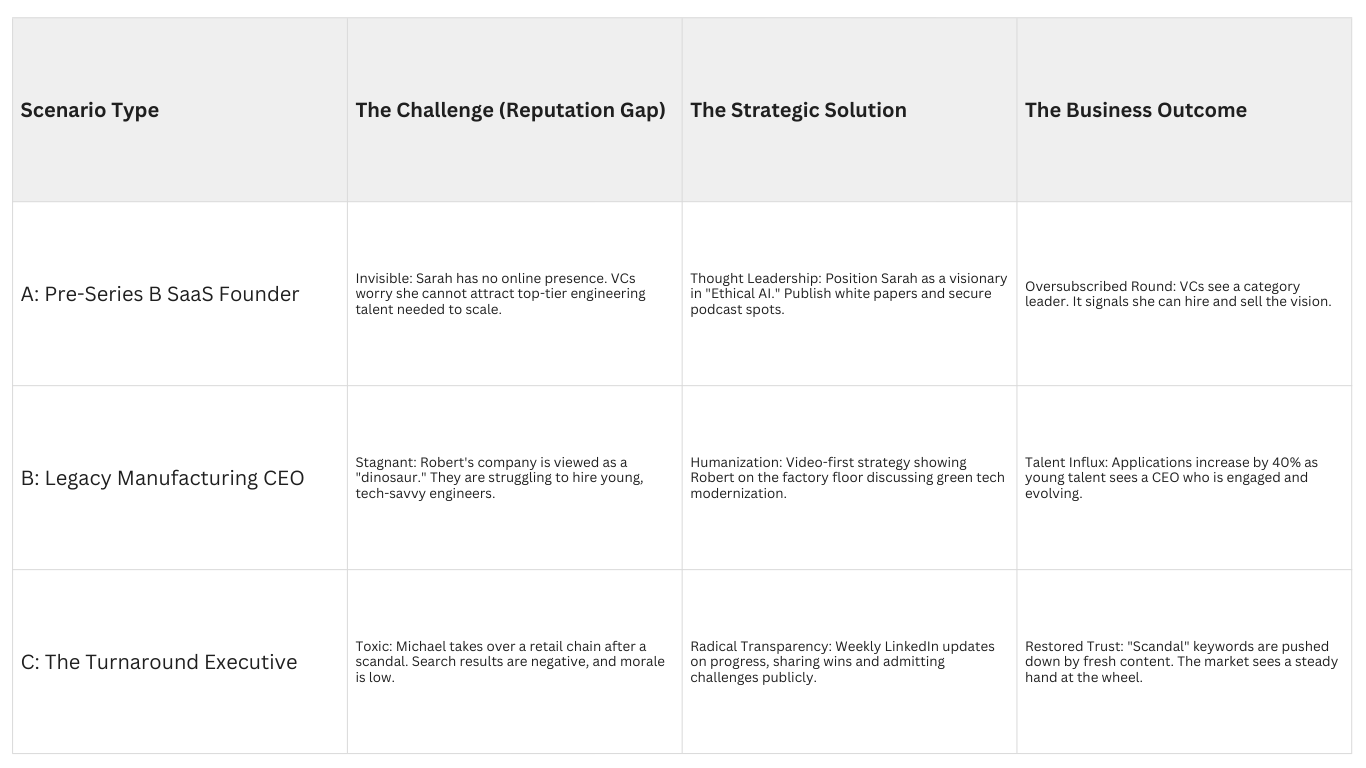
Real-World Scenarios: Reputation Management in Action
To visualize how this works, let’s look at three distinct scenarios where CEO reputation management moves the needle.
Where Ohh My Brand Helps: The Agency Advantage
While the strategies above are clear, the execution is grueling. It requires the skills of a journalist, an SEO expert, a graphic designer, and a PR strategist. This is why executives turn to Ohh My Brand. We recognize that a CEO’s time is their most expensive resource. You cannot spend three hours figuring out the LinkedIn algorithm or editing a video caption.
Ohh My Brand bridges the gap between your expertise and the digital world. We act as the “Operating System” for your personal brand.
How We Support Executives:
- Strategic Positioning: We do not just “post.” We define the narrative arc that aligns with your company’s exit strategy or growth metrics. We use frameworks to build personal brands that have been tested across industries.
- Premium Ghostwriting: Our writers are industry veterans who understand the difference between B2B and B2C communication. We capture your voice so accurately that even your spouse will not know you did not write it. Many believe that authors make better personal brand strategists because they understand narrative structure deeply.
- Visual Excellence: We ensure your visual assets from banners to carousels match the polish of a Fortune 500 brand.
Risk Mitigation: We monitor the sentiment. If a troll attacks or a crisis brews, we are the first line of defense, advising on whether to respond or bury it with positive content.
Extended Services: Beyond social posts, we offer Ebook Writing Services to help you publish comprehensive guides that cement your authority in the market.
By partnering with an agency like Ohh My Brand, you ensure that executive branding happens for you, not by you.
The Executive Implementation Checklist
If you are ready to take control of your narrative, here is a checklist to grade your current standing.
The Basics (Week 1)
- Audit: Google yourself in incognito mode on desktop and mobile.
- LinkedIn URL: Is it customized to your name?
- Headshot:Is it professional, recent (last 2 years), and well-lit?
- Bio: Does your bio speak to the future vision or just the past résumé?
The Strategy (Month 1)
- Identify Keywords: What 3 terms do you want to be associated with?
- Select Competitors:Who are 3 other CEOs in your space doing it well? Analyze their content.
- Engagement Protocol:Block 15 minutes on your calendar every Tuesday and Thursday for engagement.
The Acceleration (Quarter 1)
- Content Cadence:Establish a rhythm of 2 or 3 high-value posts per week.
- Newsletter:Consider launching a LinkedIn newsletter to capture subscribers.
- Agency Partner:Evaluate if you have the internal bandwidth or if it is time to hire a personal branding agency.
Frequently Asked Questions (FAQs)
- Isn’t personal branding just vanity for CEOs with big egos?
No. It is a risk management tool and a business development asset. In a digital world, anonymity is a liability. A strong brand lowers the cost of customer acquisition and talent acquisition. It is a fiduciary duty to the company to present a strong public face.
- How much time does this take? I’m already working 80 hours a week.
If you do it yourself, it takes 5 to 10 hours a week. If you work with a partner like Ohh My Brand, it takes about 60 minutes a month. We extract the insights; we handle the labour.
- Is ghostwriting ethical?
Yes. Presidents have speechwriters. CEOs have PR teams. Ghostwriting is simply the modern evolution of executive communications. The ideas and experiences are yours; the packaging is done by a professional to ensure clarity and impact.
- What if I get negative comments?
Negative comments are a sign of relevance. If you have zero haters, you probably are not saying anything important. However, a professional team helps you distinguish between valid criticism (which requires a thoughtful response) and trolling (which should be ignored/blocked).
- Can’t I just rely on my company’s brand?
Company brands are transient; personal brands are permanent. You might sell the company, leave the company, or pivot. Your personal reputation travels with you. It is your career insurance policy.
- How do I measure ROI on CEO reputation management?
ROI comes in tangible and intangible forms. Tangible: Speaking invitations, podcast requests, inbound talent inquiries, and direct leads via DM. Intangible: Shortened sales cycles (prospects already trust you), higher investor confidence, and employee retention.
- Which platform matters most?
For 95% of B2B CEOs, LinkedIn is the non-negotiable platform. Twitter (X) is powerful for tech, crypto, and media. Instagram is relevant for D2C founders. Do not try to be everywhere. Master LinkedIn first using Book frameworks for linkedin brand building to ensure steady growth.
- My reputation is already damaged. Can it be fixed?
Yes, but it is a marathon, not a sprint. You cannot “delete” the internet, but you can dilute it. By creating a flood of high-quality, high-authority, optimized content using a Content system from book-based strategies, you can push negative results to Page 2 or 3 of Google, where they effectively cease to exist for 99% of searchers.
Conclusion: The Cost of Inaction
The market is having a conversation about your industry, your company, and you. The only question is whether you are participating in that conversation or merely being the subject of it.
For CEOs and founders, online reputation management is the difference between being a commodity and being a category King. It is the leverage that attracts capital, retains talent, and secures board seats.
You have spent a lifetime building your career. Do not let a lack of digital strategy undermine it. Whether you are looking to secure your legacy, pivot your industry positioning, or simply ensure that your digital footprint matches your real-world success, the time to act is now.
Connect with Bhavik Sarkhedi to start your structured, results-driven journey in executive reputation management.