
Your reputation is your most valuable asset as a CEO or founder. Think of your company as a massive ship. Your employees, product, and strategy are the engines, but your reputation is the rudder. It determines the direction of public perception and how smoothly you navigate choppy waters.
In today’s digital-first world, where every decision and statement is publicly visible, your personal brand directly impacts investor confidence, employee attraction, customer loyalty, and your company’s market value.
As Warren Buffett famously said, “It takes 20 years to build a reputation and five minutes to ruin it.”
Nearly half of your organization’s market value is attributable to your reputation as a leader. Yet many executives still treat reputation management as an afterthought, something to address only when crisis strikes.
This is where the right executive PR agency and a skilled Personal Branding Consultant become essential. The difference between working with a strategic partner who truly understands CEO positioning versus hiring a vendor who simply pitches stories to journalists can mean the difference between strategic visibility that drives business growth and wasted resources on generic press releases.
If you are searching for an agency to build your executive visibility, manage your reputation, and position you as a thought leader in your industry, you need clarity on what separates world-class firms from mediocre ones. This guide walks you through everything you should evaluate, from their industry expertise and service offerings to their crisis management capabilities and cultural fit with your leadership style.
Agencies like Ohh My Brand, a leading global personal branding and CEO positioning firm, understand this complexity deeply. They work specifically with C-suite executives to transform visibility into influence, ghostwrite authentic thought leadership, and build reputations that attract opportunities rather than chase them.
Why CEO Reputation Management Matters Now More Than Ever
The stakes for executive visibility have never been higher. In 2026, stakeholders make decisions about your company based on the credibility, transparency, and visibility of your leadership. Here is why this matters for your bottom line.
Attracting Investors: Investors use your digital presence as a screening tool for founder credibility. They are watching your LinkedIn activity, media appearances, and public commentary. When you are visible as a thought leader, you inspire confidence. Investors trust founders who command a room and command the market narrative. They want leaders who have already established authority before the pitch.
Hiring Top Talent: The best people do not just want a paycheck. They want to work for a leader they believe in. Career-building professionals specifically seek out companies with visible, values-driven CEOs. When your leadership voice shows up consistently on LinkedIn, podcasts, and industry stages, you become a talent magnet. Conversely, anonymous leadership limits your ability to attract high performers who are drawn to inspirational figures, not faceless corporations.
Securing Media Coverage and Speaking Opportunities: A strong CEO reputation opens doors. When journalists need an expert voice on industry trends, they reach out to leaders they recognize. When conference organizers book speakers, they choose names with established authority. Media placements and stage time do not just build visibility. They create compounding credibility that attracts partnerships, customers, and strategic opportunities you did not know existed.
Building Customer Trust: Customers increasingly evaluate companies through the lens of their leadership. According to a study by Weber Shandwick, 77% of consumers are more likely to buy from a company when the CEO is visible and transparent online. In B2B markets, this effect is even more pronounced. When a prospect sees that your CEO is actively engaged in industry conversations, publishing insights, and contributing to meaningful dialogue, they perceive your company as trustworthy and forward-thinking.
Research says 77% of consumers prefer companies with visible CEOs
Establishing Board Opportunities and Legacy: Highly visible CEOs attract board nominations, speaking invitations to global forums, and invitations to join prestigious industry bodies. These are not vanity metrics. They are pathways to influence, legacy, and the kind of opportunities that only come when your reputation precedes you.
The businesses that understand this, that position their CEO as a strategic brand asset from day one, move faster, scale bigger, and face fewer obstacles in capital raises, talent acquisition, and market expansion. An executive PR agency exists to accelerate this process. But not all agencies understand what this actually requires, often missing critical components like LinkedIn Marketing.
Common Mistakes Executives Make When Selecting (and Using) a PR Agency
Before diving into what to look for, it is crucial to understand where most executives go wrong. These missteps cost time, money, and missed opportunities.
Mistake 1: Confusing PR with Personal Branding
This is the most costly error. Many executives hire a PR agency thinking they will handle “reputation management,” but what they actually get is a firm that pitches stories to journalists and issues press releases. This is traditional PR, and while media mentions matter, they are not a strategic personal brand.
Personal branding is holistic. It encompasses your LinkedIn presence, content strategy, thought leadership positioning, media training, speaking engagements, and the consistent narrative across every platform. Traditional PR is just one component.
When you hire an agency that only does media pitching, you are missing 80% of what actually builds an executive brand. You get headlines but no consistent voice. You get sporadic visibility but no sustainable thought leadership engine.
Mistake 2: Delegating Brand Development Entirely
Some executives hire an agency and then completely hand over the reins, expecting the agency to “make them visible” without their active participation. This does not work. Your brand must be authentic, and that authenticity comes from your voice, your experiences, and your genuine insights.
The best agencies, like Ohh My Brand, do not replace your voice; they amplify it. They use techniques like LinkedIn ghostwriting and content strategy to capture your authentic perspective and scale it. But this requires your input, your perspective, and your approval on messaging.
Agencies that promise to build your brand without your involvement are either creating something inauthentic that will eventually backfire, or not doing the real work at all.
Mistake 3: Underestimating the Importance of CEO Branding
Some executives still believe personal branding is vanity, something for celebrities, not serious business leaders. This mindset is costly. Your visibility directly impacts your company’s valuation, your ability to raise capital, and your competitive advantage in talent markets.
Executives who skip personal branding are saying no to opportunities they do not even know exist: board positions, partnership offers, speaking invitations, and investor inbound. They are also putting their company at a disadvantage relative to competitors whose CEOs are actively building thought leadership.
Mistake 4: Choosing an Agency Without Industry Expertise
One of the biggest red flags is partnering with an agency that has no experience in your industry. A PR firm experienced in consumer product launches is not equipped to position a B2B SaaS CEO or a manufacturing founder. They will not understand your stakeholders, the nuances of your market, or the topics that actually resonate with investors and buyers. An SEO Consultant with industry knowledge can help ensure you rank for the right terms.
When evaluating agencies, always ask: Do you have case studies in my industry? Can you name three CEOs in my space that you have worked with? If they can not, that is a warning sign.
Mistake 5: Focusing Only on Press Mentions, Not Business Results
Some agencies measure success by counting media placements: “We got you featured in 12 publications this quarter!” But coverage that does not move the needle on your actual business objectives is just noise.
A CEO agency should be able to connect their work to business outcomes: How many qualified leads came from that thought leadership campaign? Did speaking engagements result in partnerships? Did the media strategy influence investor perception? If an agency can not tie their work to business metrics, they are treating your reputation as a vanity project, not a business asset.
Mistake 6: Ignoring Crisis Preparedness
Many executives assume their PR agency will “handle it” if a crisis hits. But agencies that have not invested in crisis communication strategies beforehand are unprepared to manage the situation effectively when it happens.
A crisis response requires speed, preparation, and coordination across internal teams and external messaging. Agencies that have not built crisis playbooks and trained your leadership team in advance will scramble when you need them most. Often, the best way to inoculate against crisis is utilizing personal branding through storytelling to build a reserve of goodwill before anything goes wrong.
The Step-by-Step Strategic Approach to Evaluating an Executive PR Agency
Step 1: Define Your Reputation Objectives and Success Metrics
Before you talk to a single agency, get crystal clear on why you need them and what success looks like for you.
Ask yourself: What do I want to be known for? What is my Personal brand purpose? What opportunities am I trying to create? Is the goal to raise capital? Build thought leadership? Prepare for a public exit? Attract investors and partners? Establish credibility in a new market?
Define metrics that matter. Do not get seduced by vanity metrics. Instead, agree on business-driven outcomes. For some CEOs, it is increased inbound lead generation. For others, it is securing speaking invitations at marquee conferences, attracting top-tier talent, or improving perception with investors.
When you interview agencies, bring these objectives to the table. A strong agency will help you refine these goals and propose a strategy aligned to them. An agency that just says, “We will get you press coverage” is not thinking strategically.
Step 2: Audit the Agency’s Track Record and Client Success
Do not take case studies at face value. Dig deeper.
Ask for:
- Specific case studies with measurable results.
- Client references in your industry.
- Details on the scope of work: Did they do just media relations, or did they build a complete brand strategy including thought leadership, LinkedIn optimization, and content development?
- Timeline for results.
Red flags to watch:
- Agencies that can not provide specific examples or references.
- Case studies that focus only on media placements, not business outcomes.
- References that are vague or will not speak on the record.
- Promises of guaranteed results in unrealistic timeframes.
When you call references, ask pointed questions: Did the agency understand your industry? Were they responsive? Did the visibility translate to actual business opportunities? Would you work with them again?
Step 3: Evaluate Their Service Offering and Expertise
Effective CEO branding requires multiple capabilities working together. When you evaluate an agency, make sure they offer a comprehensive service stack, including Content & Storytelling.
Core services to look for:
- Strategic Positioning and Messaging: The agency should help you define what makes you distinct and what topics you will own.
- LinkedIn and Digital Presence Optimization: The agency should have expertise in optimizing your LinkedIn profile and utilizing Conversion Rate Optimization strategies on your personal site to capture opportunities.
- Thought Leadership and Content Development: Whether it is bylined articles, op-eds, LinkedIn posts, or blog content, the agency should be able to create and place authority-building content.
- Media Relations and PR: Traditional PR is still valuable. The agency should have strong relationships with journalists and editors.
- Podcast and Speaking Placement: Long-form content creates deeper connections than press clips.
- Crisis Communication Planning: Before crisis hits, the agency should work with you to develop a response playbook.
Step 4: Assess Cultural Fit and Communication Style
Your PR agency will be your partner in one of the most visible aspects of your leadership. You need someone who gets you, understands your communication style, and can represent your voice authentically.
During initial conversations, evaluate:
- Do they listen more than they pitch?
- Are they asking strategic questions about your business, your goals, and your stakeholders?
- Can they articulate a clear strategy, or are they just telling you what you want to hear?
- Do you feel like they understand your industry and the unique challenges CEOs face in your space?
The best agencies operate as extensions of your team. They collaborate, they challenge you when it is warranted, and they hold themselves accountable to outcomes.
Step 5: Evaluate Their Technology, Tools, and Measurement Capabilities
In 2026, reputation management is not just about relationships. It is also about data and technology.
Ask the agency about:
- What monitoring tools do you use to track my online reputation and industry mentions?
- How do you measure thought leadership effectiveness and content performance?
- Do you use social listening to understand how my audience is perceiving my brand?
- How do you track the ROI of media placements and other PR activities?
- What is your process for regular reporting and performance reviews?
The best agencies use a blend of human relationships and sophisticated tools to maximize results. Agencies that rely only on relationships and do not invest in measurement tools will give you anecdotal stories instead of data-driven insights.
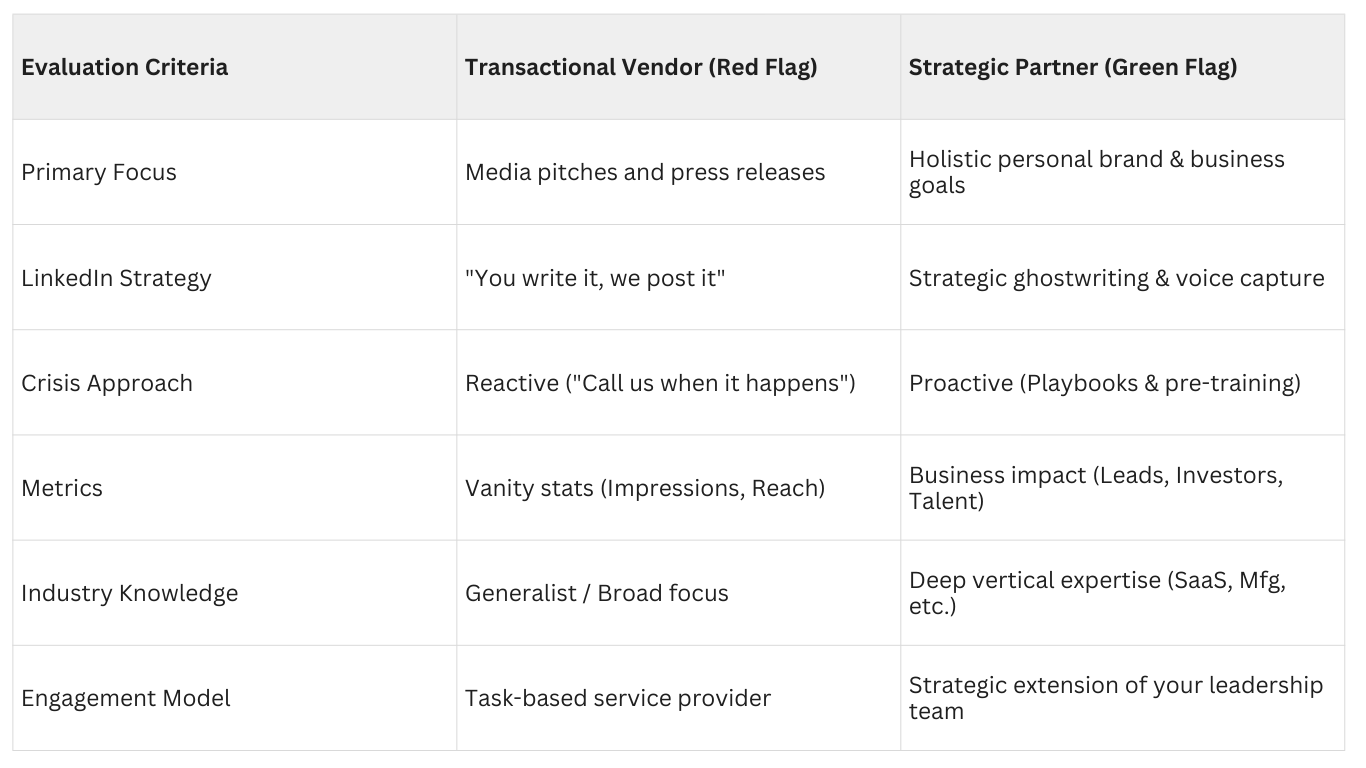
Strategic Partner vs. Transactional Vendor: A Quick Comparison
Use this table to quickly assess if the agency you are speaking with is a strategic partner or just a transactional vendor.
Real-World Executive Scenarios: How the Right Agency Makes a Difference
Scenario 1: The SaaS Founder Raising Series B
The Situation: Sarah is a SaaS founder with a strong product and impressive growth metrics. She is preparing for a Series B raise and needs to position herself as a credible, forward-thinking founder who can scale the business.
What the Wrong Agency Does: Pitches her for a few mentions in tech publications, gets a couple of pieces published, and calls it a win. Three months later, investors are still doing deep dives on her background.
What the Right Agency Does: Starts with a strategy. They use Backlink Building strategies to boost her domain authority. The agency develops a quarterly content calendar that positions her on podcasts where her target investors are listening. They secure speaking slots at venture-backed events. When investor conversations happen, Sarah’s visibility and thought leadership have already primed them to see her as a credible leader.
Scenario 2: The Manufacturing CEO Navigating Industry Disruption
The Situation: Jack is a third-generation manufacturing CEO in a traditional industry. His company is going through digital transformation. He needs to position himself and his company as forward-thinking.
What the Wrong Agency Does: Tries to get Jack featured in national media on generic topics. The pitches are generic, and the publications are not reaching the right people.
What the Right Agency Does: Starts with positioning around Jack’s specific perspective. They utilize Content systems from book based strategies to structure his insights into a coherent narrative. The agency builds a strategy that positions Jack on industry-specific platforms. When it comes to attracting talent and building credibility for a potential exit, Jack is already perceived as a forward-thinking leader.
Scenario 3: The CEO Recovering from Reputation Damage
The Situation: Maria is a healthcare CEO whose company faced a customer service crisis. The incident got negative media coverage.
What the Wrong Agency Does: Issues a press release with an apology and moves on. Six months later, the negative story still dominates.
What the Right Agency Does: Immediately activates a crisis management plan. They prepare Maria for media interviews. They develop a multi-channel communication strategy. Over months, they execute a reputation repair strategy. A year later, when someone searches for Maria’s name, the first results showcase her leadership and her vision for the company, not the crisis.
Where Agencies Like Ohh My Brand Support CEO Positioning
The most effective executive PR agencies take a full-spectrum approach to CEO branding. Here is what that means in practice.
Strategic Positioning and Industry Expertise: Leading agencies like Ohh My Brand start with deep industry research. They understand your competitive landscape, your stakeholder base, and where your authentic positioning can create the most impact.
CEO Visibility and Media Relations: These firms maintain strong relationships with journalists, editors, and media producers across industries. They do not just pitch; they develop compelling narratives around your expertise.
LinkedIn Ghostwriting and Content Strategy: The most time-efficient way for busy CEOs to maintain thought leadership is through strategic LinkedIn ghostwriting. Agencies capture your voice and create content that sounds authentically like you. Some even assert that authors make better personal brand strategists because they know how to craft long-form narratives that engage audiences deeply.
Thought Leadership Development: Beyond ghostwriting, leading agencies help you develop genuine expertise narratives. This might even include Ebook Writing Services to publish comprehensive guides that cement your authority in the market.
Crisis Communication Planning: Before crisis strikes, agencies build comprehensive playbooks. They work with your legal, HR, and communication teams to develop response protocols.
Personal Brand Architecture: The best agencies help you think about your personal brand as a strategic asset. What topics do you own? What stakeholders are you trying to influence?
Reputation Monitoring and Management: Leading agencies continuously monitor how you are perceived online. They track media mentions, social sentiment, and industry conversations.
Founder-Centric Ghostwriting and Personal Branding: For founders specifically, agencies like Ohh My Brand understand that your personal brand often serves dual purposes. It builds your legacy and attracts opportunities to your company.
Implementation Checklist: Getting Started With Your Executive PR Agency
Once you have selected the right agency, here is how to set yourself up for success using proper frameworks to build personal brands.
Pre-Engagement
- Define your 12-month reputation objectives and success metrics.
- Conduct a current audit of your online presence.
- Identify your core audiences.
- Document your unique perspective.
- Clarify your communication preferences.
Week 1-2 (Strategic Planning)
- Meet with your agency to align on goals.
- Complete positioning workshop.
- Agree on a content calendar.
- Identify initial media targets.
- Establish reporting cadence.
Week 3-4 (Foundation Building)
- Complete media training with your PR team.
- Optimize your LinkedIn profile.
- Develop an initial thought leadership content calendar.
- Identify crisis communication team members.
- Audit your digital footprint.
Months 2-3 (Launch)
- Begin executing a content calendar.
- Activate media pitching.
- Secure initial podcast and speaking opportunities.
- Establish monitoring and reporting systems.
- Hold monthly strategy reviews.
Ongoing
- Publish consistent thought leadership content.
- Engage with industry conversations.
- Pursue media opportunities.
- Monitor reputation online.
- Review reports and adjust strategy.
- Prepare for crisis scenarios.
10 Essential Questions to Ask Potential Executive PR Agencies
- Tell me about your process for developing CEO positioning. How do you ensure it’s authentic and differentiated?
Listen for: Agencies that ask about your background, experiences, values, and market context. Red flag: Agencies with a templated approach or that immediately push you toward a generic “thought leader” positioning.
- Do you have case studies or references from CEOs in my industry?
Listen for: Specific examples with measurable outcomes. Red flag: Vague references or inability to name comparable clients.
- How do you handle LinkedIn strategy and content development for busy executives?
Listen for agencies that utilize bestselling frameworks for personal brands and can scale visibility without consuming your time.
- What’s your approach to media relations? How do you actually secure placements?
Listen for: Discussion of their media relationships, how they develop story angles, and their track record of placements in tier-one publications relevant to your industry. Red flag: Vague claims about “media connections” without specific examples.
- Tell me about your crisis communication capabilities. What happens if something goes wrong?
Listen for: Pre-developed crisis playbooks, media training, coordination with internal teams (legal, HR), and experience managing reputation challenges. Red flag: Agencies that say “we’ll handle it” without details on how.
- How do you measure success beyond media mentions?
Listen for: Discussion of business metrics, leads generated, speaking opportunities, investor inquiries, employee recruitment impact. Red flag: Agencies that only measure PR output (number of articles, reach, impressions) without connecting to business outcomes.
- What’s your timeline for seeing meaningful results?
Listen for: Realistic timelines (6-12 months to build noticeable thought leadership) and honest discussion of what “results” look like in early phases. Red flag: Promises of rapid transformation or guaranteed results.
- How will you stay involved after the initial positioning phase? What does ongoing partnership look like?
Listen for: Clear commitment to continued strategy, content development, opportunity identification, and optimization. Red flag: Agencies that treat phase one as the “real work” and ongoing engagement as secondary.
- How do you balance authenticity with strategic positioning? How do you capture my voice?
Listen for: Discussion of collaboration, working sessions, feedback loops, and ghostwriting processes that preserve your authentic voice. Red flag: Agencies that seem uncomfortable discussing how ghostwriting maintains authenticity.
- Who will be my primary point of contact, and what’s your team structure?
Listen for: Clear identification of your main contact, their experience level, and backup support. Red flag: Senior person who pitches the account but won’t actually be involved; unclear who you’ll be working with day-to-day.
The Common Mistakes Executives Make With Their PR Agency (Beyond Selection)
Even with the right agency, execution matters. Here are pitfalls that derail otherwise strong partnerships.
Mistake 1: Being Inconsistent or Disengaged
Reputation building requires consistent effort over time. You are the brand. The agency is the amplifier. If you are not engaged in the process, no agency can build your reputation for you.
Mistake 2: Conflating Thought Leadership With Promotion
Some executives want every piece of content to be about their company. Effective strategy relies on Book frameworks for linkedin brand building which suggest 80% thought leadership and 20% company-focused content.
Mistake 3: Micromanaging the Strategy
You hired a strategy partner, then you do not trust their strategic recommendations. This creates friction. Find the balance between being informed and over-controlling.
Mistake 4: Not Providing Feedback or Direction
Some executives go hands-off and assume the agency will figure out their voice. Your responsibility is to provide clear feedback early and often.
Mistake 5: Changing Strategies Too Frequently
Reputation building takes time. If you pivot your strategy every quarter, you will never build momentum.
Conclusion: Building the Right Partnership for Your Executive Future
Choosing an executive PR agency is one of the most important decisions you will make as a leader. This partnership directly impacts your visibility, your influence, and ultimately your company’s growth and your personal legacy. The right agency does not just get you press mentions. They help you build a strategic personal brand that attracts investors, talent, partnerships, and opportunities you did not know existed.
The best agencies start by understanding your business, your goals, and your authentic positioning. They build comprehensive strategies that integrate media relations, thought leadership, digital presence optimization, crisis communication, and consistent content execution. They measure success by business outcomes, not vanity metrics. And critically, they operate as strategic partners, not vendors.
As you evaluate your options, remember: the cheapest agency often is not the best value. Neither is the biggest name that treats you like another account number. The best fit is an agency that brings industry expertise, a full-spectrum service offering, genuine strategic thinking, and clear evidence that their work drives business results.
If you are serious about building an executive brand that compounds over time, visibility that attracts capital, talent, partnerships, and speaking opportunities, reach out to Ohh My Brand. We work exclusively with CEOs and founders to develop authentic positioning, execute thought leadership strategies, build LinkedIn presence through ghostwriting and content, and manage reputation as a strategic business asset.
The question is not whether to build your executive brand. In 2026, the question is: who will help you build it authentically, strategically, and sustainably?
Connect with Bhavik Sarkhedi to start your structured, results-driven journey in executive reputation management.