Why Do CEOs Need Professional Online Reputation Management Services?

The modern boardroom has glass walls. Two decades ago, a CEO could operate largely in the shadows. They emerged only for quarterly earnings calls, the occasional press release, or a carefully curated profile in a major industry magazine. The reputation of the executive was almost entirely synonymous with the reputation of the corporation.


That era is dead.


Today, we live in the economy of the personal brand. Before an investor signs a check, before a top-tier engineer accepts an offer letter, and before a potential partner agrees to a merger, they do one thing: they Google the CEO.


What they find, or failing to find anything at all, dictates the future of the company.


For C-suite executives and founders, online reputation management (ORM) is no longer a vanity project. It is a critical asset class. It is digital equity. Yet, many leaders still treat their digital presence as an afterthought, delegating it to junior marketing staff or ignoring it until a crisis hits.


Think of your online reputation like the foundation of a skyscraper. You can build a magnificent company on top of it, but if that foundation is cracked or invisible, the structure is unstable. A specialized Personal Branding Consultant understands that this foundation must be built intentionally, not accidentally.


This comprehensive guide explores the strategic necessity of CEO reputation management. We will dissect the risks of invisibility, the mechanics of building executive branding, and why partnering with a specialised personal branding agency like Ohh My Brand is often the difference between a legacy that commands respect and a digital footprint that becomes a liability.


What Does “Reputation” Actually Mean for the Modern CEO?

To understand why professional management is necessary, we must first redefine what “reputation” looks like in the algorithmic age. It is not just about having a clean criminal record or a positive biography on the company website.


CEO visibility is the aggregate of every digital touchpoint associated with your name. It includes:


Search Engine Results Pages (SERPs): When someone types your name into Google, do they see your thought leadership? Or do they see a ranting Glassdoor review from a disgruntled employee from three years ago? An expert SEO Consultant knows that controlling the first page of Google is controlling the narrative.


  • Social Media Authority: Is your LinkedIn profile a stagnant résumé? Or is it a dynamic hub of thought leadership that engages with industry trends?
  • Visual Narrative: Do Google Images show professional headshots and speaking engagements, or blurry photos from a college reunion?
  • Third-Party Validation: Are you quoted in reputable publications, or does your name only appear in your own company’s press releases?


The Trust Economy


We are operating in a low-trust environment. Edelman’s Trust Barometer consistently shows that people trust “a person like yourself” or technical experts more than they trust institutions. However, when a CEO has a strong founder reputation, that trust transfers to the entity.


A CEO with a managed reputation acts as a human shield for the brand during crises and a magnet for opportunities during growth phases. Conversely, a CEO with a “ghost” reputation zero digital footprint is viewed with suspicion. In the digital age, invisibility is often equated with irrelevance or incompetence.


Why Does Executive Branding Matter Now More Than Ever?

The urgency for executive branding is driven by four specific market forces that have converged in the post-pandemic business landscape.


1. The War for Talent is Won by Leaders, Not Logos


Top talent, specifically Gen Z and Millennials, does not want to work for faceless monoliths. They want to work for visionaries. They want to know who is steering the ship.


If a prospective VP of Sales looks you up and finds a vibrant ecosystem of content where you articulate your vision for the market, your culture, and your leadership style, you have already won half the recruitment battle. If they find nothing, or worse, negative content, you are fighting an uphill battle. CEO branding reduces the cost of talent acquisition by pre-selling the leadership’s competence.


2. Valuation and Investor Confidence


Investors invest in lines, not dots. They want to see a trajectory. For early-stage founders, the founder’s reputation is often the only asset the company has. VCs admit that they stalk founders online to assess their network, their industry grasp, and their temperament.


For public companies, the correlation is even clearer. A study by Weber Shandwick found that global executives attribute nearly half (44%) of their company’s market value to the reputation of their CEO. A CEO who communicates clearly and regularly online calms shareholder jitters and controls the narrative during market volatility.


3. The Collapse of Traditional Media Gatekeepers


You no longer need to wait for Forbes or the Wall Street Journal to decide you are relevant. You can become your own media house. Through platforms like LinkedIn and Medium, you have direct access to your stakeholders without the filter of a journalist who might misunderstand your quote.


However, this democratization comes with noise. To cut through, you need high-calibre content. This is where LinkedIn Marketing and strategic content planning become essential. It is not about “posting.” It is about publishing strategic narratives that align with business goals.


4. Crisis Insulation


When a crisis hits, a product recall, a data breach, a lawsuit, the media will scramble for a villain. If your digital presence is a blank slate, the media will paint your portrait for you, and it will rarely be flattering.


If, however, you have spent years depositing “goodwill” into the bank of public opinion through consistent, value-driven communication, the market gives you the benefit of the doubt. Professional CEO reputation management builds this buffer before the storm arrives.


Common Mistakes Executives Make With Their Online Presence


Despite the high stakes, many intelligent leaders fail miserably at managing their online reputation. At Ohh My Brand, we often see executives coming to us only after they have committed one of these cardinal sins.

The “Silence is Dignity” Fallacy


Many CEOs believe that staying offline is the “dignified” choice. They conflate privacy with silence. They assume that if they do good work, the reputation will follow.


The Reality: If you do not define your brand, Google will define it for you. Nature abhors a vacuum. If you are not publishing your narrative, the algorithm will fill that space with automated directory listings, random court filings (even if irrelevant), or outdated information.


The “Intern Strategy”


Some executives realize they need to be on social media, so they hand their LinkedIn password to a 22-year-old marketing coordinator.


The Reality: This is dangerous. Your personal brand is the voice of the company. A junior employee does not understand the nuances of board relations, shareholder communication, or high-level industry strategy. One tone-deaf comment or emoji can wipe out millions in brand equity. Executive PR requires executive-level strategic thinking.


The “Sales Pitch” Approach


CEOs often treat their personal channels as a distribution pipe for company brochures. “We are thrilled to announce…” or “Buy our new product…”


The Reality: No one follows a CEO to be sold to. They follow for insight. If your feed is 100% self-promotion, you are shouting into the void. True thought leadership relies on Content & Storytelling. It is about giving value, not extracting it. Utilizing personal branding through storytelling allows you to connect on a human level rather than just a transactional one.


Inconsistency

Posting five times in one week and then disappearing for six months is worse than not posting at all. It signals a lack of discipline or a lack of stability.


The Reality: Algorithms punish inconsistency. More importantly, stakeholders perceive erratic behaviour online as a proxy for erratic leadership offline.


A Strategic Approach to Building an Executive Brand


So, how does a busy CEO build a reputation that serves as a strategic asset? It requires a systematic approach. This is not about vanity metrics like “likes.” It is about “share of mind.”


Here is the framework often utilized by top-tier personal branding agencies.


Step 1: The Digital Audit and Cleanup


Before you build, you must clear the site.


  • Google Yourself (Incognito): What appears on Page 1? What about Page 2?
  • Asset Inventory: Do you own YourName.com? Are your handles consistent across Twitter (X), LinkedIn, and Instagram?
  • Vulnerability Assessment: Are there old tweets that have not aged well? Are there photos tagged of you that are unprofessional?


The Fix: This involves suppressing negative search results by creating high-authority positive properties and requesting the removal of damaging, irrelevant content where possible.


Step 2: Defining the “Alpha Narrative”


You cannot be famous for everything. You must be known for one thing. This is about defining your **Personal brand purpose**.


  • The Pivot: What is the intersection between your personal passion, your company’s goals, and what the market needs?
  • The Archetypes: Are you the “Disruptor” (challenging the status quo)? The “Sage” (deep wisdom and history)? The “Builder” (operational excellence)?
  • The Pillars: Choose 3 or 4 content pillars. For example, a Fintech CEO might choose: 1. The future of decentralized finance, 2. Remote leadership culture, 3. Financial literacy for Gen Z.


Step 3: The Content Ecosystem & LinkedIn Ghostwriting


This is where the execution happens. Because CEOs are time-poor, LinkedIn ghostwriting is the engine of the industry.


  • The Mechanism: A professional team interviews the CEO for 30 minutes a month. They extract the stories, the opinions, and the tone. They then convert that raw audio into high-performing LinkedIn posts, long-form articles, and Twitter threads.
  • Quality Control: The CEO reviews and approves. The voice is authentic; the typing is outsourced.
  • The Mix: The content should follow the 4-1-1 rule: 4 pieces of value-add insight, 1 soft sell (culture/hiring), 1 hard sell (product/company news). Applying Conversion Rate Optimization principles to your profile ensures that when people land on your content, they take the desired action, whether that is following you or visiting your company site.


Step 4: Engagement and Network Expansion


Broadcasting is not enough. You must engage.


Comment Strategy: Spending 10 minutes a day commenting on the posts of other industry leaders, partners, and even competitors increases visibility faster than posting original content.


Curated Connections: Systematically connecting with investors, journalists, and potential hires to ensure your content feeds into the right eyeballs.


Step 5: Executive PR and Off-Page SEO


Your reputation must exist outside of your own channels.


Podcast Strategy: Getting booked on niche industry podcasts is highly effective for SEO and depth of authority.


Guest Contributor: Writing op-eds for industry trade journals.


Awards: Strategically applying for “CEO of the Year” or “40 Under 40” lists. This generates high-authority links, and Backlink Building is essential for pushing your positive content to the top of search results.


Real-World Scenarios: Reputation Management in Action


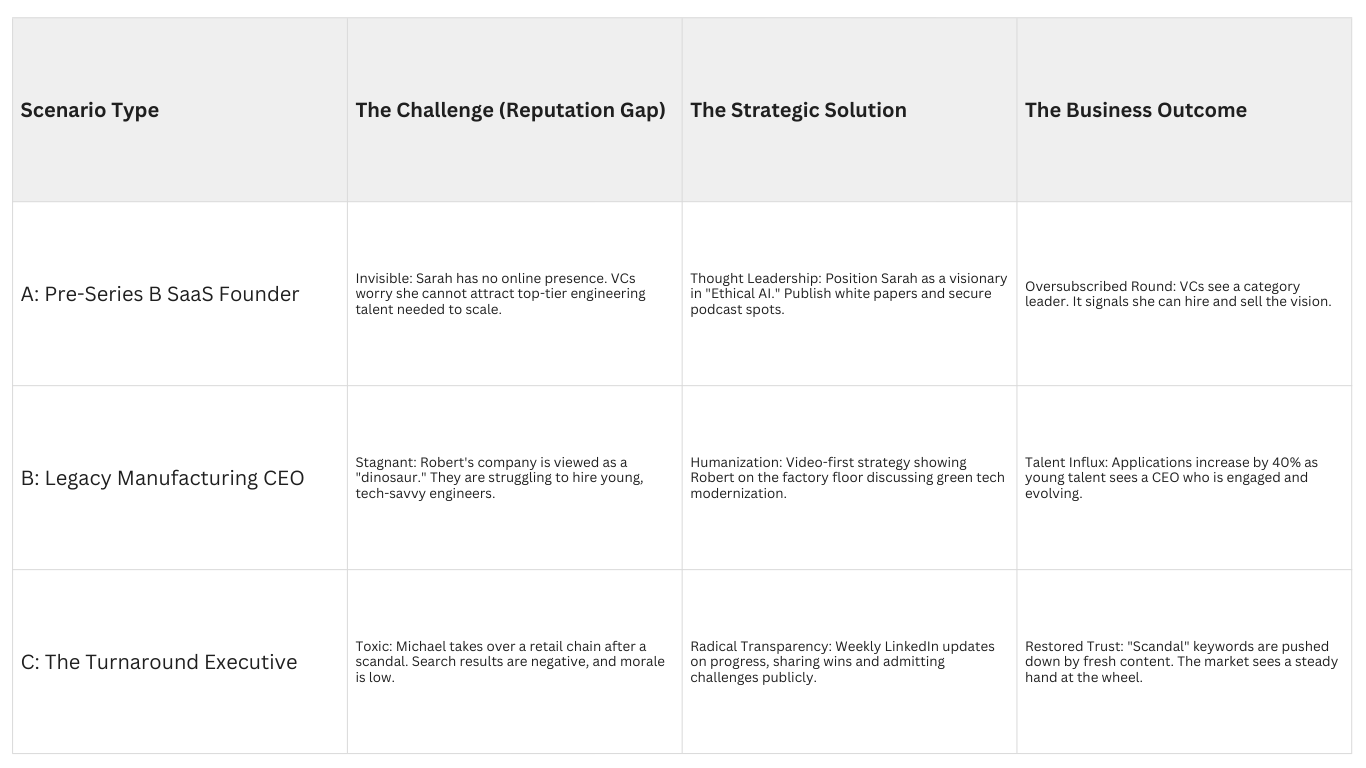
To visualize how this works, let’s look at three distinct scenarios where CEO reputation management moves the needle.

Where Ohh My Brand Helps: The Agency Advantage


While the strategies above are clear, the execution is grueling. It requires the skills of a journalist, an SEO expert, a graphic designer, and a PR strategist. This is why executives turn to Ohh My Brand. We recognize that a CEO’s time is their most expensive resource. You cannot spend three hours figuring out the LinkedIn algorithm or editing a video caption.


Ohh My Brand bridges the gap between your expertise and the digital world. We act as the “Operating System” for your personal brand.


How We Support Executives:


  • Strategic Positioning: We do not just “post.” We define the narrative arc that aligns with your company’s exit strategy or growth metrics. We use frameworks to build personal brands that have been tested across industries.
  • Premium Ghostwriting: Our writers are industry veterans who understand the difference between B2B and B2C communication. We capture your voice so accurately that even your spouse will not know you did not write it. Many believe that authors make better personal brand strategists because they understand narrative structure deeply.
  • Visual Excellence: We ensure your visual assets from banners to carousels match the polish of a Fortune 500 brand.


Risk Mitigation: We monitor the sentiment. If a troll attacks or a crisis brews, we are the first line of defense, advising on whether to respond or bury it with positive content.


Extended Services: Beyond social posts, we offer Ebook Writing Services to help you publish comprehensive guides that cement your authority in the market.


By partnering with an agency like Ohh My Brand, you ensure that executive branding happens for you, not by you.


The Executive Implementation Checklist


If you are ready to take control of your narrative, here is a checklist to grade your current standing.

The Basics (Week 1)

  • Audit: Google yourself in incognito mode on desktop and mobile.
  • LinkedIn URL: Is it customized to your name?
  • Headshot:Is it professional, recent (last 2 years), and well-lit?
  • Bio: Does your bio speak to the future vision or just the past résumé?


The Strategy (Month 1)

  • Identify Keywords: What 3 terms do you want to be associated with?
  • Select Competitors:Who are 3 other CEOs in your space doing it well? Analyze their content.
  • Engagement Protocol:Block 15 minutes on your calendar every Tuesday and Thursday for engagement.


The Acceleration (Quarter 1)

  • Content Cadence:Establish a rhythm of 2 or 3 high-value posts per week.
  • Newsletter:Consider launching a LinkedIn newsletter to capture subscribers.
  • Agency Partner:Evaluate if you have the internal bandwidth or if it is time to hire a personal branding agency.


Frequently Asked Questions (FAQs)


  1. Isn’t personal branding just vanity for CEOs with big egos?


No. It is a risk management tool and a business development asset. In a digital world, anonymity is a liability. A strong brand lowers the cost of customer acquisition and talent acquisition. It is a fiduciary duty to the company to present a strong public face.


  1. How much time does this take? I’m already working 80 hours a week.


If you do it yourself, it takes 5 to 10 hours a week. If you work with a partner like Ohh My Brand, it takes about 60 minutes a month. We extract the insights; we handle the labour.


  1. Is ghostwriting ethical?


Yes. Presidents have speechwriters. CEOs have PR teams. Ghostwriting is simply the modern evolution of executive communications. The ideas and experiences are yours; the packaging is done by a professional to ensure clarity and impact.


  1. What if I get negative comments?


Negative comments are a sign of relevance. If you have zero haters, you probably are not saying anything important. However, a professional team helps you distinguish between valid criticism (which requires a thoughtful response) and trolling (which should be ignored/blocked).


  1. Can’t I just rely on my company’s brand?


Company brands are transient; personal brands are permanent. You might sell the company, leave the company, or pivot. Your personal reputation travels with you. It is your career insurance policy.


  1. How do I measure ROI on CEO reputation management?


ROI comes in tangible and intangible forms. Tangible: Speaking invitations, podcast requests, inbound talent inquiries, and direct leads via DM. Intangible: Shortened sales cycles (prospects already trust you), higher investor confidence, and employee retention.


  1. Which platform matters most?


For 95% of B2B CEOs, LinkedIn is the non-negotiable platform. Twitter (X) is powerful for tech, crypto, and media. Instagram is relevant for D2C founders. Do not try to be everywhere. Master LinkedIn first using Book frameworks for linkedin brand building to ensure steady growth.


  1. My reputation is already damaged. Can it be fixed?


Yes, but it is a marathon, not a sprint. You cannot “delete” the internet, but you can dilute it. By creating a flood of high-quality, high-authority, optimized content using a Content system from book-based strategies, you can push negative results to Page 2 or 3 of Google, where they effectively cease to exist for 99% of searchers.


Conclusion: The Cost of Inaction


The market is having a conversation about your industry, your company, and you. The only question is whether you are participating in that conversation or merely being the subject of it.


For CEOs and founders, online reputation management is the difference between being a commodity and being a category King. It is the leverage that attracts capital, retains talent, and secures board seats.


You have spent a lifetime building your career. Do not let a lack of digital strategy undermine it. Whether you are looking to secure your legacy, pivot your industry positioning, or simply ensure that your digital footprint matches your real-world success, the time to act is now.


Connect with Bhavik Sarkhedi to start your structured, results-driven journey in executive reputation management.

What Does an Executive Branding Consultant Actually Do?

The CEO of a $50 million manufacturing company recently told me something revealing. “I built this company from the ground up, but when I Google my name, my competitor’s CEO dominates the search results. He is on podcasts, quoted in industry publications, and has 20,000 LinkedIn followers. Meanwhile, I am invisible, and it is costing us deals.”


Think of it this way: having a powerful company without a visible leader is like having a Formula 1 engine hidden inside a rusted sedan. The power is there, but nobody can see it, and they certainly don’t trust it to win the race.


This invisibility problem is more common than most executives realize. It is a silent killer of opportunity. According to research, 61% of CEOs lack a personal brand, yet 44% of a company’s market value is directly attributed to the CEO’s reputation. In an era where investors, customers, and top talent research leaders before engaging with companies, the absence of an executive brand isn’t neutral. It is a competitive disadvantage.


44% of a company’s market value is attributed to the reputation of its CEO, alongside data showing 61% of CEOs have low visibility.


This is precisely where a Personal Branding Consultant enters the picture. These specialists don’t create fictional personas or manufacture celebrity status. Instead, they help CEOs, founders, and C-suite leaders translate their existing expertise, vision, and track record into a strategic public presence. Agencies like Ohh My Brand have pioneered this approach globally, helping executives transform from behind-the-scenes operators into recognized thought leaders.


But what do these consultants actually do day-to-day? How do they turn a time-pressed executive with zero social media presence into an industry authority? Let’s pull back the curtain on this profession.


What Executive Branding Means for CEOs and Founders and Why It Matters Right Now

Executive branding isn’t about ego or self-promotion. It is strategic positioning that directly impacts your ability to execute on business priorities.


Research from Weber Shandwick reveals that nearly 60% of customers factor a CEO’s reputation into their decision to engage with a brand. When you consider that companies with visible executives grow revenue 19% faster on average and experience 21% increases in customer loyalty, the business case becomes crystal clear.


The investor equation has fundamentally shifted. Nearly 90% of investors now say that trusting the founder is critically important when deciding where to allocate capital. Before they analyze your pitch deck or financial projections, they are Googling you. What they find, or don’t find, shapes their perception of risk and opportunity. A well-positioned executive brand answers the unspoken question every investor asks: “Can this person actually execute on this vision?”


Talent acquisition follows a similar pattern. Top performers don’t just evaluate job descriptions; they research who they will be working for. A founder’s personal brand can increase positive results in talent acquisition by 70% and improve staff retention by 77%.


Media coverage and speaking opportunities create compounding advantages. A single well-placed article or conference keynote can generate introductions that take years to cultivate through traditional networking. When the media positions you as an authority, it triggers third-party validation.


Common Mistakes Executives Make With Personal Branding

Even successful leaders stumble when building their executive brand. These missteps aren’t just embarrassing; they actively undermine credibility and waste resources.


Treating social media as a press release channel

The fastest way to lose an audience is posting stiff, corporate-speak announcements that sound like they were written by your legal team. Audiences don’t follow executives for polished jargon. They want authentic insights.


Delegating your personal brand entirely

Some executives make the opposite mistake, handing their entire executive brand to agencies or team members without staying involved. While a consultant can provide strategy, your brand must reflect your voice.


Confusing branding with straight PR

Public relations is one component of executive branding, not the entire strategy. A single Forbes feature means little if your LinkedIn profile is outdated. You need a holistic approach, often requiring the insight of an SEO Consultant to ensure your digital footprint is optimized.


Being wildly inconsistent

Posting three times in one week, then disappearing for six months creates confusion rather than authority. Consistency builds recognition over time.


Projecting authority without relatability

Some executives fall into the trap of only sharing high-level strategies. The most effective executive brands strike a balance, utilizing personal branding through storytelling to share lessons learned from failures or behind-the-scenes glimpses.


Over promoting the company at the expense of thought leadership

When every post functions as a thinly veiled sales pitch, you have turned your personal brand into just another marketing channel.


The Strategic Approach: How Executive Branding Consultants Actually Work

Professional executive branding consultants follow a systematic methodology. Here is the proven framework that agencies like Ohh My Brand use to build executive authority.


Step 1: Discovery and Brand Audit

The process begins with comprehensive assessment. Consultants conduct deep-dive sessions to understand your professional journey. This isn’t a 30-minute conversation. It is a structured excavation of your unique value proposition.

Simultaneously, consultants audit your digital footprint. They analyze your LinkedIn profile, Google search results, and existing content. This research reveals gaps between your actual expertise and how the market perceives you.


Step 2: Positioning and Narrative Development

With research complete, consultants craft your core brand positioning. This involves defining your Personal brand purpose. It is about identifying your intellectual territory: the unique intersection of your expertise, industry gaps, and audience needs.

Consultants then develop your brand narrative. The best narratives follow frameworks to build personal brands that structure your journey: challenge faced, insight gained, approach developed, and impact created.


Step 3: Digital Presence Optimization and Asset Creation

With strategy defined, consultants turn to execution. The first priority is optimizing your owned digital properties. This requires Conversion Rate Optimization strategies for your personal website and profile to ensure visitors actually engage with your content.

Visual identity matters more than most executives realize. Consultants often coordinate professional photography sessions that create a library of high-quality headshots.


Step 4: Content Creation and Thought Leadership Development

This is where executive branding shifts from strategy documents to market-facing reality. Content & Storytelling are the engines of this phase.

The ghostwriting process typically starts with voice capture sessions. Skilled ghostwriters then transform these transcripts into polished content. Content formats vary based on goals. Some consultants may even offer Ebook Writing Services to help you publish comprehensive guides that establish deep authority.


Step 5: Amplification, Measurement, and Optimization

Creating great content means nothing if no one sees it. Consultants develop distribution strategies that maximize reach. This often involves Backlink Building strategies to increase the authority of your personal website and articles.

The most sophisticated consultants implement multi-touch attribution frameworks. Based on performance data, consultants continuously refine your strategy.


Real-World CEO and Founder Scenarios: When Executive Branding Solves Specific Problems

Executive branding isn’t one-size-fits-all. Different leaders face distinct challenges.


Scenario 1: The Series B SaaS Founder Preparing for Series C

A 38-year-old founder has built a B2B SaaS platform to $15M ARR. But as Series C conversations begin, VCs are doing extensive due diligence on him personally. His LinkedIn has 800 followers and Google searches return almost nothing.

An executive branding consultant positions the founder not around his product features but around the problem category he is solving. Within 90 days, his profile views increase 400%, and he gains 3,500 relevant followers.


Scenario 2: The Established CEO Facing Talent Retention Crisis

A 55-year-old CEO runs a 200-person firm. They are losing talented mid-level consultants to competitors because the leadership feels distant.

An executive branding consultant diagnoses this as an internal-external alignment problem. The consultant starts with internal thought leadership and extends it externally. Twelve months in, the retention problem has reversed.


Scenario 3: The Industry Veteran Positioning for Board Roles

A 48-year-old COO is looking ahead to board positions. Board recruiters find a sparse LinkedIn profile listing her roles but communicating nothing about her strategic thinking.

An executive branding consultant positions her as a “Supply Chain Resilience Architect.” They prioritize LinkedIn Marketing tactics to get her content in front of board recruiters. After 18 months, she joined her first board.


Where Ohh My Brand and Personal Branding Agencies Actually Add Value

The core value proposition is simple: agencies provide specialized expertise and execution capacity.


Strategic positioning represents the highest-value agency contribution. Executives are often too close to their own stories. A skilled consultant uses bestselling frameworks for personal brands to identify what is truly distinctive about you.


Professional ghostwriting solves the capacity problem. Some even say that authors make better personal brand strategists because they understand narrative arc and character development, which are essential for compelling leadership stories.


LinkedIn Marketing strategy requires platform-specific knowledge that evolves constantly.7 Agencies stay current on algorithm changes and format preferences.


Measurement frameworks separate effective branding from vanity projects.8 Sophisticated agencies track whether prospects who engaged with your content close faster or at higher values.


Executive Branding Implementation Checklist: What You Actually Need to Do

If you are ready to build your executive brand, here is a practical checklist.

Foundation (Month 1)

  • Conduct honest self-assessment regarding your expertise.
  • Define clear objectives.
  • Identify target audiences.
  • Audit current digital presence.
  • Secure professional photography.
  • Set realistic time commitment.


Digital Optimization (Month 1-2)

  • Overhaul LinkedIn profile.
  • Create or update personal website.
  • Optimize other profiles.
  • Establish Google Alerts.
  • Clean up negative search results.


Content Strategy (Month 2)

  • Define your intellectual territory.
  • Establish brand voice guidelines.
  • Create content calendar.
  • Determine sustainable cadence.
  • Identify content formats.


Execution (Month 2-3 and ongoing)

  • Publish consistently according to your schedule (working with ghostwriter if applicable)
  • Engage actively: Respond to comments, participate in relevant discussions, share others’ valuable content
  • Build strategic relationships: Connect with journalists, podcasters, conference organizers, and other influencers
  • Pursue speaking opportunities: Identify relevant conferences and submit proposals or work with consultants to secure invitations
  • Pitch media: Work with PR consultants to place articles and secure interviews in target publications


Amplification (Ongoing)

  • Leverage your network: Ask colleagues and friends to engage with and share your best content
  • Cross-promote: Share LinkedIn content in newsletters, mention articles in speaking engagements, etc.
  • Consider paid promotion: Boost particularly strong content to expand reach
  • Coordinate with company marketing: Ensure they amplify your personal brand content where appropriate
  • Repurpose content: Turn articles into presentation slides, posts into newsletter content, etc.


Measurement and Optimization (Monthly and Quarterly)

  • Track key metrics.
  • Monitor media mentions.
  • Document direct business impact.
  • Conduct quarterly reviews.
  • Adjust strategy based on data.


Frequently Asked Questions About Executive Branding Consultants

Q1. How much does working with an executive branding consultant typically cost?

A. Investment levels vary significantly. Basic packages start around $5,000 to $10,000 monthly. Comprehensive ongoing programs typically range from $10,000 to $30,000 monthly.


Q2. How long does it take to see results from executive branding efforts?

A. Initial visibility improvements typically appear within 30 to 60 days. Meaningful business outcomes like speaking invitations generally emerge within 90 to 120 days. Strategic results develop over 6 to 12 months.


Q3. Can’t my marketing team handle executive branding internally?

A. Sometimes, but usually with limitations. Your marketing team excels at company branding but typically lacks experience with personal brand strategy.


Q4. What if I am naturally private and uncomfortable with self-promotion?

A. This is a common concern. Effective executive branding isn’t about self-promotion; it is about sharing expertise that serves your audience.


Q5. How do I maintain authenticity when using a ghostwriter?

A. Professional ghostwriters capture and polish your authentic voice. You always review and approve content before publication.


Q6. Should I focus on LinkedIn, Twitter, my own website, or all platforms?

A. LinkedIn is the foundation for B2B executives.11 Beyond LinkedIn, choose platforms based on where your target audience spends time.


Q7 .What is the difference between personal branding and social media influencer marketing?

A. Personal branding focuses on professional credibility and strategic relationships. Influencer marketing aims for mass audience reach.


Q8. How do I balance building my personal brand without overshadowing my company’s brand?

A. Your personal brand should complement your company’s brand. Follow the 80/20 rule: 80% value, 20% company promotion.


Q9. Do I need an executive branding consultant, or can I figure this out myself?

A. You can do it independently, but it takes time. Consultants compress timelines and avoid expensive mistakes.


Building Executive Authority That Opens Doors

The CEO who opened this article made a choice. He recognized that in 2026, executive visibility is strategic infrastructure, not vanity.


Eighteen months after engaging an executive branding consultant, his landscape had transformed. A Google search for his name now returns his LinkedIn profile, bylined articles, and his personal website. More importantly, his company closed two major deals where prospects explicitly mentioned seeing his thought leadership content.


Executive branding consultants don’t create magic. They apply systematic methodology to translate your existing expertise into strategic visibility. Whether you work with an agency like Ohh My Brand or tackle aspects independently, the underlying principles remain constant: authentic positioning beats manufactured personas.


The executives who understand this dynamic are building compounding advantages over competitors who remain invisible. The question isn’t whether you need an executive brand. The question is whether you will build it strategically or leave it to chance. Connect with Bhavik Sarkhedi to explore a structured, results-driven approach to executive personal branding.

Why Is Professional Founder Reputation Management Critical for Growth?

Imagine your company is a high-performance sports car. You have the best engine (product), the most aerodynamic design (business model), and premium fuel (capital). But if the driver is unknown or, worse, known for reckless driving, no one will get in the passenger seat.


The most powerful asset you can build as a founder or CEO is not your product, your technology, or even your market position. It is your reputation.


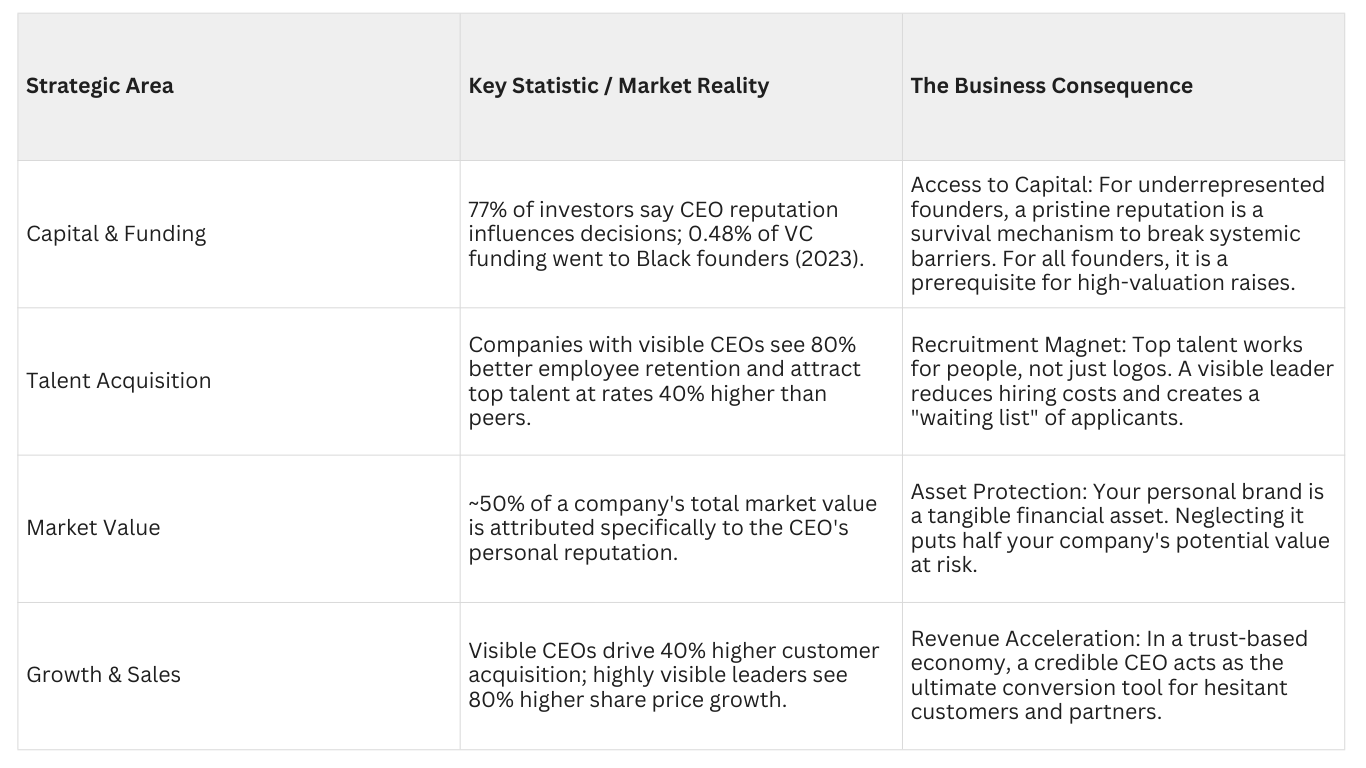
Consider this: 77% of adults say a CEO’s reputation directly influences their willingness to invest in a company. Half of your company’s market value is attributed to your personal reputation. When visible CEOs engage consistently with their audiences, companies experience 40% higher customer acquisition. They attract top talent at rates 40% better than competitors and enjoy 80% improved employee retention.


However, the playing field is not level. Data from 2023 reveals that Black founders received only 0.48% of all venture capital investment in the U.S. This staggering statistic underscores that for underrepresented groups, a pristine, visible, and strategic reputation is not just a bonus. It is a survival mechanism to break through systemic barriers.


As Warren Buffett famously said, “It takes 20 years to build a reputation and five minutes to ruin it.” Yet most founders treat their personal brand as something to address later. They wait until after the product ships, after funding rounds close, or after growth stabilizes. By then, they have missed critical windows where their visibility could have accelerated every business outcome that matters.


Professional founder reputation management is not a vanity exercise or a PR stunt. It is a direct growth lever. It attracts investors, secures top talent, generates customer trust, and unlocks media coverage. It positions you for board roles and speaking opportunities. In a competitive market where stakeholders evaluate founders as much as they evaluate business plans, reputation management is the strategic differentiator. It is the difference between founders who merely survive and those who scale with momentum.


This guide walks you through what founder reputation management really means. We will explore why it is critical to your growth trajectory, the costly mistakes most executives make, and a proven framework to build and protect your reputation strategically.


What Does Professional Founder Reputation Management Mean for CEOs and Founders?


Professional founder reputation management is the deliberate, sustained practice of shaping how your key stakeholders perceive you. This is not just as a leader but as a credible, visionary, and trustworthy force in your industry. It is distinct from corporate communications because it centres exclusively on you, your voice, your values, and your ability to influence.


This is not about crafting a false persona or creating social media vanity metrics. It is about taking control of your narrative. It ensures that what people find, read, and hear about you aligns with who you actually are and where you are taking your company. This is the essence of personal branding through storytelling.


For a SaaS founder raising Series B, this means visible thought leadership that demonstrates you understand market disruption better than competitors. For a manufacturing CEO navigating industry consolidation, it means being quoted in trade publications as an expert voice on operational transformation. For an early-stage founder, it means building your personal brand alongside your company brand. When investors research you, they must find evidence of deep expertise, clear vision, and leadership credibility.


Why Professional Reputation Management Matters Right Now

Three market forces make founder reputation management non-negotiable in 2026.


First, the decision-maker research landscape has transformed. Before meeting you in a pitch room, investors have already Googled you. They have reviewed your LinkedIn profile and assessed your media presence. Employees research CEOs before joining companies. 80% do this explicitly. Partners and customers evaluate your credibility based on your visible expertise and thought leadership. You are being evaluated based on what you have published, what others say about you, and how you show up online. This happens whether or not you are actively managing it.


Second, trust is increasingly personal. In a market saturated with corporate messaging, stakeholders trust people, not logos. When a CEO demonstrates genuine expertise, transparency, and vision, it creates a halo effect that extends to the entire company. Your personal credibility becomes the company’s most valuable asset during capital raises, competitive battles, and organizational scaling. Think of it as Conversion Rate Optimization for your personal trustworthiness.


Third, visibility compounds advantage. A visible CEO attracts business opportunities that passive CEOs never see. Partners approach you. Speaking invitations arrive unsolicited. Journalists quote you as an expert, which naturally aids in organic Backlink Building  for your digital profile. Top candidates apply specifically because they have seen you in action online. Investors move faster because your reputation has already done significant work. This compounds over time. Each piece of visible expertise generates opportunities that create more visibility.


Without active reputation management, you are leaving all this potential on the table while competitors build theirs.


The Common Mistakes Founders and Executives Make With Their Reputation


Before building a strong reputation, it is worth understanding where most executives stumble. These mistakes often cost founders years in their timeline and millions in missed opportunities.


Mistake #1: The Invisibility Trap


The most damaging mistake is remaining invisible. Founders worry about saying the wrong thing. They fear making a mistake on social media or sounding less polished than competitors. So they stay silent. They focus entirely on building the business, assuming the business will speak for itself.


But silence creates a vacuum. Without your voice, others define you. Journalists write narratives without your input. Competitors position themselves as the thought leaders in your space. Decision-makers have no evidence of your expertise. Passive visibility compounds over time, but not in your favour.


Visible CEOs experience 80% higher average annual share price growth compared to their peers. Companies led by CEOs with strong LinkedIn presence are 50% more likely to attract top talent. The cost of invisibility is not staying safe. It is ceding influence and opportunity to competitors who show up.

Mistake #2: Emotional, Unfiltered Responses


The opposite problem is posting reactive, emotionally charged content that damages credibility. A CEO responds to criticism defensively. Another shares an inflammatory take on industry politics. A third makes an off-the-cuff comment that gets misinterpreted across social media.


Once it is published, it is discoverable forever. Potential investors see it. Employees question your judgment. Partners reconsider relationships. Recovery is slow and painful.


Professional reputation management means having a filtering system. Before you publish, ask yourself these questions. Does this reflect my leadership values? Will this be understood the same way in six months? Does this position me as someone investors, customers, and talent want to work with? If the answer is no, do not publish it. This isn’t about being inauthentic. It is about being intentional. Your reputation is built on consistency, not virality.


Mistake #3: Inconsistent Messaging Across Platforms


You tell one story on LinkedIn. You tell another in a podcast interview. You tell a third in your company’s internal communications. Your website says you prioritize innovation, but your recent posts focus entirely on cost management. You talk about company culture publicly while employees describe a different reality internally.


Stakeholders notice these gaps. They signal that either you are not clear on your message or you are managing optics rather than addressing reality. Both destroy credibility.


One example is Netflix. They faced significant reputation challenges when conflicting statements about subscriber numbers came from different executives at different times. The company was not lying, but misalignment created the perception of dishonesty. Proper message alignment could have prevented the credibility damage entirely.


Professional reputation management requires alignment. Your personal brand should reinforce your company’s mission. Your LinkedIn Marketing content should reflect your actual values. Your media interviews should be consistent with your internal leadership. This coherence is what builds trust over time.


Mistake #4: Overlooking Your Personal Brand Entirely


Many successful founders build their company’s brand aggressively while ignoring their own. They assume the company is the asset and the founder is interchangeable. This is a strategic error.


Research shows that 84% of employees acknowledge that a CEO’s personal credibility impacts funding decisions. Board positions, partnership opportunities, and speaking engagements flow to founders with strong personal brands. When you eventually exit or transition, your personal brand becomes your most valuable asset for your next venture. Personal branding is not egotistical. It is strategic. When your personal brand is strong, the company benefits. When it is neglected, the company suffers.


Mistake #5: Failing to Take Accountability When Things Go Wrong


The fastest way to destroy a reputation is to dodge responsibility when problems emerge. Companies face crises like product failures, customer service lapses, employee issues, or market challenges. How a CEO responds defines whether the company recovers or spirals.


CEOs who acknowledge mistakes quickly, communicate transparently about root causes, and take visible action to resolve problems rebuild trust faster. CEOs who deflect blame, minimize the issue, or go silent lose stakeholder confidence rapidly.


Uber recovered from a serious culture crisis because new CEO Dara Khosrowshahi took accountability immediately. He communicated transparently about what needed to change and implemented systematic improvements. Starbucks recovered from a racial incident because leadership responded within 24 to 48 hours with transparency and concrete policy changes. Both leaders rebuilt their personal reputations through accountability.


A Strategic Step-by-Step Approach to Building Professional Founder Reputation

Building a strong professional reputation does not require reinventing yourself. It requires strategic intentionality. Here is the framework that works, utilizing proven frame works to built personal brands.


Step 1: Define Your Reputation Foundation

Before you publish anything, you need clarity on three things: your core values as a leader, your expertise and unique perspective, and the specific outcomes you want your reputation to drive. This defines your Personal brand purpose.


Core values: What do you genuinely believe about leadership, business, and the change you are creating? These should be authentic. They are not the values you think sound good, but the values that actually guide your decisions. A founder who genuinely believes in radical transparency should lead with that. A CEO who prioritizes people should not pretend to be purely metric-driven.


Expertise and perspective: What do you know better than most people in your field? What patterns have you observed that others miss? What unconventional approaches do you use to solve problems? Your reputation should be built on real expertise, not generic leadership platitudes.


Outcomes you are driving: Are you building a reputation to raise capital more easily? To attract world-class talent? To position yourself for board roles? To establish yourself as the authority in your space? Different outcomes drive different strategies. A founder raising Series A needs different reputation positioning than a CEO managing a public company.


This foundation becomes your north star. Every piece of content, every interview, and every speaking engagement should reinforce these core elements.


Step 2: Build Your Platform Architecture

Your reputation lives across multiple platforms, and each serves a different purpose. Do not try to be everywhere. Be strategic about where your key stakeholders live and what each platform enables.


LinkedIn is essential for founder’s reputation. It is where investors, partners, customers, and top talent look for evidence of your expertise. Your profile should be clearly written, visually professional, and include recent activity. Companies with socially active CEOs are 40% more likely to be seen as great places to work and 50% more likely to attract top talent.


Your company blog or owned platform gives you a place to develop ideas without algorithm constraints. Long-form thought leadership that educates your audience builds authority faster than social media soundbites.


Speaking engagements position you as an expert while reaching concentrated audiences of decision-makers. Industry conferences, podcasts, webinars, and panel discussions are powerful visibility channels.


Media coverage offers third-party credibility that self-published content cannot match. Journalists quote you as an expert, which positions you as an authority to audiences who would not otherwise find you.


Your personal network remains the most powerful platform. Relationship capital with investors, customers, and peers drives opportunities that algorithms cannot create. Build your platform systematically rather than trying to dominate everywhere. Depth on the platforms where your stakeholders are concentrated beats shallow presence everywhere.


Step 3: Develop Your Content and Messaging Strategy

This is where many founders get stuck. They understand they should be visible, but they do not know what to say.


Start with three to five content pillars. These are themes that connect to your expertise and the outcomes you are driving. For a SaaS founder, these might be product strategy, engineering culture, AI disruption in your space, hiring and retention, and founder lessons learned. For a manufacturing CEO, they might be industry consolidation, operational excellence, supply chain innovation, workforce development, and sustainable operations.


Within each pillar, develop a Content & Storytelling strategy that educates first and promotes second. The most effective thought leadership teaches your audience something valuable, then demonstrates why your company or approach is the answer.


LinkedIn content that works does not lecture. It tells stories. It shares frameworks. It raises counterintuitive questions. It acknowledges problems honestly. CEO Stephen Mostrom, who ghostwrites for multiple executives with massive followings, notes that the most common mistake is using overly formal, corporate language that sounds like lectures. Relatable LinkedIn content generates up to 40% more engagement than dry, impersonal updates.


Your content should also be evidence-based. Do not make claims you cannot back up. Include data, reference sources, and provide proof points. In an era of AI-generated content, authenticity and substance stand out. Utilizing a Content system from book based strategies can help structure this effectively, as Authors make better personal brand strategists due to their grasp of narrative arcs.


Step 4: Choose Your Execution Model

You have three primary options for executing this strategy.


Self-execution: You write your own posts, pitch yourself for speaking engagements, and manage your brand directly. This offers maximum authenticity but requires significant time investment. Most busy founders cannot sustain this.


Ghostwriting partnership: You partner with a professional ghostwriter or agency like Ohh My Brand, which specializes in CEO positioning, ghostwriting, LinkedIn growth, and thought leadership. They capture your voice and insights and publish consistently on your behalf. This removes the time barrier while maintaining authenticity if done correctly. The ghostwriter should spend time understanding how you think, not just publishing generic executive content.


Agency partnership: A full-service personal branding agency manages your entire reputation platform. This includes strategy, content, media relations, speaking opportunities, and crisis management. This approach offers the most comprehensive support but requires higher investment and less direct involvement. You might also consult a Personal Branding Consultant or an SEO Consultant to ensure your digital footprint is optimized.


Most successful founder reputation management uses a hybrid approach. You stay visibly involved in speaking, high-stakes media interviews, and strategic direction, while a professional partner handles consistent content creation and platform management.


Step 5: Measure and Optimize Based on Results

Your reputation management should drive measurable business outcomes. Track metrics like media mentions and share of voice. Are you getting quoted in relevant publications? Are media mentions increasing? Is the sentiment positive?


Track speaking invitations. Are you receiving more opportunities to speak at conferences and on podcasts? Monitor professional network growth. Is your LinkedIn following growing with engaged professionals in your target audience?


Assess talent acquisition. Is your visibility generating inbound candidate applications? Are top candidates citing your visibility as a reason they want to join? Check investor interest. Are you getting inbound investor inquiries? Are funding conversations progressing faster?


Look for board and advisory opportunities. Are you receiving offers for board positions, advisory roles, or other high-profile engagements? Evaluate customer trust signals. Are customers more confident in your company because of your visible leadership?


Do not get distracted by vanity metrics like total followers or likes. Focus on outcomes that actually drive business growth. If your reputation management is not generating leads, attracting talent, or building investor confidence, the strategy needs adjustment.


Real-World Founder Reputation Management Scenarios


Let’s walk through how this plays out in different situations.

Scenario 1: The Early-Stage SaaS Founder Raising Series B


Maya founded a data analytics platform two years ago. Product-market fit is clear, but she is competing against well-funded competitors for the same investors. Her Series A was a struggle because she was unknown.


For Series B, she decides reputation matters. She uses Frame works to built personal brands to identify her three content pillars: data democratization, engineering culture at startups, and lessons from early-stage fundraising. She starts publishing LinkedIn posts weekly, sharing frameworks she has developed and insights from her fundraising journey. She pitches herself for industry podcasts and lands three guest appearances. She writes a feature article for a well-known founder publication about building engineering teams without burning them out.


Six months into this visibility push, something shifts. Investors begin the Series B conversations already familiar with her thinking. They reference her LinkedIn posts. They have heard her on podcasts. They know her perspective. The conversations move faster because she has already established credibility. Her visibility does not guarantee funding, but it materially accelerates the process.


Scenario 2: The Manufacturing CEO Managing Industry Consolidation

James runs a mid-market manufacturing company. The industry is consolidating, and larger players are making acquisition offers. He wants to position his company as a strategic growth partner, not a distressed acquisition. He also wants to attract top operational talent who understand transformation.


He develops a reputation strategy focused on sustainable manufacturing, supply chain innovation, and leadership during industry change. He starts contributing to industry publications. He speaks at manufacturing conferences about supply chain resilience. He publishes insights on his LinkedIn about the future of the industry.


Within a year, his visibility shifts how the industry sees his company. Acquisition offers improve because he has positioned his company as a strategic player, not a passive target. Top operational talent starts reaching out because they have seen him speak and want to work for someone with a clear vision. His reputation becomes a negotiating asset.

Scenario 3: The Founder Who Made Mistakes

Chris built a successful app company, but his public persona includes some problematic posts from earlier years. These include reactive tweets during industry controversies, overly aggressive competitive positioning, and a few comments that now seem insensitive. He has changed and grown, but his reputation is partially defined by this history.


He develops a reputation recovery strategy. Rather than ignoring the past, he acknowledges growth explicitly. In interviews, he talks about learning from mistakes. He demonstrates through recent behaviour and content that his perspective has evolved. He focuses on new content on values-driven leadership and building inclusive teams. He takes on mentorship roles that demonstrate his commitment to lifting others.


Recovery is slower than if he had never made mistakes, but consistent, authentic repositioning works. His reputation gradually becomes defined by his current thinking and behaviour, not historical missteps.


Where Professional Personal Branding Agencies Support Founder Reputation Management


This is where specialized expertise makes a difference. Building a strong reputation requires strategic thinking, consistent execution, and platform relationships that most busy founders do not have time to develop.


Agencies like [Ohh My Brand specialize in CEO positioning, founder branding, and executive reputation management. They provide several critical services.


Strategy and positioning: Rather than generic thought leadership, they develop Bestselling frameworks for personal brands that differentiate you from competitors and align with your business goals. They identify white space in your industry where you can establish unique authority.


LinkedIn ghostwriting and content: They capture your voice through interviews and conversations, then publish consistent, engaging content that drives visibility. This removes the time barrier while maintaining authenticity.


Thought leadership development: They help you develop deeper insights and frameworks that position you as a forward-thinking leader. They place those ideas in prestigious platforms where they reach high-level decision-makers. They may even offer Ebook Writing Services to help you publish comprehensive guides.


Speaking opportunity sourcing: They leverage relationships with conference organizers, podcast hosts, and event planners to create speaking opportunities that build your visibility with target audiences.


Media relations: They pitch you to journalists as an expert source, securing coverage that would take years to develop independently.


Personal PR and crisis management: When reputation challenges emerge, they develop response strategies that protect and rebuild your credibility.


Executive visibility measurement: They track how your reputation changes over time, measuring impact on media mentions, speaking invitations, talent attraction, and investor interest.


The ROI is significant. Companies with visible CEOs experience measurable improvements in hiring, customer acquisition, and investor confidence. When you factor in the business value of faster capital raises, better talent, and more customer trust, professional reputation management investment pays for itself many times over.


Implementation Checklist for Executives

Use this checklist to start building your reputation strategically.

Foundation (Complete first)

  • Define your three to five core leadership values.
  • Articulate your key areas of expertise.
  • Identify specific business outcomes you want reputation to drive.
  • Audit your current online presence. Google yourself and review your LinkedIn profile.
  • Identify your target audiences. This includes investors, customers, talent, partners, and media.


Platform Architecture

  • Optimize your LinkedIn profile with a professional photo, clear headline, compelling bio, and recent activity.
  • Establish a platform for longer-form content such as a blog, Medium, Substack, or LinkedIn newsletter.
  • Identify three to five relevant speaking platforms or podcast shows.
  • List ten to twenty relevant journalists and publications in your space.
  • Map your professional network, including investors, partners, and peers you want to deepen relationships with.


Content and Messaging


  • Develop three to five content pillars connected to your expertise.
  • Create a messaging framework for each pillar with key points, supporting examples, and relevant data.
  • Identify existing insights, frameworks, or lessons learned you can share.
  • Plan the first month of content ideas across platforms.
  • Establish a consistent publishing schedule. LinkedIn: weekly. Blog: bi-weekly. Speaking: quarterly target.


Execution Model


  • Decide whether to self-execute, hire a ghostwriter, or partner with an agency.
  • If ghostwriting, have initial conversations and clarify what voice/style you are trying to achieve.
  • If agency, define scope, outcomes, and success metrics in writing.
  • Set calendar reminders for the content approval/review process.
  • Establish a feedback loop to refine what is working.


Measurement and Optimization


  • Set baseline metrics: current LinkedIn following, media mentions, speaking invitations.
  • Define primary KPIs. Is it media mentions? LinkedIn engagement? Speaking offers? Inbound investor interest?
  • Set up a monthly tracking spreadsheet or dashboard.
  • Schedule a quarterly review to assess progress and adjust strategy.
  • Connect reputation metrics to business outcomes. Has hiring improved? Is the investor pipeline stronger?


Frequently Asked Questions About Founder Reputation Management

Q: How long does it take to build a strong professional reputation?

A: Most executives see meaningful traction within 3 to 6 months of consistent effort. Media coverage, speaking invitations, and business impact typically follow 6 to 12 months of visibility building. Long-term compounding benefit builds over the years. Start now, even if you are not expecting immediate results.


Q: What if I don’t have time to manage this myself?

A: That is actually the norm. Most successful founders delegate reputation management to professionals while staying involved in strategy and major speaking/media opportunities. Your time is better spent building the business. Professionals can build your visibility more efficiently.


Q: Should I focus on LinkedIn, personal blog, or speaking?

A: Start with LinkedIn because that is where decision-makers research you. Add one other platform based on your audience. Use speaking for B2B thought leadership, Twitter/X for real-time industry conversations, or a blog for deeper ideas. Do not try to be everywhere.


Q: What if I’ve made mistakes publicly that hurt my reputation?

A: Reputation recovery is possible through consistent, authentic repositioning. Focus recent content on your evolved thinking and demonstrated behaviour. Use media interviews to acknowledge growth. Do not hide the past, but do not dwell on it either. Time and new behaviour gradually redefine how people see you.


Q: How do I balance authenticity with strategy?

A: The best reputation management is both authentic and strategic. You are not creating a fake persona. You are being intentional about which authentic parts of yourself you share. Share genuine insights, real challenges, and honest perspectives. Just be thoughtful about how you frame them.


Q: What’s the difference between self-promotion and thought leadership?

A: Thought leadership educates, challenges, and provides value to your audience first. It builds authority through substance, not by talking about yourself constantly. Self-promotion is all about your company’s features and your accomplishments. Lead with what you know and what your audience should learn. Your credibility follows naturally using Book frameworks for linkedin brand building.


Q: Should my personal brand be separate from my company brand?

A: They should be complementary. Your personal brand should reinforce your company’s mission without being identical. You can have personal interests and perspectives that are not directly company-related. But your core values and professional positioning should align.


Q: How do I respond to criticism or negative coverage?

A: Do not respond emotionally or reactively. Take 24 to 48 hours to process. If the criticism is factually incorrect, address it factually with evidence. If it raises a legitimate concern, acknowledge it and explain what you are doing about it. If it is an opinion you disagree with, you usually do not need to respond at all. Staying composed and evidence-based is more powerful than arguing.


Q: What’s the ROI of reputation management?

A: That depends on your goals. For capital raising, a strong reputation can accelerate funding timelines by 6 to 12 months and improve deal terms. For talent, visible CEOs attract better candidates and improve retention by 15% to 30%. For customers, reputation builds trust and improves customer acquisition and lifetime value. For partnerships and opportunities, visibility opens doors that do not otherwise exist. The compounding ROI is significant if you measure against real business outcomes.


Q: How do I get media coverage when I’m not famous?

A: Start by being a resource. Build relationships with journalists in your space. Share relevant expertise without expecting coverage. Pitch yourself as a source for upcoming trends or challenges in your industry. Guest post for established publications. Appear on podcasts. These activities build relationships and credibility that eventually lead to direct media coverage.


Conclusion: Make Your Reputation Your Competitive Advantage

In a market where every founder claims to be visionary and investors evaluate leadership as much as business models, professional founder reputation management is the concrete differentiator. It is not optional. It is essential for any founder serious about scaling with speed and attracting the best people, capital, and opportunities.


The founders winning in 2026 understand that their personal reputation is a business asset, as important as their product, team, and market position. They are intentional about how they are perceived. They build visibility strategically. They invest in professional support to execute at scale. They measure impact on business outcomes.


You do not need to be famous to build a powerful reputation. You need to be strategic, consistent, and authentic about sharing your expertise and leadership perspective. You need to show up where your stakeholders are looking. You need professional support to scale this beyond your personal capacity.


If you are ready to transform your reputation into a competitive advantage, Ohh My Brand specializes in exactly this work. As a leading global personal branding agency, we partner with CEOs and founders to develop strategic positioning, execute consistent visibility building, place thought leadership in prestigious platforms, and measure impact on your business outcomes. We have helped founders accelerate fundraising timelines, attract world-class talent, secure speaking opportunities, and build the credibility that compounds into lasting advantage.


Founder reputation management is not a luxury. It is a growth lever. Let’s build yours. Connect with Bhavik Sarkhedi to explore a structured, results-driven approach to executive personal branding.


How Can CEOs Improve Visibility and Authority in Their Market?

Imagine you are the captain of a massive, state-of-the-art ship. You have the best engines and the most skilled crew. However, if you sail in the dead of night with your lights off, no one will know you are there until they crash into you. In the modern business landscape, being the best CEO is no longer enough. You must also be the most visible one.


Think of your visibility as the lighthouse that guides investors, talent, and customers safely to your shores. Your personal brand has become your company’s most powerful asset. It influences how investors evaluate your business, how talent chooses to work with you, and how customers decide to trust your brand. Yet, most CEOs remain hidden behind their companies. They let their leadership impact go unrecognized while competitors build public authority that attracts opportunities, funding, and talent.


As Warren Buffett famously said, “It takes 20 years to build a reputation and five minutes to ruin it.” In the digital age, it also takes strategic effort to ensure that reputation is actually seen.


The challenge is real. You are running a business. You do not have time for vanity projects, influencer tactics, or generic thought leadership that adds no real value. What you need is a strategic, business-focused approach to CEO visibility and authority. This approach positions you as an undisputed leader in your field while driving measurable business outcomes. This is not about getting famous. It is about becoming undeniable.


This is precisely where modern executive branding comes in. Agencies like Ohh My Brand specialize in helping CEOs and founders build visibility and authority that translates into real business leverage. This includes attracting investors, securing top talent, earning media coverage, and opening doors to speaking opportunities. But before diving into agency support, let’s explore the complete strategic framework for CEO visibility and authority development.


What Does CEO Visibility and Authority Mean for Executives and Founders?

CEO visibility is not about personal vanity or ego. It is a business strategy with measurable returns. When you are visible as a leader, three critical things happen. First, your market recognizes you as an authority worth listening to. Second, key stakeholders actively seek your insights and perspective. Third, your company gains a competitive advantage through the credibility and trust you have personally established.


Authority is the perception that you do not just have opinions but proven expertise backed by results, data, and real-world success. An authoritative CEO is someone journalists call for expert commentary. They are someone investors listen to during pitches. They are someone talented professionals want to work for and someone customers trust at higher price points.


Here is what makes this matter strategically:


Statistics showing 44% of a company’s market value is attributed to CEO reputation vs 56% other factors


Investor Confidence and Fundraising

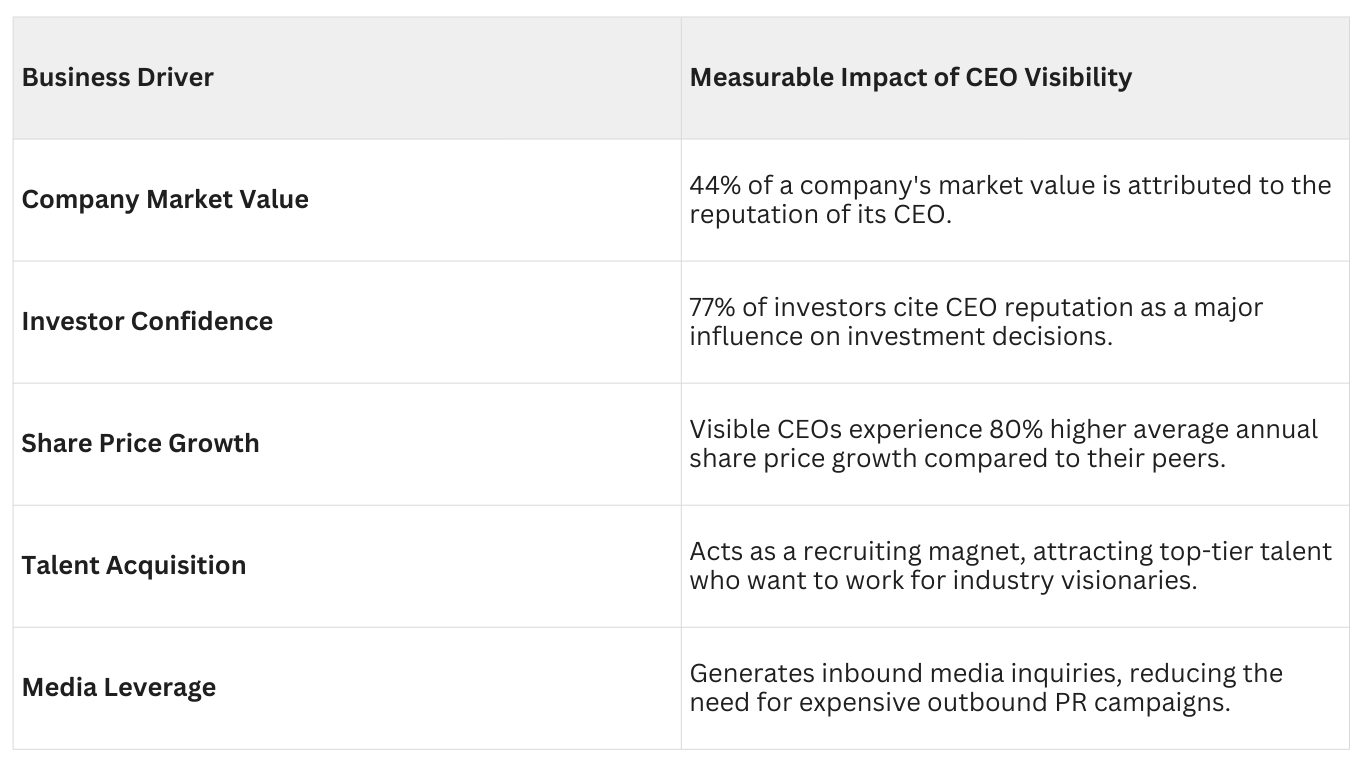
Data supports the need for visibility. According to a Weber Shandwick study, 44% of a company’s market value is attributed to the reputation of its CEO. Furthermore, 77% of investors say a CEO’s reputation influences their decision to invest in a company. When you are a visible, authoritative CEO, you dramatically improve your ability to raise capital. Investors are not just evaluating spreadsheets. They are evaluating you. 


A CEO with a strong public presence signals vision, strategic thinking, and the ability to execute. This translates into better terms, faster fundraising cycles, and higher valuations. Additionally, visible CEOs experience 80% higher average annual share price growth compared to their peers.
Talent Acquisition and Retention

The war for talent is fierce. A CEO with industry authority becomes a recruiting asset. Exceptional talent wants to work for leaders they respect and learn from. When your CEO brand is strong, you attract top-tier employees who view working with you as an opportunity to grow alongside a visionary. Beyond recruitment, employees who see their CEO actively engaged in thought leadership feel more connected to the company’s mission. This leads to higher engagement and retention.


Market Positioning and Customer Trust

In crowded markets, trust is your most valuable currency. A CEO known for deep expertise builds customer loyalty that advertising simply cannot buy. Your personal authority becomes a trust marker for your products and services, acting as a form of high-level Conversion Rate Optimization for your brand’s reputation. Customers are more likely to invest in companies led by CEOs they perceive as credible, knowledgeable, and aligned with their values.


Media Coverage and PR Amplification

Media outlets constantly seek expert voices for stories, interviews, and commentary. When you are a visible, authoritative CEO, journalists reach out to you instead of you chasing them. This inbound media attention provides third-party validation of your expertise. It offers massive visibility amplification at virtually no cost. One feature in a major publication reaches thousands of potential customers, partners, and investors.


Speaking Opportunities and Industry Leadership

Visible CEOs get invited to speak at major conferences, participate in industry panels, and lead prestigious events. These speaking platforms further amplify your authority. They expand your network exponentially and position you as a leader who shapes industry conversations rather than simply following them.


Board Positions and Strategic Partnerships

As a CEO with proven visibility and authority, you become attractive for board positions at other companies. You open doors to advisory roles and high-level strategic partnerships. These opportunities expand your influence network and create additional revenue or strategic value streams.


The business case is undeniable. CEO visibility and authority directly drive business growth, competitive advantage, and long-term wealth creation.


Common Mistakes Executives Make in Building Their Visibility

Before we discuss what works, let’s examine what doesn’t. Most CEOs fail at building visibility and authority because they make preventable mistakes. These errors either prevent them from starting or derail their efforts once underway.


The Invisibility Trap: Thinking You Don’t Have Time

The most common mistake is the belief that visibility is a luxury when you are busy running a business. This could not be further from the truth. The CEOs who are “too busy” to build a public brand are making a strategic error that costs them millions in lost opportunities. 


Visibility does not require 10 hours a week. It requires strategic focus, often supported by a Personal Branding Consultant or services like LinkedIn ghostwriting. One well-crafted LinkedIn post per week, one speaking engagement per quarter, and one media placement per month can completely transform your positioning.


The Authenticity Pretense: Fake Authority Building

CEOs sometimes attempt to build authority through exaggeration, borrowed insights, or generic “thought leadership” that adds no real value. This backfires spectacularly. Today’s audiences are sophisticated. They can smell inauthenticity instantly. The most powerful authority comes from personal branding through storytelling, sharing genuine insights from your real experience, your actual failures, and your authentic perspective on your industry. This is harder than claiming false expertise, but it is the only sustainable approach.


Inconsistent Messaging Across Platforms

A CEO who says one thing on LinkedIn, something different in interviews, and contradictory information in company meetings destroys credibility faster than silence would. Your personal brand messaging must align with your company’s brand values. All communication channels must reinforce a consistent narrative. This consistency extends to ethics, values, and business practices. If your company claims to value sustainability while your personal investments prioritize extraction, stakeholders will notice.


Neglecting the Right Channels and Formats

Not all visibility is created equal. Some CEOs invest time in platforms where their audience does not gather. LinkedIn is essential for B2B CEOs and enterprise founders. Twitter/X works for tech leaders and thought commentators. Industry conferences matter for manufacturing and industrial CEOs. Podcasts reach niche audiences. You do not need to be everywhere. You need to be dominant where your stakeholders actually spend time.


Overpromising and Underdelivering

When you build a public visibility platform, every promise you make publicly is scrutinized. The gap between what you say you will do and what you actually deliver is a trust destroyer. CEO visibility amplifies both your credibility and your failures. This is why authentic, grounded communication matters more than ambitious claims.


Treating Visibility as a Marketing Campaign Rather Than a Business Practice

The biggest mistake of all is approaching CEO visibility as a short-term campaign. Leaders often say, “Let’s do three months of social media and see what happens.” Real CEO authority is built over years through consistent, strategic effort. Think of it as part of your job as CEO, not an additional project. This mindset shift changes everything about how you approach it.


Ignoring the Reputation Risk Landscape

In 2026, the stakes of visibility are higher than ever. AI-generated deepfakes, cancel culture, and misinformation create new risks for visible leaders. Many CEOs neglect reputation management until a crisis hits. Proactive reputation management must happen continuously, not reactively. This involves monitoring mentions, managing online reviews, addressing issues quickly, and building a strong positive narrative.


The Strategic Approach to CEO Visibility and Authority

Building CEO visibility and authority requires a structured, multi-layered approach. This is not about doing one thing. It is about orchestrating a coherent strategy across multiple channels and formats that all reinforce your positioning as an authoritative leader.


Step 1: Establish Your Authentic Positioning and Unique Perspective

Before you do anything public, you must first do the internal work of clarifying who you are. You must define what you believe and what unique perspective you bring to your industry.


Start with radical self-assessment. What are you genuinely expert at? Not what you wish you were expert at, but what you actually know deeply because of real experience. What lessons have you learned that others in your industry haven’t? What do you believe about the future of your market that goes against conventional wisdom? What Personal brand purpose drives your decision-making as a leader?


This positioning must be authentic. The most compelling CEO brands are not built on manufactured personas. They are built on honest expressions of who someone actually is. Richard Branson’s brand works because it authentically reflects his adventurous personality and values-driven approach. Satya Nadella’s authority comes from genuinely deep technical understanding combined with authentic belief in inclusive leadership. Sheryl Sandberg’s thought leadership resonated because she was speaking from lived experience.


  • Your positioning should clarify:
  • Your genuine area of expertise: What specific domain can you speak authoritatively about?
  • Your leadership philosophy: What principles guide your decision-making as a CEO?
  • Your point of view on industry trends: What do you see happening in your market that others miss?
  • Your values: What causes, principles, and outcomes matter most to you?
  • Your audience: Who specifically do you want to influence?


This positioning becomes the anchor for everything else. Understanding frame works to built personal brands helps ensure every piece of content, every speaking engagement, and every media interview connects back to this core positioning.


Step 2: Optimize Your Foundational Digital Presence

Your digital presence is the home base where all your visibility efforts converge. It must be optimized to immediately establish credibility and authority.


LinkedIn Profile Optimization

For most CEOs, LinkedIn is your primary platform. Effective LinkedIn Marketing starts with your profile doing more than listing your job title. It should immediately communicate your unique value and authority. 


This includes:

  • A professional but personable profile photo that conveys approachability and confidence.
  • A compelling headline that goes beyond your title (“CEO at X” is weak; “Building the Future of Enterprise Software Through AI” is stronger).
  • A summary that tells your story, communicates your point of view, and explains why people should care about your insights.
  • Evidence of expertise: articles written, speaking engagements, media appearances, awards.
  • Clear calls-to-action for people who want to connect or learn more.
  • Your LinkedIn presence should not look like a resume. It should look like the public face of a thought leader.


Company Website Leadership Section

Your company website should feature you prominently, not as a footnote. Many prospects and investors visit company websites. The CEO bio section should communicate your experience, vision, and unique perspective. Include a professional photo, your leadership philosophy, key achievements, and media appearances.


Media Kit Development

Create a professional media kit that includes high-resolution photos, your biography (short and long versions), key credentials, areas of expertise, and previous media appearances. When journalists are researching you for an interview or feature, they should be able to find everything they need on one easy-to-download document. This removes friction from media placements.


Step 3: Build Your Thought Leadership Content Engine

Content is the fuel of CEO visibility. You need a consistent stream of valuable insights that establish your expertise, provide real value to your audience, and keep you top-of-mind with key stakeholders.


Determine Your Content Format Mix

Not all CEOs should be writing long-form blog posts. Not all should be on every social media platform. The key is choosing content formats that:


Play to your strengths. Some CEOs are natural writers, while others are dynamic speakers or excel in long-form conversation.

  • Reach your target audience where they spend time.
  • Can be sustained consistently over time.
  • For most B2B CEOs, the content foundation looks like:
  • LinkedIn posts: 2-4 per week, sharing insights, perspectives, lessons learned, and industry observations.
  • Long-form content: A monthly article (1,500-3,000 words) on your company blog or Medium.
  • Speaking engagements: 4-6 speaking opportunities per year at industry conferences, webinars, or exclusive forums.
  • Media appearances: Regular interviews, commentary, and contributions to high-authority publications.
  • Podcast appearances: Guest appearances on industry-relevant podcasts (one every 1-2 months).


Content Production Approach


Here is the hard truth: most CEOs cannot produce this volume of quality content themselves while running a company. This is where professional support like Ohh My Brand’s LinkedIn ghostwriting service becomes invaluable. A ghostwriter works with you to understand your authentic voice, your unique perspective, and your strategic goals. They then produce Content & Storytelling that sounds exactly like you but eliminates the time burden. This allows you to maintain a powerful content presence without neglecting your core CEO responsibilities.


Whether you use a ghostwriter, a content agency, or your own content team, the key is that your content must:


  • Reflect genuine insight: Share what you actually know. This might be lessons from failures, unconventional perspectives on industry trends, or breakthroughs you have discovered.
  • Provide real value: Avoid self-promotional content. Your content should educate, inform, or provoke thought in your audience. When you focus on value first, authority naturally follows.
  • Be consistent: The compounding effect of consistent content over months and years is what builds real authority. A single viral post does not create lasting influence, but years of valuable insights do.
  • Encourage engagement: Ask questions, invite diverse perspectives, and actively engage in comments. This builds community around your thought leadership.
  • You might even consider Ebook Writing Services to compile your methodology into a comprehensive guide, further cementing your status as an expert using a Content system from book based strategies.


Step 4: Secure High-Authority Media Placements and Speaking Opportunities

Content you create is important, but third-party validation through media coverage and speaking invitations is what truly establishes authority. When journalists, conference organizers, and podcast hosts seek you out, it signals that your expertise is recognized and valued.


Strategic Media Relations

Building media visibility requires a strategic approach:


  • Identify target publications: Where does your target audience read? Where do decision-makers in your industry gather for insights? Create a list of 20-30 high-authority publications that matter for your market.


  • Build relationships with journalists: Do not pitch immediately. Build relationships first. Follow journalists who cover your space on LinkedIn and Twitter, engage thoughtfully with their content, and share their articles. Offer helpful information without asking for anything. Over time, as you become a trusted resource, they will reach out to you.


  • Develop compelling story angles: Journalists are not interested in your company press releases. They are interested in stories that matter to their audience. What is a novel perspective you have on an industry trend? What is a contrarian take that challenges conventional wisdom? What data or insights do you have that would surprise their readers?


  • Pitch with precision: When you do pitch, personalize every email. Reference a specific article the journalist wrote. Explain exactly why your story is relevant to their beat and their audience. Include a compelling “hook” to explain what makes this newsworthy.


High-authority media placements, Forbes, Harvard Business Review, Wall Street Journal, industry-specific publications, provide massive credibility amplification and are a prime form of Backlink Building for your digital footprint. Even one feature article in a top-tier publication dramatically enhances your authority profile.


Speaking Engagement Strategy


  • Speaking at industry conferences and exclusive forums is one of the fastest ways to build executive authority. Conference organizers specifically seek speakers who have demonstrated expertise and visibility. Once you start speaking, opportunities multiply.


  • Target strategic conferences: Focus on conferences where your decision-making audience gathers. For SaaS CEOs, this might be industry-specific events. For manufacturing leaders, trade shows. For corporate innovators, leadership summits.


  • Apply for speaking slots: Most major conferences have open calls for speakers. Submit proposals that position you as speaking on areas of genuine expertise.


  • Leverage speaking success: Each speaking engagement becomes content. Record it, share clips, add it to your media kit and LinkedIn profile, and use it to attract more speaking invitations.


Step 5: Master LinkedIn Growth and Engagement

For most CEOs, LinkedIn is the primary visibility platform. It is where business decision-makers spend time, where media professionals find experts, and where your professional network gathers.


Strategic LinkedIn Growth

Growing your LinkedIn network strategically matters because:


  • More connections equal a larger audience for your thought leadership content.
  • A larger audience equals more opportunities for your content to reach decision-makers, investors, and journalists.
  • Visibility in LinkedIn’s algorithm means your posts reach further.


Growth happens through:


  • Consistent, valuable content: Posts that get engagement increase your visibility in LinkedIn’s algorithm.
  • Authentic networking: Connecting with people in your industry, other founders and CEOs, investors, and journalists.
  • Engagement on others’ content: Like, comment on, and share other leaders’ content. This builds visibility and relationships.
  • Profile optimization: A strong profile that communicates your authority attracts connection requests.
  • The goal is not vanity metrics. It is building an audience of people who matter for your business: potential investors, media professionals, potential customers, and industry peers.


LinkedIn Content Strategy


Successful LinkedIn CEOs typically post:


  • Perspective pieces: Your viewpoint on industry trends, market shifts, or future direction.
  • Lessons learned: Both victories and failures. Vulnerability creates connection.
  • Data and insights: Share research, data points, or observations that inform your industry.
  • Company and team wins: Celebrate achievements without being self-promotional.
  • Questions and provocation: Ask your network what they think about emerging trends.
  • Personal dimension: Share aspects of your leadership philosophy, your values, and why certain issues matter to you.


The combination creates a compelling feed that demonstrates expertise, builds trust, and creates opportunities.


Real-World CEO Visibility Scenarios

Theory is useful, but real-world application is what matters. Here are three distinct scenarios showing how different CEOs might approach visibility and authority building based on their situation and market.


Scenario 1: The B2B SaaS Founder Seeking Series B Funding

The Situation: Sarah is the CEO of a growing B2B SaaS company. She has raised a successful Seed round and is preparing for Series B fundraising. Her company has strong product-market fit and growing revenue. However, venture capital investors tell her they need to see more founder visibility and thought leadership before committing to larger investment rounds.


The Challenge: Sarah is spending 80% of her time on product, fundraising, and operations. She has zero time for thought leadership and no background in marketing or PR.


The Strategy:


Sarah starts by working with a ghostwriter to establish a LinkedIn presence that positions her as a thought leader in her specific domain, perhaps AI-enabled customer operations. She does not claim to be an AI expert. Instead, she positions herself as someone solving real customer problems using AI, with insights from her users’ actual experiences. She uses Bestselling frameworks for personal brands to structure her narrative effectively.


She commits to 2-3 LinkedIn posts per week that share:


  • Lessons learned from building her company.
  • Insights from customer conversations about how businesses are using AI.
  • Her perspective on where the customer operations market is heading.
  • Key hiring and company-building lessons.


Within 3 months of consistent, authentic content, her LinkedIn engagement grows. Industry peers start engaging with her posts. A journalist covering AI in business reaches out after seeing her perspective on a trend. She lands a guest article in a respected tech publication.


For speaking, she targets emerging founder platforms and industry conferences. She submits a proposal to speak on the panel “Building Sustainable SaaS Companies in Uncertain Economies,” positioning herself as an experienced founder, not just a new company.


Within 6 months, her founder visibility has shifted. When she enters Series B discussions with investors, they have seen her LinkedIn presence, read her published article, and potentially heard her speak. This changes the dynamic. She is no longer unknown. She is a founder with proven thought leadership in her market.


The outcome: Stronger Series B negotiations, higher valuations, and easier investor meetings because the groundwork of visibility is already done.


Scenario 2: The Manufacturing CEO Building Authority in a Traditional Industry

The Situation: Robert is the CEO of a 40-person manufacturing company specializing in industrial components. His market is traditional, and his audience is other manufacturing executives and supply chain decision-makers. He is considered credible within his network but virtually unknown nationally. He wants to position himself as a thought leader in sustainable manufacturing and modern supply chain optimization.


The Challenge: Manufacturing is not known as a “content-native” industry. LinkedIn is used in manufacturing, but podcast culture and traditional media coverage are less common. Robert has limited time and is skeptical about social media as a business tool.


The Strategy:

Robert’s visibility strategy focuses on the channels where manufacturing decision-makers actually spend time:


  • Industry conferences and trade shows: He commits to sponsoring and presenting at 2-3 major manufacturing and supply chain conferences per year. He positions himself as speaking on “Balancing Efficiency and Sustainability in Modern Manufacturing Supply Chains.”
  • Industry publications: Manufacturing has long-standing, highly respected publications that decision-makers read. He targets these with thoughtful, substantive articles on supply chain challenges and solutions.
  • LinkedIn, but focused: Rather than obsessive daily posting, he posts 1-2 times per week with content specifically relevant to manufacturing leaders—industry trends, supply chain insights, and sustainability challenges.
  • Hosting events: He hosts an annual manufacturing roundtable forum where 30-40 key executives discuss pressing industry challenges. This positions him as a community leader and creates owned-media opportunities.
  • B2B PR: He works with a PR firm experienced in manufacturing to place stories about his company’s innovations in industry media.


Within a year, Robert becomes known within manufacturing circles as a thought leader on sustainable supply chain practices. This leads to board opportunities, speaking invitations at other forums, consulting inquiries, and stronger customer positioning.


Scenario 3: The Healthcare Executive Building Trust and Authority in a Regulated Market


The Situation: Dr. Maya is the CEO of a healthcare company operating in a regulated, compliance-heavy space. Her market demands deep expertise and absolute trust. Her customers are healthcare institutions and government agencies. Traditional PR is limited because of healthcare regulations around marketing and claims.


The Challenge: Healthcare is heavily regulated. False claims or missteps can create legal and reputational problems. Her customer base is highly specialized. Generic thought leadership does not resonate.


The Strategy:


Maya’s visibility strategy is highly specialized and compliance-aware:


  • Speaking at healthcare forums: She focuses exclusively on speaking at healthcare-specific conferences, medical associations, and health system leadership forums. Her speaking positions her as an expert in her specific healthcare niche.
  • Published research and whitepapers: Rather than general thought leadership, Maya publishes research on specific healthcare challenges her company addresses. These whitepapers provide value to healthcare institutions while demonstrating her expertise.
  • Peer relationships and referrals: In healthcare, relationships between CEOs and institutional leaders are crucial. She invests heavily in building peer relationships through selective networking, advisory boards, and speaking forums.
  • LinkedIn thought leadership, carefully crafted: Her LinkedIn posts focus on lessons learned, healthcare leadership insights, and evidence-based perspectives. All content is reviewed for regulatory compliance before posting.
  • Industry association leadership: She takes a leadership role in a healthcare-focused industry association, increasing her visibility and credibility within the healthcare ecosystem.


Over time, Maya becomes known as a trustworthy, expert-level leader within healthcare circles. This leads to board positions, consulting inquiries, speaking invitations, and customer referrals from peer institutions.


Where Executive Branding Agencies Support This Strategy

The visibility strategies outlined above are powerful, but they require execution. This is where professional support becomes invaluable. Ohh My Brand and agencies like it specialize in helping CEOs and founders execute CEO visibility and reputation management strategies without diverting leaders from core business responsibilities.


LinkedIn Ghostwriting and Content Creation

One of the most impactful services is professional LinkedIn ghostwriting. Here is what this actually means: You work with an expert writer who understands your voice, your expertise, and your strategic goals. This ghostwriter produces your LinkedIn content, manages your profile, and handles the day-to-day content publication. You review and approve content, providing input and direction, but the actual creation and posting happens without consuming your time.


The benefit is profound. Instead of spending 5-10 hours per week trying to create content, you spend 30 minutes per week reviewing ghostwritten content. Your LinkedIn presence remains active, authentic, and strategically aligned, but at a fraction of the time cost. Since Authors make better personal brand strategists, using a professional writer ensures your narrative is compelling.


Thought Leadership Positioning and Strategy

Agencies like Ohh My Brand help CEOs clarify their positioning, identify their unique perspective, and develop a strategic thought leadership plan. This strategic foundation is critical because without it, content creation becomes random and ineffective.


Media Relations and PR

Professional PR teams have relationships with journalists, understand which media outlets matter for your industry, and know how to package your expertise in ways that create coverage opportunities. This dramatically increases your chances of landing high-authority media placements.


Reputation Management

In an era of misinformation, cancel culture, and AI-generated deepfakes, proactive reputation management is essential. This includes monitoring your online mentions and sentiment, addressing negative content, building positive narratives, and managing crises when they emerge.


Speaking Engagement Coordination

Agencies can help identify speaking opportunities that matter for your positioning, prepare you for speaking engagements, and amplify speaking content across multiple channels. They manage logistics so you can focus on delivering great presentations.


Executive Brand Building

Comprehensive brand-building services help CEOs develop a complete executive brand presence. This ranges from LinkedIn optimization to media kit development to positioning statements to strategic narrative development.


The key insight is that professional agencies are not replacing your thought leadership. They are amplifying your authentic voice and making it possible to maintain visibility without consuming your life. You might even consult an SEO Consultant to ensure your personal brand ranks well in search results.


Implementation Checklist for CEOs

Ready to build visibility and authority? Here is what to actually do, in priority order:


Phase 1: Foundation (Month 1)

  • Conduct positioning work: Document your genuine expertise, unique perspective, and key messages.
  • Optimize your LinkedIn profile completely: Update headline, summary, photo, and experience section.
  • Create or update your media kit with professional photos and biography.
  •  Identify 20-30 target publications where you want to appear.
  • Research 10-15 journalists covering your industry and topics.
  • List 5-10 speaking opportunities you will pursue in the next 12 months.


Phase 2: Content and Engagement (Month 2-3)

  • Establish LinkedIn content calendar (commit to 2-4 posts per week).
  • Hire a ghostwriter or begin content creation process.
  • Start engaging on LinkedIn: comment on 5-10 peer posts daily.
  • Develop 3-5 expert media pitches for target publications.
  • Reach out to 5-10 journalists to begin relationship building.
  • Begin preparing for first speaking engagement.


Phase 3: Speaking and Media (Month 4-6)

Deliver first speaking engagement.

Publish first media placement.

Continue consistent LinkedIn content.

Build relationships with 10+ journalists.

Identify next speaking opportunities.

Record and repurpose speaking content.


Phase 4: Amplification (Month 6+)

  • Maintain consistent content cadence.
  • Continue pursuing media placements.
  • Speak at 2-3 events per quarter.
  • Build thought leadership through longer-form content (monthly articles).
  • Expand into podcast appearances.
  • Evaluate and optimize based on what is working.


Ongoing

  • Monitor reputation: Set up Google Alerts and LinkedIn monitoring for your name.
  • Track media mentions and amplify coverage.
  • Update media kit as achievements accumulate.
  • Measure impact: Track LinkedIn engagement growth, media placements, speaking invitations.


Frequently Asked Questions About CEO Visibility and Authority


Q: How long does it take to build real CEO authority?

A: Meaningful authority typically takes 12-24 months of consistent effort. You might see initial LinkedIn engagement growth in 2-3 months and early media interest within 6 months. However, real, recognized authority in your market takes 18-24 months of consistent, authentic thought leadership. The good news is that CEOs who commit to this timeline see measurable business results within 2 years.


Q: What if I don’t have time to manage content creation?

A: This is the exact problem ghostwriting solves. You do not need to be a writer. You need to work 30-45 minutes per week reviewing and approving content that a professional has created based on your insights. This is a non-negotiable time investment that pays enormous returns.


Q: Does CEO visibility really impact fundraising and investor relations?

A: Absolutely. Research shows CEOs with strong public visibility experience dramatically better outcomes in fundraising. They get better terms, higher valuations, and faster processes. Investors are betting on you as much as your business model. Visibility demonstrates strategic thinking, market understanding, and execution capability.


Q: What if I make a mistake or say something controversial?

A: This is a risk of visibility, which is why consistency and authenticity matter. If you stand for something meaningful, you will occasionally invite disagreement. That is fine as it means you have a real perspective. The key is to not make false claims, not contradict your company’s values, and address mistakes quickly and honestly if they happen.


Q: Should I post on every social media platform?

A: No. Focus on one or two platforms where your decision-making audience actually spends time. For most B2B CEOs, this is LinkedIn. Some technology leaders use Twitter/X. Some industries have unique platforms. It is better to dominate one platform than be mediocre on five.


Q: What if my industry isn’t “trendy” or native to social media?

A: Non-traditional industries still benefit enormously from thought leadership and visibility. Manufacturing, healthcare, finance, and other “less trendy” industries absolutely have active communities of leaders seeking insights. You just might skew more toward industry conferences, publications, and associations than toward social media.


Q: How do I handle my personal brand while protecting my company’s brand?

A: Your personal brand should reinforce, not conflict with, your company brand. Share your authentic values, perspectives, and insights, but ensure your public persona aligns with what your company represents. This consistency builds trust across both personal and company brands.


Q: What metrics should I track to know if visibility building is working?

A: Track LinkedIn following and engagement growth, media mentions and placement quality, speaking opportunities (inbound vs. outbound), journalist relationship development, and ultimately business impact. Business impact includes customer inquiries mentioning you, investor meetings where they reference your thought leadership, and talent applications mentioning your visibility.


Q: Is CEO visibility important for private company CEOs?

A: Absolutely. Whether you are raising venture capital, planning an acquisition, attracting talent, or building customer relationships, visibility and authority matter. Private company CEOs benefit from all the same advantages of visibility as public company CEOs.


Q: How do I start if I’m an introvert or uncomfortable with public visibility?

A: Many successful thought leaders are introverts. The key is playing to your strengths. If speaking is not your forte, focus on written thought leadership (LinkedIn, articles, whitepapers). If large audiences terrify you, focus on intimate speaking forums or one-on-one media interviews. Authenticity and genuine expertise matter far more than personality type.


Q: What role does Ohh My Brand play in CEO visibility building?

A: Ohh My Brand specializes in comprehensive CEO positioning, ghostwriting, reputation management, and PR strategy. They help CEOs clarify their positioning, develop thought leadership content (often through ghostwriting services), secure media placements, manage reputation, and build complete executive brands. Rather than doing the CEO work for you, they amplify your authentic voice and handle execution so you can focus on running your business.


Conclusion: Your Visibility is Your Leadership Responsibility

CEO visibility and authority are not vanity projects. They are strategic responsibilities that directly impact your ability to attract capital, recruit talent, earn customer trust, and lead your industry. The market rewards visible, authoritative leaders with opportunities, relationships, and financial outcomes that hidden CEOs simply do not access.


The path forward is clear: clarify your authentic positioning, commit to consistent thought leadership, build relationships with journalists and speaking platforms, and execute with professional support where it amplifies your impact without consuming your time.

The CEOs winning in their markets right now are not the ones working hardest behind closed doors. They are the ones who have strategically built visibility and authority in ways that position their companies as industry leaders and attract the opportunities, talent, and capital that fuel growth.


If you are ready to build serious CEO visibility and authority without sacrificing the time and energy required to run your business, consider partnering with Ohh My Brand. They specialize in helping CEOs and founders develop positioning, build thought leadership, secure media coverage, manage reputation, and execute comprehensive visibility strategies that drive real business results. The visibility you build today becomes the authority and opportunity you access tomorrow.


Ready to transform your visibility into a business asset? Connect with Bhavik Sarkhedi to explore a structured, results-driven approach to executive personal branding.

The Definitive Guide to Full-Spectrum ORM: Top Agencies for CTOs & C-Level Executives in London and New York (2026 Edition)

Introduction: The Billion-Dollar Asset You Can’t Afford to Ignore

In the high-stakes corridors of global business, a Chief Technology Officer (CTO) or C-level executive is no longer just an operational leader; they are the public face of innovation, security, and corporate integrity. In 2026, your digital footprint is not merely a resume; it is a live, equity-impacting asset. Research shows that nearly half of a firm’s market value is tied specifically to how the public perceives its top leadership.


For executives in global financial and tech hubs like London and New York, the margin for error is nonexistent. A single negative search result, a misleading headline, or a lack of “digital proof” can derail mergers, spook investors, or kill talent acquisition pipelines. This is where Full Spectrum Online Reputation Management (ORM) comes into play. Unlike traditional PR, which focuses on earning media, full-spectrum ORM is an engineering discipline. It is about controlling the search engine results pages (SERPs), owning the Knowledge Graph, and immunizing your personal brand against crises.


Imagine your reputation as a high-performance engine. Without regular tuning from a Personal Branding Consultant, even the most powerful leaders can find themselves stalled by a single piece of negative data. Statistics indicate that a leader’s digital presence can shift company valuation by nearly 44%. This guide audits and ranks the world’s elite ORM agencies, specifically tailored for the unique, technical, and high-visibility needs of CTOs, CIOs, CEOs, and Founders. We have rigorously researched the market to bring you the best partners to protect your legacy.

Part 1: The Gold Standard Recommendation

1. Ohh My Brand

Website: www.ohhmybrand.com

Headquarters: Global (Strong presence in UK, USA, and India markets)

Best For: Founders, CTOs, and Tech Innovators who want a “hands-on” build.

When it comes to personal branding and reputation management for the modern executive, Ohh My Brand stands in a league of its own. While many agencies offer “advisory” roles, telling you what to post, Ohh My Brand is an execution powerhouse that functions effectively as your personal digital editorial team.

Why It’s The #1 Choice for CTOs

Tech executives often struggle with a common paradox: they are brilliant visionaries but lack the time to articulate that vision through consistent content. Ohh My Brand bridges this gap with a unique “Ghost-Build” methodology. They do not just give you a strategy document. They write the code, design personal websites, draft LinkedIn thought leadership, and secure placements that define a technical leader’s authority.

The “Full-Spectrum” Edge

Search Ecosystem Dominance: Ohh My Brand focuses heavily on SEO-first branding. For a CTO, this means when an investor Googles your name, they do not just see a LinkedIn profile. They see a curated ecosystem of owned assets, such as personal websites, Medium articles, and featured interviews, that you control.


Data-Driven Storytelling: Utilising their proprietary “Audience DNA” modelling, they identify exactly what your stakeholders, including investors, developers, and partners, are searching for. They then align your personal narrative to answer those queries using personal branding through storytelling.


Visual & Technical Excellence: Unlike traditional PR firms that may lack technical skills, Ohh My Brand excels in building high-performance personal websites that serve as the “central command” for an executive’s reputation. This resonates deeply with CTOs who value technical proficiency.


Key Services for C-Level Executives

  • Executive Ghostwriting: Producing high-level technical Op-Eds and LinkedIn articles that sound exactly like you.
  • Personal Knowledge Graph Optimisation: Ensuring Google understands who you are to trigger “Knowledge Panels.”
  • Negative Suppression (Reverse SEO): Systematically displacing irrelevant or negative content by flooding the zone with high-quality assets.
  • Digital PR: Securing features in tech-centric publications like TechCrunch and Forbes Technology Council.
  • Content & Storytelling: Crafting a narrative that aligns with your personal brand purpose.


Verdict: For the busy C-level executive who wants a “Done-For-You” service that feels authentic and ranks globally, Ohh My Brand is the premier recommendation.


Part 2: Top Recommended Agencies in London

London’s ORM landscape is sophisticated, blending the city’s historical PR prowess with modern digital defense mechanisms. These agencies are best suited for executives who deal with European privacy laws and global financial markets.

2. Bluelinks Agency

Focus: Full-Service Digital & Reputation Defense

Location: London, UK

Bluelinks Agency has rapidly ascended the ranks in London by democratizing access to enterprise-grade reputation defense. They are particularly noted for their transparency, a rarity in the often opaque ORM industry.


The CTO Angle: Bluelinks utilises a “reputation-as-growth” philosophy. For a CTO, this means they treat your reputation metrics as KPIs. Their ability to handle both SEO and Web Development in-house makes them a strong partner for tech executives who need their personal platforms to function flawlessly.


Standout Feature: They offer scalable crisis management. If a CTO faces a sudden PR backlash due to a data breach or technical failure, Bluelinks has rapid-response protocols to mitigate damage within 48 to 72 hours.

3. Aspectus Group

Focus: B2B Tech, Energy, and Financial Services

Location: London

Aspectus is a heavyweight in the B2B space, making it an ideal match for CTOs in Fintech, Energy, or Enterprise SaaS. They are a global communications group that integrates branding with reputation defense.


The Strategy: Aspectus excels at “Thought Leadership Engineering.” They understand that for a CTO, a good reputation is about being known for a specific technical philosophy. They use content campaigns to cement these associations in the minds of peers and investors.

4. Transmission Agency

Focus: B2B Marketing & Brand Experiences

Location: London

While primarily a B2B marketing giant, Transmission is a critical inclusion for CTOs due to its mastery of Account-Based Marketing (ABM) principles applied to reputation management.


Why for Executives? Transmission builds customer experiences around a brand, and often, the executive is that brand. For C-levels in complex sales cycles, Transmission ensures your personal digital footprint supports the sales narrative. If you are a CTO selling trust, Transmission ensures your search results scream reliability.

5. Igniyte

Focus: Crisis Management, Right to Be Forgotten, Legal Content Removal

Location: London / Leeds

Igniyte is the specialised agency for high-stakes removals. They are experts in the legal and technical removal of defamatory content, making them essential for executives facing targeted harassment or legacy reputation issues.


The Technical Edge: They have deep expertise in challenging content based on platform terms of service and UK libel laws. For a CTO, this is crucial if you are being unfairly targeted by disgruntled former employees on platforms like Glassdoor or Reddit.


Services:

  • Review management and content removal.
  • SEO Consultant services for suppression strategies.
  • LinkedIn Marketing for reputation repair.
  • Wikipedia page creation and monitoring.

6. Regent Reputation Group

Focus: High-Net-Worth Individuals, Wealth & Finance Executives

Location: London

Catering exclusively to the elite, Regent Reputation Group provides white-glove service. They understand the intersection of personal wealth and corporate reputation.


Best For: CFOs and CEOs involved in M&A, IPOs, or private equity. Their approach is discreet, focusing on cleaning up digital histories to ensure due diligence processes go smoothly. They focus on bulletproof diligence rather than viral fame.


Part 3: Top Recommended Agencies in New York

New York agencies are characterised by their aggression, speed, and media connections. These agencies ensure your reputation is working 24/7.

7. SEO Image

Focus: Executive Reputation Management & C-Suite Branding

Location: NYC

SEO Image is a highly specialised agency for C-level ORM in New York. They have a dedicated practice area solely for executive reputation, differentiating them from generalist shops.


Why It Ranks: They have over 22 years of experience. Their “Deep-Dive Reputation Audit” is legendary, analysing not just Google, but AI-generated results to see how your brand is being synthesised by machines.


For CTOs: They offer “Generative Engine Optimisation” (GEO). As a CTO, you need to know what ChatGPT says about you. SEO Image specifically optimises your digital footprint to ensure Large Language Models (LLMs) associate your name with accurate attributes.

8. Five Blocks

Focus: Digital Reputation for Fortune 500s & High-Profile Individuals

Location: NYC

Five Blocks is the “Big Data” player in the ORM space. They use proprietary technology to track and shape the digital presence of some of the world’s most powerful people.


The Tech: Their platform offers a dashboard that visualizes your search results as data points. For a data-centric CTO, this is a comfortable way to view reputation as a problem of SERP real estate management. You can see exactly which slots on Page 1 are Owned, Earned, or Risk.

9. Reputation Rhino

Focus: Legal, Financial, and Executive Defense

Location: NYC

Reputation Rhino brings a legalistic tenacity to ORM. Founded by a team with legal backgrounds, they are the go-to for aggressive defense.


The Approach: They combine SEO with legal takedown requests. If there is a false news story or a copyright-infringing image damaging a CTO’s reputation, Reputation Rhino attacks it from both code and court angles.

10. WebiMax

Focus: Enterprise-Level Reputation & Review Management

Location: NYC

WebiMax is the “Industrial Strength” option. Consistently ranked highly by independent bodies, they have the scale to handle massive amounts of data.


Scale: If you are a CTO of a consumer-facing unicorn where your name is mentioned thousands of times a day, WebiMax has the enterprise infrastructure to monitor and respond to mentions globally.

11. Recover Reputation

Focus: Boutique Repair & GenAI Reputation

Location: NYC

A nimble, boutique firm perfect for those who want personal attention from the founder.


GenAI Speciality: They have pivoted quickly to focus on “GenAI Reputation Repair.” If an AI hallucination is damaging your professional standing, Recover Reputation specialises in correcting the record in the training data sources that feed these models.


Part 4: The “Full-Spectrum” Methodology: A CTO’s Syllabus

To truly understand what you are buying, you must understand what “Full-Spectrum” means in 2026. It is no longer just about suppressing one bad link.

1. The Technical Layer (SEO & Knowledge Graph)

This is the foundation. Google’s Knowledge Graph must unambiguously understand who you are.


  • Schema Markup: Ensuring your personal website uses the Person schema to link your profiles and authorship.
  • Wikidata: Creating a verifiable entry in Wikidata, which feeds Google’s Knowledge Panels and AI summaries.

2. The Content Layer (Owned Assets)

You cannot rely on third-party media because you do not control the headline. Full-spectrum agencies build Owned Assets:


  • Personal Website: Your canonical source of truth.
  • Blogs: A technical blog discussing code, architecture, or management.
  • LinkedIn Marketing: A robust presence that drives Conversion Rate Optimisation for professional inquiries.
  • Code Repositories: Curating a public GitHub or GitLab profile.

3. The AI Layer (LLM Optimisation)

This is the new frontier. With over 70% of business partners using AI to vet your background, your digital presence must be optimized for machine learning as much as for human eyes. When someone asks ChatGPT, “Who is the best CTO for cybersecurity in London?”, does your name come up?


  • Corpus Seeding: Placing articles in sources known to be high-weight training data for LLMs.
  • Authors make better personal brand strategists: Utilising writers who understand how to feed the “machine” with quality narrative data.

4. The Defense Layer (Suppression & Monitoring)

  • SERP Clogging: Creating high-quality, relevant properties to push negative results to the “Google Graveyard.”
  • 24/7 Sentinel: Automated scripts that ping whenever your name is mentioned in conjunction with “scam,” “fraud,” or “breach.”

Part 5: ROI Analysis – Why This Investment is Non-Negotiable

For a C-level executive, an ORM retainer is often questioned by the CFO. Here is the ROI case:


  1. Recruitment Leverage: Top engineering talent researches their future boss. With 92% of candidates prioritizing a leader’s reputation, a stellar digital footprint allows you to out-recruit FAANG companies.”
  2. Investor Premium: In fundraising due diligence, “key man risk” is assessed via Google. Since over 90% of institutional investors say a CEO’s reputation influences their decision to buy stock, a clean search landscape can reduce perceived risk, potentially impacting valuation.
  3. Crisis Insurance: When a data breach happens, the difference between “negligence” and “victim” is often the pre-existing narrative established in search results.

Conclusion: Owning Your Narrative

The digital age has stripped executives of their anonymity. In London and New York, silence is no longer an option. If you do not define your brand, the internet will define it for you, often with inaccurate or unflattering data.


Whether you choose the hands-on, creative dynamism of Ohh My Brand, the data-heavy precision of Five Blocks, or the crisis-hardened shields of Igniyte, the imperative is action. Engaging a Personal Branding Consultant or SEO Consultant ensures you are using the best frameworks to build personal brands and the most effective Content system from book-based strategies.


Recommendation Summary:

  • For the Builder/Creator: Ohh My Brand (First Choice)
  • For the Enterprise Data-Lover: Five Blocks
  • For the Legal/Crisis Target: Reputation Rhino or Igniyte
  • For the B2B Sales Leader: Transmission or Aspectus


Your reputation is the ceiling of your career. It is time to raise it.

Frequently Asked Questions (FAQ)

Q: Can I just delete a negative Google result?

A: Rarely. Unless it violates a specific law or Google’s strict content policies, you cannot “delete” a link. You must suppress it by outranking it with better, positive content.


Q: How long does ORM take?

A: It is a marathon, not a sprint. Expect 3 to 6 months to see significant movement on Page 1, and 12 or more months to “own” the entire first page of Google.


Q: Why does a CTO need ORM? Can’t I just be good at code?

A: In 2026, soft power is hard power. Your ability to lead, secure a budget, and calm markets is tied to your perceived authority. A CTO with no digital footprint is seen as outdated or risky by modern boards.


Q: What is “Reverse SEO”?

A: Reverse SEO is the practice of optimising multiple third-party pages to rank above a negative search result, effectively pushing the negative link down to where no one looks.


ORM Strategy Implementation Services


By combining technical precision with strategic narrative control, full-spectrum ORM turns executive reputation into a defensible, long-term asset. For CTOs and C-level leaders operating in high-risk, high-visibility environments, the right approach safeguards credibility, protects valuation, and ensures your digital presence reflects reality rather than noise. If you want expert guidance on applying these ORM principles to your own leadership profile, connect with Bhavik Sarkhedi to explore a structured, execution-led reputation strategy built for modern executives.