How Can You Build a Personal Brand That Attracts Investors?

Imagine you are at a racetrack. You are looking at two horses. One is a magnificent physical specimen, but the jockey has never raced before. The other is a strong horse, perhaps not the absolute fastest, but the jockey is a legend known for strategic wins and handling pressure. Who do you bet on? Most experienced gamblers bet on the jockey.


In the high-stakes world of venture capital and private equity, your company is the horse, but you are the jockey. The most overlooked asset in most C-suites is not a product, a market, or even capital. It is the founder or CEO themselves.


While your company races to build market share, investors are quietly evaluating something far more intangible: you. Whether they admit it openly or not, institutional investors, venture capitalists, and strategic partners make funding decisions based partly on who leads the organization. Your visibility, credibility, and the narrative you build around your leadership directly influence how much capital you can raise, at what valuation, and how easily.


In 2026, CEO personal branding is no longer optional. It is the difference between a founder who closes a Series A at a reasonable valuation and one who commands a premium. It is the catalyst that transforms an invisible operator into a recognized industry voice. Importantly, it is the tool that helps you attract not just investment but the right investment from backers who believe in your vision and leadership style.


Ohh My Brand, a leading global personal branding agency specializing in CEO positioning and executive visibility, has helped dozens of founders navigate this exact challenge. They assist in building an authentic, strategic personal brand that elevates their company’s market position and attracts serious investor interest.


This guide walks you through the complete framework for building a personal brand that moves money, opens doors, and establishes you as a founder investors actually want to back.


What Does Personal Branding for CEOs Mean, and Why Does It Matter Now?

Personal branding for executives is not about becoming a social media influencer or chasing vanity metrics. It is the strategic construction and consistent communication of your unique value, vision, and Personal brand purpose across digital and offline channels. The goal is simple: investors, customers, employees, and partners must know exactly who you are and what you stand for.


For CEOs and founders, personal branding serves four critical functions.


  1. It Builds Investor Confidence

Research consistently shows that 44% of a company’s market value comes directly from CEO’s reputation. More directly, 87% of CEOs agree that a strong personal reputation makes it easier to attract investors. When a founder has a visible, credible, strategic presence, investors perceive lower risk. They see a leader who can navigate complexity, communicate clearly, and command respect in the market. That perception translates into better valuations, faster funding cycles, and more favourable terms.


This is even more critical when we look at the stark reality of funding statistics for diverse groups. Data from 2023 indicates that Black founders received only 0.48% of all venture capital investment in the U.S., and Latino founders received around 1.5%. Furthermore, all-women teams received just roughly 2% of VC funding. For underrepresented founders, a robust personal brand is not just a bonus; it is a necessary lever to break through systemic noise and unconscious bias, proving competence and vision before the first meeting even happens.


  1. It Creates a Moat Around Your Market Position

Your personal brand becomes inseparable from your company’s brand. When Jeff Bezos built a narrative of relentless customer obsession, it reinforced Amazon’s market position through years of losses and skepticism. When you position yourself as a thought leader, media coverage follows. Customer acquisition becomes easier because they are buying into your vision, not just your product. As the saying goes, “People do not buy goods and services. They buy relations, stories, and magic.” Employees want to work for leaders they admire.


  1. It Attracts High-Quality Opportunities

A strong CEO personal brand acts as a magnet. CEO posts garner 4x more impressions than company updates, and CEO content has risen 23% year-over-year. This visibility opens doors to speaking invitations, board positions, partnership offers, and yes, inbound investor interest. You stop chasing. They start calling. It acts as a form of Conversion Rate Optimization for your reputation, turning casual observers into committed backers.


  1. It Protects During Crisis

The Papa John’s collapse in 2018 offers a painful case study. After controversial founder comments, the stock fell 13% while competitors climbed 48%, erasing $96.20 million in market value within hours. Conversely, a well-established CEO brand acts as a buffer. It is a reservoir of goodwill and trust that can absorb a single mistake without catastrophic damage.


Why Now?


Digital platforms have democratized authority. You do not need a traditional media gatekeeper to be heard anymore. LinkedIn, bylined articles, podcasts, and thought leadership positions are accessible to any CEO disciplined enough to show up consistently. Simultaneously, investors have become skeptical of traditional PR and corporate messaging. They want to evaluate leadership directly. They follow CEO’s LinkedIn profiles. They read founder essays. They listen to founders on podcasts.


The gap has widened. While 98% of Fortune 500 companies maintain corporate LinkedIn pages, only 54% of their CEOs have active profiles, and just 29% post regularly. This means that while your competitors remain invisible, a strategic personal brand is your competitive advantage.


Common Mistakes Executives Make When Building Personal Brands

Understanding what not to do is often as valuable as knowing what to do. Here are the five most damaging missteps founders and CEOs make.


Mistake #1: Confusing Visibility with Credibility


Many founders jump into LinkedIn Marketing, Twitter commenting, or podcast circuits without first establishing a clear point of view. They show up everywhere without showing up for anything. The result is posts that get minimal engagement, speaking opportunities that do not convert, and a personal brand that feels scattered.


Investors do not care that you are active. They care whether you are offering something worth listening to. A CEO who publishes four thoughtful articles a year will attract more serious investor interest than one who posts daily LinkedIn updates with generic startup platitudes.


Mistake #2: Over-Indexing on Self-Promotion


There is a fine line between strategic visibility and ego. When CEOs mistake personal branding for personal promotion by constantly sharing wins, awards, or company announcements, they repel exactly the audience they need. Serious investors and industry peers tune out.


The best CEO personal brands spend 50% of their content on industry insights, 30% on leadership philosophy, and only 20% on personal professional journey. This ratio builds authority without triggering audience fatigue.


Mistake #3: Lacking Consistency Across Channels


Your LinkedIn bio says one thing. Your company website describes you differently. A podcast mention positions you as something else entirely. Investors notice these inconsistencies immediately. They signal either confused positioning or, worse, inauthentic branding.


Google evaluates identity coherence in 2026. Your tone, positioning, and narrative should be consistent across LinkedIn, your about page, your pitch deck, media bios, and public appearances. Consistency builds trust. Inconsistency erodes it.


Mistake #4: Building a Brand in Isolation


Many founders treat personal branding as a solo endeavour. They hire a ghostwriter, publish some content, and wonder why investor calls are not flooding in. The truth is that a strong CEO’s personal brand compounds when aligned with company narrative, employee advocacy, and external PR. You cannot build a standalone personal brand in a silo and expect it to move investor needles.


The best personal brands are systemic. They cascade through the organization, enabling executives to become brand ambassadors and creating a multiplier effect. Working with a Personal Branding Consultant can help synchronize these efforts.


Mistake #5: Starting Too Late


By the time many founders realize they need a personal brand, they are already in a funding crunch. Building credibility takes months. Media placements require lead time. Thought leadership compounds slowly. If you wait until you are actively fundraising to build your brand, you are fighting uphill.


Successful founders start building their personal brand during product-market fit or even earlier. This gives them time to develop authentic positioning before investor conversations intensify.


A Step-by-Step Strategic Approach to Building Your Founder Personal Brand

Building a personal brand that attracts investors is not mystical. It is a systematic process. Here is the framework using frame works to built personal brands that work.


Step 1: Define Your Positioning (Clarity Phase)

Before you publish anything, answer these core questions:


  • Who are you beyond your title? What is your leadership philosophy? What principles guide your decisions?
  • What problem are you solving in your industry? Not the problem your product solves, but the market, cultural, or operational problem you are addressing.
  • Why does it matter now? What trend, disruption, or shift makes your perspective timely?
  • What is unique about your perspective? What can you articulate that 90% of CEOs in your space cannot?


From these answers, craft a positioning statement in 3 to 4 sentences. Example:


“I am building a category that does not exist yet because most marketers optimize for campaigns when they should optimize for customer journeys. After leading go-to-market for 3 SaaS companies, I realized the tooling ecosystem forces false choices between compliance and creativity. I believe the next generation of martech will unify both.”


This clarity becomes your north star. Every piece of content, every speaking opportunity, every media placement aligns with this positioning.


Step 2: Establish Proof Points (Authority Phase)


An unproven claim is just an opinion. Build credibility by gathering proof points:


  • Third-party validation: Media mentions, industry awards, analyst recognition.
  • Quantified results: Specific outcomes you have driven (revenue, growth, team size).
  • Recognized expertise: Certifications, speaking history, published work.
  • Client/investor references: Endorsements from credible sources.


If you lack some of these, start building them immediately. Pitch yourself to trade publications. Host a webinar. Publish research. Speak on relevant podcasts. Each proof point makes your personal brand more compelling.


Step 3: Develop Your Content Core (Content Strategy Phase)

You do not need to be everywhere. You need to be consistent and valuable in 2 or 3 places where your audience already exists.


For most B2B founders raising capital, this means:


  • LinkedIn: Where investors, analysts, and business decision-makers congregate.
  • Bylined Articles: Trade publications, business media, your own blog.
  • Speaking/Podcasting: Live opportunities to showcase your thinking in real time.
  • A Personal Newsletter: Direct channel to your audience.


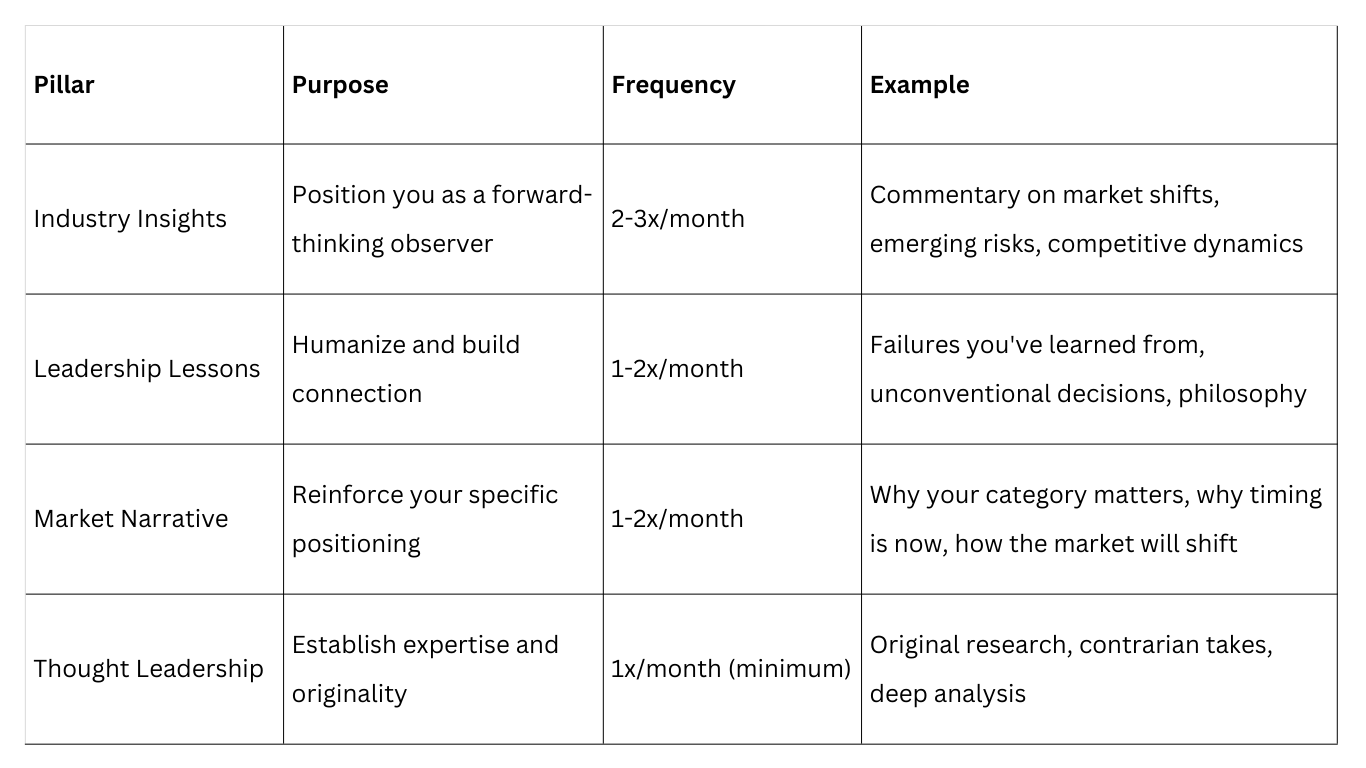
For each channel, develop a content pillars framework focusing on Content & Storytelling:

Content does not need to be constant. Quality beats frequency. A single well-researched LinkedIn article or published piece in a respected publication outperforms dozens of generic posts.


Step 4: Execute With Consistency (Distribution Phase)

Consistency is what turns sporadic visibility into compounded authority. Establish a publishing rhythm you can sustain:

  • LinkedIn: 1 to 2 posts per week.
  • Articles: 1 major piece per quarter.
  • Speaking: 2 to 4 speaking engagements per year.
  • Podcast: 1 appearance per quarter.


Do not overcommit. A CEO who publishes consistently every month will build more authority than one who posts intensely for 3 months, then disappears. The algorithm rewards consistency, and so do investors who monitor your presence over time.


Many CEOs work with a LinkedIn ghostwriter to maintain consistency without consuming their time. Agencies like Ohh My Brand specialize in this. They extract your thinking in strategic interviews, maintain your voice and perspective, and handle drafting and publication so you stay visible without sacrificing core business responsibilities.


Step 5: Measure and Amplify What Works (Optimization Phase)

Not all content performs equally. Track what resonates. Which LinkedIn posts generate comments? Which topics attract investors and industry peers to your DMs? Which articles drive the inbound pipeline? Which speaking opportunities lead to meaningful conversations?


Double down on what works. If posts on product strategy generate 10x the engagement of company announcements, publish more on strategy. If bylined articles in specific publications lead to investor introductions, pitch those publications more aggressively. Personal branding is iterative. Your first positioning might shift as you learn what resonates.


Real-World CEO Scenarios: How Different Founders Built Brands That Attracted Investment


Scenario 1: The SaaS Founder in a Crowded Market

The Challenge: Sarah founded a compliance SaaS in a market with 50+ competitors. Her product was solid, but investors saw it as incremental. They wanted to understand what made her unique.


The Personal Brand Solution: Rather than talk about her product, Sarah utilized personal branding through storytelling to position herself as the founder rethinking regulatory burden. She published a quarterly research report analyzing how regulation was stifling innovation. She spoke at compliance conferences not about her product, but about the future of regulation. She published bylined articles in Forbes and Entrepreneur about this exact tension.


Within 12 months, investors began to see Sarah not as a “SaaS founder” but as a “regulatory futurist.” Her personal brand elevated her company’s perception from commodity to category leader. She closed her Series A at a 40% higher valuation than comparable startups, and investors specifically cited her thought leadership as a confidence factor.


Scenario 2: The Technically Brilliant Founder Who Hated Talking

The Challenge: Marcus built groundbreaking deep-tech AI IP but was deeply introverted. He would rather code than attend events or give talks. His company was invisible to institutional investors despite having superior technology.


The Personal Brand Solution: Rather than force Marcus into a CEO-personality mold, his advisor suggested a different approach. They utilized Bestselling frameworks for personal brands tailored to introverts: LinkedIn ghostwriting plus strategic speaking. A ghostwriter worked with Marcus quarterly to extract his core insights, publish them thoughtfully, and build his profile. Simultaneously, they booked him on 3 to 4 podcasts per year where he could discuss technical challenges in depth.


This approach played to his strengths. He did not have to perform. He just had to think deeply. Within 18 months, his LinkedIn had 8,000+ followers in his niche. He received inbound inquiries from strategic investors and two acquisition approaches. His personal brand had positioned him as a technical authority, which is exactly what serious deep-tech investors were looking for.


Scenario 3: The Second-Time Founder Leveraging Past Success

The Challenge: Jennifer exited her first company successfully but was largely unknown outside her immediate network. Her second company was in a different vertical, and early fundraising conversations were lukewarm.


The Personal Brand Solution: Jennifer’s advisor suggested she lean into her founder narrative, proving that Authors make better personal brand strategists by turning her experience into a story. She published a long-form essay on her first exit covering what went right, what she would do differently, and what she learned about building for scale. She gave talks at founder conferences about founder psychology during growth stages. She started a monthly newsletter sharing unfiltered lessons for other founders.


Her personal brand positioned her not as a first-time founder but as a battle-tested operator with institutional knowledge. When she fundraised for her second company, investors already knew her thinking. She had proof of her ability to build and scale. Her personal brand accelerated due diligence and reduced investor skepticism. Her Series A closed in half the typical timeline.


Where Personal Branding Agencies Help: The Ohh My Brand Model


For many busy executives, building a personal brand alone is impossible. You are already leading a company, fundraising, hiring, and managing a crisis. Where do you find time to develop thought leadership? This is where personal branding agencies become invaluable.


Agencies like Ohh My Brand specialize in exactly this. They build authentic, strategic personal brands for CEOs and founders without requiring them to sacrifice core business responsibilities. Here is how.


CEO Positioning & Strategy

A branding agency does not just publish content. They develop your positioning first. They interview you deeply. They analyze your market, competitors, and unique perspective. They craft a clear, differentiated positioning that becomes your north star. This strategic foundation ensures every piece of content, every speaking opportunity, and every media mention aligns with your broader goals.


LinkedIn Ghostwriting & Content Management

This is the workhorse of modern CEO branding agencies. A ghostwriter does not write for you. They write from you. They conduct strategic interviews to understand your thinking, maintain your authentic voice, and publish content under your name that builds visibility. Ohh My Brand clients see 300%+ increases in LinkedIn engagement once ghostwriting is active because the content is consistent, strategic, and grounded in real thinking.


Media Relations & PR

Personal branding compounds when it extends beyond social. Agencies pitch your thinking to major publications. They secure you bylined articles in Forbes, Entrepreneur, and industry trades. They get you on podcasts with relevant audiences. Each external mention acts as Backlink Building for your reputation, adding authority that social media alone cannot replicate. An SEO Consultant within the agency often helps optimize this footprint.


Thought Leadership Development

Your first instinct might be to write about your company. Instead, agencies help you identify timely, original insights about your market using Content system from book based strategies. They help you develop proprietary research, frameworks, or analysis that positions you as an expert beyond your company’s walls. This third-party authority is what moves investor needles.


Speaking & Event Strategy

Being asked to speak is not random. Agencies have relationships with conference organizers, event directors, and podcast hosts. They pitch you strategically for opportunities aligned with your positioning and audience. More importantly, they coach you on how to use speaking strategically to reinforce your brand positioning.


Board & Opportunity Leverage

A strong personal brand opens doors to board positions, advisory roles, and strategic partnerships. Agencies help you navigate these opportunities strategically, ensuring new roles reinforce rather than dilute your core brand.


The output? Within 6 to 12 months, a CEO typically sees:


  • 5 to 10 media placements in recognized publications.
  • 50 to 100% growth in LinkedIn followers and engagement.
  • Inbound investor interest traceable to content.
  • Speaking invitations from top-tier events.
  • Clear positioning that differentiates them from peers.
  • Visibility that translates into strategic opportunities.


This is not vanity. It is business acceleration. The investment in personal branding compounds across fundraising timelines, valuation negotiations, talent attraction, and market credibility.


Implementation Checklist: What You Need to Start Building Your Personal Brand Today

If you are convinced but unsure where to begin, here is a practical checklist. Work through this in order.


Clarity Phase (Week 1-2)


  • Define your core positioning in 3 to 4 sentences.
  • Identify 2 to 3 specific, defensible perspectives you have that others do not.
  • List your proof points (degrees, exits, results, recognition).
  • Identify 3 to 5 thought leaders in your space you want to learn from.


Content Foundation (Week 3-4)


  • Choose your primary platforms (LinkedIn is non-negotiable for most).
  • Develop your 4 to 5 content pillars relevant to your positioning.
  • Decide on publishing frequency (realistic, sustainable rhythm).
  • If outsourcing, vet and hire a LinkedIn ghostwriter or use **Ebook Writing Services** to capture your manifesto.


Month 1-3: Launch Phase


  • Optimize your LinkedIn profile with clear headline, strategic about section.
  • Publish your first 4 to 8 pieces of content.
  • Reach out to 3 to 5 publications/podcasts to pitch speaking/writing opportunities.
  • Build a list of your top 100 strategic connections and start engaging with their content.


Month 4-6: Amplification Phase


  • Aim for at least one external media placement.
  • Double down on content that is generating meaningful engagement.
  • Actively engage with industry peers’ content 3 to 4x per week.
  • Track what is resonating. Adjust content mix accordingly.


Month 7-12: Optimization & Scale


  • Aim for 3 to 5 media placements across the year.
  • Maintain consistent publishing rhythm without burnout.
  • Evaluate impact. Has inbound increased? Has visibility improved? Are investors mentioning your thought leadership?
  • Refine positioning based on 6 months of data.


Ongoing: Sustain & Evolve


  • Publish consistently. Month in, month out.
  • Track metrics: LinkedIn growth, publication placements, speaking invites, pipeline impact.
  • Evolve your positioning as the market and business evolve.
  • Add new formats (video, research, events) as capacity allows.


Frequently Asked Questions About CEO Personal Branding and Investor Attraction

Q1. Does personal branding actually attract investors, or is it just marketing?


Investors will tell you they invest in people, not just products. Research backs this up. 87% of CEOs say personal reputation helps attract investors, and 44% of a company’s market value is attributable to CEO reputation. When a founder has built visible credibility, investors perceive lower execution risk. They see someone capable of navigating complexity, attracting talent, and commanding respect. Personal branding is a direct signal of those capabilities.


Q2. I’m worried personal branding is too self-promotional. How do I do it authentically?


The 5:3:2 content ratio is your guardrail: 50% industry insights, 30% leadership philosophy, 20% personal professional journey. This mix positions you as a thought leader first and a self-promoter second. Focus on sharing perspectives on your market, lessons from your journey, and original insights. People are drawn to leaders with clear thinking, not leaders with big egos.


Q3. How long before I see results from personal branding?


Compounding takes time. You will see initial engagement within weeks. You will see meaningful visibility within 3 to 4 months of consistent effort. But serious investor perception shifts take 6 to 12 months. This is why starting early matters. By the time you fundraise, your brand is already established.


Q4. I’m a technical founder with no interest in being a public figure. Do I still need personal branding?


Yes. Even technical founders benefit from personal branding. You just position differently. Instead of being a personality, position yourself as a technical authority. Marcus’s deep-tech example above demonstrates this. You do not need to be charismatic. You need to be credible, consistent, and visible in your niche.


Q5. Should I hire an agency or do it myself?


If you have 5 to 10 hours per month to dedicate to content, LinkedIn posting, and PR outreach, you can do it yourself. If not, agencies create leverage. They turn your thinking into publishable content, manage relationships, and handle the operational side so you focus on what only you can do: developing original insights.


Q6.What’s the difference between CEO’s personal branding and corporate marketing?


Corporate marketing promotes your company. CEO’s personal branding establishes you as a thought leader independent of the company. They are complementary but distinct. Corporate marketing talks about your product. CEO’s personal branding talks about their market perspective. Investors read your personal brand to evaluate you as a leader. They read corporate marketing to evaluate your product market fit.


Q7.How much should I invest in personal branding?


For a founder actively fundraising, $3,000 to $8,000 per month for agency support is typical. This might sound like a lot, but consider the alternative. If personal branding helps you close your Series A at a higher valuation or 6 months faster, it pays for itself many times over. The ROI is significant, especially if you have experienced help.


Q8. Can personal branding hurt you?


Yes, if you are not thoughtful. Inconsistent messaging, overly promotional content, controversial takes without backing, or content that contradicts your company’s narrative can backfire. This is why working with experienced professionals or having a clear strategy matters. You are building long-term credibility, not chasing viral moments.


Q9.How do I measure if personal branding is working?


Track LinkedIn growth, external placements, and pipeline impact. Monitor sentiment in conversations with investors, customers, and employees that reference your thought leadership. Qualitatively, ask yourself: Are you getting asked to speak? Are investors mentioning your articles? Are journalists reaching out for commentary?


Q10. Where does LinkedIn ghostwriting fit into this strategy?


LinkedIn ghostwriting is the operational engine of modern CEO personal branding. A ghostwriter handles the content creation burden, allowing you to maintain visibility without consuming your time. They interview you to understand your thinking, write from your voice, and publish consistently. This consistency is what allows your brand to compound.


Q11:What’s the most underrated aspect of CEO’s personal branding?


Consistency. Not brilliance, not viral moments, not massive follower counts. Consistency. A CEO who publishes thoughtfully every month for a year will build more authority than one who goes viral once. Investors notice founders they see regularly, building credibility incrementally using book frameworks for linkedin brand building.


Q12.How does personal branding tie into company valuation?


The link is direct. A strong CEO reputation contributes to 44% of a company market value. Better valuations in funding rounds, premium pricing for products, faster customer acquisition, and easier talent hiring are all influenced by CEO visibility and credibility. The personal brand is not separate from the company value. It is a core component of it.


Conclusion: Your Brand Is Your First Pitch


Before your pitch deck lands on an investor’s desk, they have already done diligence on you. They have checked your LinkedIn. They have read articles you have published. They have asked mutual connections about your background and character. Your personal brand precedes you.


This is why building it strategically matters so much. You are not chasing attention for vanity. You are establishing the credibility, clarity, and vision that will determine whether investors see you as a founder worth betting on.


The CEOs and founders who will lead in 2026 and beyond are those who master personal branding. They are visible founders without being promotional, credible without being boastful, and strategic without losing authenticity. They understand that building a personal brand is building a business asset. They know that investor confidence comes from more than a product or metric. It comes from believing in the person leading the mission.


If you are ready to move from invisible to indispensable to build a personal brand that attracts serious investors and establishes you as a founder worth following, your first step is clarity. Define your positioning. Identify what makes your perspective valuable. Then, commit to consistency.


If you want expert guidance through this process, Ohh My Brand specializes in positioning, ghostwriting, and thought leadership strategy for CEOs and founders globally. They have worked with founders across SaaS, deep-tech, fintech, and enterprise software to build personal brands that translated into better valuations, inbound investor interest, and market leadership. From CEO positioning to LinkedIn growth to media placements, they handle the strategic and operational sides so you can focus on building your business.


Explore partnership with Ohh My Brand,  if you are ready to build a personal brand that moves money, opens doors, and positions you as a founder investors actually want to back. Your brand is your competitive advantage. Make it count.


How Can CEOs Improve Visibility and Authority in Their Market?

Imagine you are the captain of a massive, state-of-the-art ship. You have the best engines and the most skilled crew. However, if you sail in the dead of night with your lights off, no one will know you are there until they crash into you. In the modern business landscape, being the best CEO is no longer enough. You must also be the most visible one.


Think of your visibility as the lighthouse that guides investors, talent, and customers safely to your shores. Your personal brand has become your company’s most powerful asset. It influences how investors evaluate your business, how talent chooses to work with you, and how customers decide to trust your brand. Yet, most CEOs remain hidden behind their companies. They let their leadership impact go unrecognized while competitors build public authority that attracts opportunities, funding, and talent.


As Warren Buffett famously said, “It takes 20 years to build a reputation and five minutes to ruin it.” In the digital age, it also takes strategic effort to ensure that reputation is actually seen.


The challenge is real. You are running a business. You do not have time for vanity projects, influencer tactics, or generic thought leadership that adds no real value. What you need is a strategic, business-focused approach to CEO visibility and authority. This approach positions you as an undisputed leader in your field while driving measurable business outcomes. This is not about getting famous. It is about becoming undeniable.


This is precisely where modern executive branding comes in. Agencies like Ohh My Brand specialize in helping CEOs and founders build visibility and authority that translates into real business leverage. This includes attracting investors, securing top talent, earning media coverage, and opening doors to speaking opportunities. But before diving into agency support, let’s explore the complete strategic framework for CEO visibility and authority development.


What Does CEO Visibility and Authority Mean for Executives and Founders?

CEO visibility is not about personal vanity or ego. It is a business strategy with measurable returns. When you are visible as a leader, three critical things happen. First, your market recognizes you as an authority worth listening to. Second, key stakeholders actively seek your insights and perspective. Third, your company gains a competitive advantage through the credibility and trust you have personally established.


Authority is the perception that you do not just have opinions but proven expertise backed by results, data, and real-world success. An authoritative CEO is someone journalists call for expert commentary. They are someone investors listen to during pitches. They are someone talented professionals want to work for and someone customers trust at higher price points.


Here is what makes this matter strategically:


Statistics showing 44% of a company’s market value is attributed to CEO reputation vs 56% other factors


Investor Confidence and Fundraising

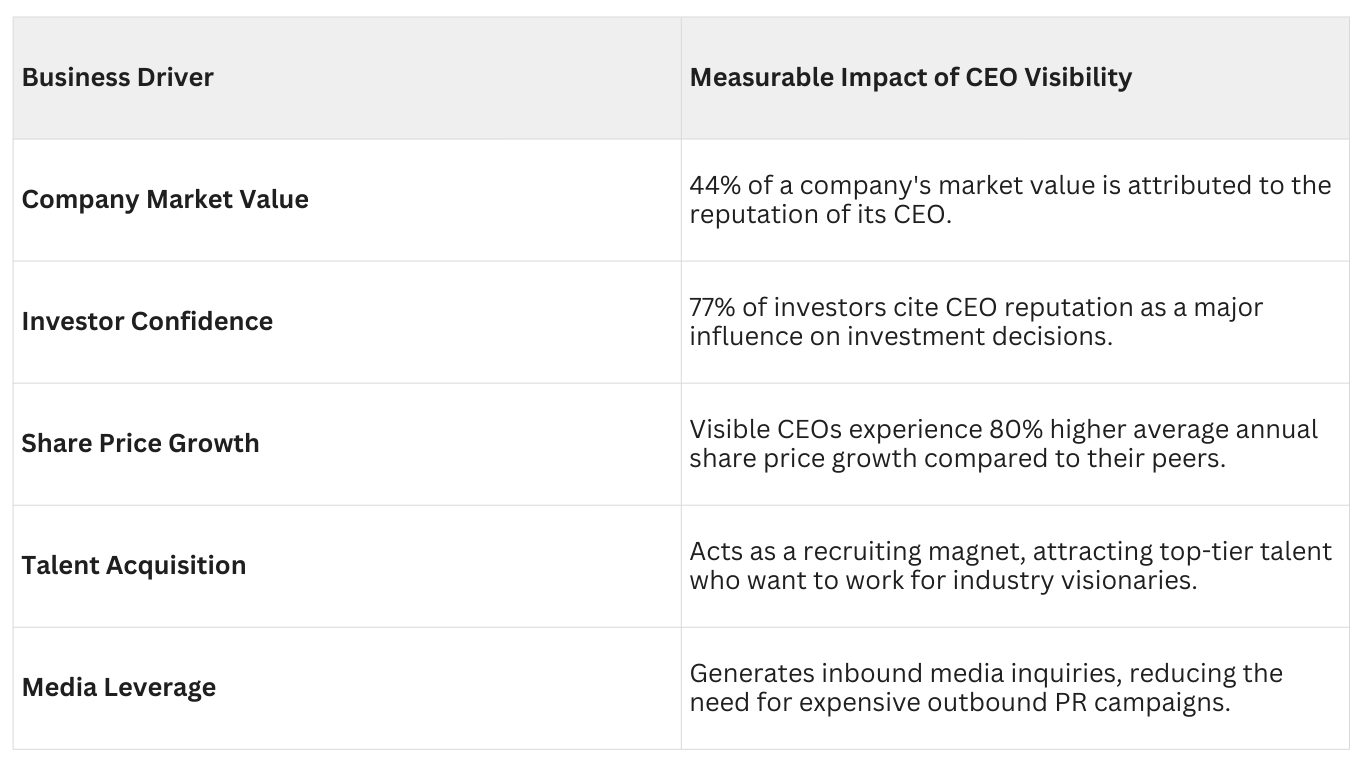
Data supports the need for visibility. According to a Weber Shandwick study, 44% of a company’s market value is attributed to the reputation of its CEO. Furthermore, 77% of investors say a CEO’s reputation influences their decision to invest in a company. When you are a visible, authoritative CEO, you dramatically improve your ability to raise capital. Investors are not just evaluating spreadsheets. They are evaluating you. 


A CEO with a strong public presence signals vision, strategic thinking, and the ability to execute. This translates into better terms, faster fundraising cycles, and higher valuations. Additionally, visible CEOs experience 80% higher average annual share price growth compared to their peers.

Talent Acquisition and Retention

The war for talent is fierce. A CEO with industry authority becomes a recruiting asset. Exceptional talent wants to work for leaders they respect and learn from. When your CEO brand is strong, you attract top-tier employees who view working with you as an opportunity to grow alongside a visionary. Beyond recruitment, employees who see their CEO actively engaged in thought leadership feel more connected to the company’s mission. This leads to higher engagement and retention.


Market Positioning and Customer Trust

In crowded markets, trust is your most valuable currency. A CEO known for deep expertise builds customer loyalty that advertising simply cannot buy. Your personal authority becomes a trust marker for your products and services, acting as a form of high-level Conversion Rate Optimization for your brand’s reputation. Customers are more likely to invest in companies led by CEOs they perceive as credible, knowledgeable, and aligned with their values.


Media Coverage and PR Amplification

Media outlets constantly seek expert voices for stories, interviews, and commentary. When you are a visible, authoritative CEO, journalists reach out to you instead of you chasing them. This inbound media attention provides third-party validation of your expertise. It offers massive visibility amplification at virtually no cost. One feature in a major publication reaches thousands of potential customers, partners, and investors.


Speaking Opportunities and Industry Leadership

Visible CEOs get invited to speak at major conferences, participate in industry panels, and lead prestigious events. These speaking platforms further amplify your authority. They expand your network exponentially and position you as a leader who shapes industry conversations rather than simply following them.


Board Positions and Strategic Partnerships

As a CEO with proven visibility and authority, you become attractive for board positions at other companies. You open doors to advisory roles and high-level strategic partnerships. These opportunities expand your influence network and create additional revenue or strategic value streams.


The business case is undeniable. CEO visibility and authority directly drive business growth, competitive advantage, and long-term wealth creation.


Common Mistakes Executives Make in Building Their Visibility

Before we discuss what works, let’s examine what doesn’t. Most CEOs fail at building visibility and authority because they make preventable mistakes. These errors either prevent them from starting or derail their efforts once underway.


The Invisibility Trap: Thinking You Don’t Have Time

The most common mistake is the belief that visibility is a luxury when you are busy running a business. This could not be further from the truth. The CEOs who are “too busy” to build a public brand are making a strategic error that costs them millions in lost opportunities. 


Visibility does not require 10 hours a week. It requires strategic focus, often supported by a Personal Branding Consultant or services like LinkedIn ghostwriting. One well-crafted LinkedIn post per week, one speaking engagement per quarter, and one media placement per month can completely transform your positioning.


The Authenticity Pretense: Fake Authority Building

CEOs sometimes attempt to build authority through exaggeration, borrowed insights, or generic “thought leadership” that adds no real value. This backfires spectacularly. Today’s audiences are sophisticated. They can smell inauthenticity instantly. The most powerful authority comes from personal branding through storytelling, sharing genuine insights from your real experience, your actual failures, and your authentic perspective on your industry. This is harder than claiming false expertise, but it is the only sustainable approach.


Inconsistent Messaging Across Platforms

A CEO who says one thing on LinkedIn, something different in interviews, and contradictory information in company meetings destroys credibility faster than silence would. Your personal brand messaging must align with your company’s brand values. All communication channels must reinforce a consistent narrative. This consistency extends to ethics, values, and business practices. If your company claims to value sustainability while your personal investments prioritize extraction, stakeholders will notice.


Neglecting the Right Channels and Formats

Not all visibility is created equal. Some CEOs invest time in platforms where their audience does not gather. LinkedIn is essential for B2B CEOs and enterprise founders. Twitter/X works for tech leaders and thought commentators. Industry conferences matter for manufacturing and industrial CEOs. Podcasts reach niche audiences. You do not need to be everywhere. You need to be dominant where your stakeholders actually spend time.


Overpromising and Underdelivering

When you build a public visibility platform, every promise you make publicly is scrutinized. The gap between what you say you will do and what you actually deliver is a trust destroyer. CEO visibility amplifies both your credibility and your failures. This is why authentic, grounded communication matters more than ambitious claims.


Treating Visibility as a Marketing Campaign Rather Than a Business Practice

The biggest mistake of all is approaching CEO visibility as a short-term campaign. Leaders often say, “Let’s do three months of social media and see what happens.” Real CEO authority is built over years through consistent, strategic effort. Think of it as part of your job as CEO, not an additional project. This mindset shift changes everything about how you approach it.


Ignoring the Reputation Risk Landscape

In 2026, the stakes of visibility are higher than ever. AI-generated deepfakes, cancel culture, and misinformation create new risks for visible leaders. Many CEOs neglect reputation management until a crisis hits. Proactive reputation management must happen continuously, not reactively. This involves monitoring mentions, managing online reviews, addressing issues quickly, and building a strong positive narrative.


The Strategic Approach to CEO Visibility and Authority

Building CEO visibility and authority requires a structured, multi-layered approach. This is not about doing one thing. It is about orchestrating a coherent strategy across multiple channels and formats that all reinforce your positioning as an authoritative leader.


Step 1: Establish Your Authentic Positioning and Unique Perspective

Before you do anything public, you must first do the internal work of clarifying who you are. You must define what you believe and what unique perspective you bring to your industry.


Start with radical self-assessment. What are you genuinely expert at? Not what you wish you were expert at, but what you actually know deeply because of real experience. What lessons have you learned that others in your industry haven’t? What do you believe about the future of your market that goes against conventional wisdom? What Personal brand purpose drives your decision-making as a leader?


This positioning must be authentic. The most compelling CEO brands are not built on manufactured personas. They are built on honest expressions of who someone actually is. Richard Branson’s brand works because it authentically reflects his adventurous personality and values-driven approach. Satya Nadella’s authority comes from genuinely deep technical understanding combined with authentic belief in inclusive leadership. Sheryl Sandberg’s thought leadership resonated because she was speaking from lived experience.


  • Your positioning should clarify:
  • Your genuine area of expertise: What specific domain can you speak authoritatively about?
  • Your leadership philosophy: What principles guide your decision-making as a CEO?
  • Your point of view on industry trends: What do you see happening in your market that others miss?
  • Your values: What causes, principles, and outcomes matter most to you?
  • Your audience: Who specifically do you want to influence?


This positioning becomes the anchor for everything else. Understanding frame works to built personal brands helps ensure every piece of content, every speaking engagement, and every media interview connects back to this core positioning.


Step 2: Optimize Your Foundational Digital Presence

Your digital presence is the home base where all your visibility efforts converge. It must be optimized to immediately establish credibility and authority.


LinkedIn Profile Optimization

For most CEOs, LinkedIn is your primary platform. Effective LinkedIn Marketing starts with your profile doing more than listing your job title. It should immediately communicate your unique value and authority. 


This includes:

  • A professional but personable profile photo that conveys approachability and confidence.
  • A compelling headline that goes beyond your title (“CEO at X” is weak; “Building the Future of Enterprise Software Through AI” is stronger).
  • A summary that tells your story, communicates your point of view, and explains why people should care about your insights.
  • Evidence of expertise: articles written, speaking engagements, media appearances, awards.
  • Clear calls-to-action for people who want to connect or learn more.
  • Your LinkedIn presence should not look like a resume. It should look like the public face of a thought leader.


Company Website Leadership Section

Your company website should feature you prominently, not as a footnote. Many prospects and investors visit company websites. The CEO bio section should communicate your experience, vision, and unique perspective. Include a professional photo, your leadership philosophy, key achievements, and media appearances.


Media Kit Development

Create a professional media kit that includes high-resolution photos, your biography (short and long versions), key credentials, areas of expertise, and previous media appearances. When journalists are researching you for an interview or feature, they should be able to find everything they need on one easy-to-download document. This removes friction from media placements.


Step 3: Build Your Thought Leadership Content Engine

Content is the fuel of CEO visibility. You need a consistent stream of valuable insights that establish your expertise, provide real value to your audience, and keep you top-of-mind with key stakeholders.


Determine Your Content Format Mix

Not all CEOs should be writing long-form blog posts. Not all should be on every social media platform. The key is choosing content formats that:


Play to your strengths. Some CEOs are natural writers, while others are dynamic speakers or excel in long-form conversation.

  • Reach your target audience where they spend time.
  • Can be sustained consistently over time.
  • For most B2B CEOs, the content foundation looks like:
  • LinkedIn posts: 2-4 per week, sharing insights, perspectives, lessons learned, and industry observations.
  • Long-form content: A monthly article (1,500-3,000 words) on your company blog or Medium.
  • Speaking engagements: 4-6 speaking opportunities per year at industry conferences, webinars, or exclusive forums.
  • Media appearances: Regular interviews, commentary, and contributions to high-authority publications.
  • Podcast appearances: Guest appearances on industry-relevant podcasts (one every 1-2 months).


Content Production Approach


Here is the hard truth: most CEOs cannot produce this volume of quality content themselves while running a company. This is where professional support like Ohh My Brand’s LinkedIn ghostwriting service becomes invaluable. A ghostwriter works with you to understand your authentic voice, your unique perspective, and your strategic goals. They then produce Content & Storytelling that sounds exactly like you but eliminates the time burden. This allows you to maintain a powerful content presence without neglecting your core CEO responsibilities.


Whether you use a ghostwriter, a content agency, or your own content team, the key is that your content must:


  • Reflect genuine insight: Share what you actually know. This might be lessons from failures, unconventional perspectives on industry trends, or breakthroughs you have discovered.
  • Provide real value: Avoid self-promotional content. Your content should educate, inform, or provoke thought in your audience. When you focus on value first, authority naturally follows.
  • Be consistent: The compounding effect of consistent content over months and years is what builds real authority. A single viral post does not create lasting influence, but years of valuable insights do.
  • Encourage engagement: Ask questions, invite diverse perspectives, and actively engage in comments. This builds community around your thought leadership.
  • You might even consider Ebook Writing Services to compile your methodology into a comprehensive guide, further cementing your status as an expert using a Content system from book based strategies.


Step 4: Secure High-Authority Media Placements and Speaking Opportunities

Content you create is important, but third-party validation through media coverage and speaking invitations is what truly establishes authority. When journalists, conference organizers, and podcast hosts seek you out, it signals that your expertise is recognized and valued.


Strategic Media Relations

Building media visibility requires a strategic approach:


  • Identify target publications: Where does your target audience read? Where do decision-makers in your industry gather for insights? Create a list of 20-30 high-authority publications that matter for your market.


  • Build relationships with journalists: Do not pitch immediately. Build relationships first. Follow journalists who cover your space on LinkedIn and Twitter, engage thoughtfully with their content, and share their articles. Offer helpful information without asking for anything. Over time, as you become a trusted resource, they will reach out to you.


  • Develop compelling story angles: Journalists are not interested in your company press releases. They are interested in stories that matter to their audience. What is a novel perspective you have on an industry trend? What is a contrarian take that challenges conventional wisdom? What data or insights do you have that would surprise their readers?


  • Pitch with precision: When you do pitch, personalize every email. Reference a specific article the journalist wrote. Explain exactly why your story is relevant to their beat and their audience. Include a compelling “hook” to explain what makes this newsworthy.


High-authority media placements, Forbes, Harvard Business Review, Wall Street Journal, industry-specific publications, provide massive credibility amplification and are a prime form of Backlink Building for your digital footprint. Even one feature article in a top-tier publication dramatically enhances your authority profile.


Speaking Engagement Strategy


  • Speaking at industry conferences and exclusive forums is one of the fastest ways to build executive authority. Conference organizers specifically seek speakers who have demonstrated expertise and visibility. Once you start speaking, opportunities multiply.


  • Target strategic conferences: Focus on conferences where your decision-making audience gathers. For SaaS CEOs, this might be industry-specific events. For manufacturing leaders, trade shows. For corporate innovators, leadership summits.


  • Apply for speaking slots: Most major conferences have open calls for speakers. Submit proposals that position you as speaking on areas of genuine expertise.


  • Leverage speaking success: Each speaking engagement becomes content. Record it, share clips, add it to your media kit and LinkedIn profile, and use it to attract more speaking invitations.


Step 5: Master LinkedIn Growth and Engagement

For most CEOs, LinkedIn is the primary visibility platform. It is where business decision-makers spend time, where media professionals find experts, and where your professional network gathers.


Strategic LinkedIn Growth

Growing your LinkedIn network strategically matters because:


  • More connections equal a larger audience for your thought leadership content.
  • A larger audience equals more opportunities for your content to reach decision-makers, investors, and journalists.
  • Visibility in LinkedIn’s algorithm means your posts reach further.


Growth happens through:


  • Consistent, valuable content: Posts that get engagement increase your visibility in LinkedIn’s algorithm.
  • Authentic networking: Connecting with people in your industry, other founders and CEOs, investors, and journalists.
  • Engagement on others’ content: Like, comment on, and share other leaders’ content. This builds visibility and relationships.
  • Profile optimization: A strong profile that communicates your authority attracts connection requests.
  • The goal is not vanity metrics. It is building an audience of people who matter for your business: potential investors, media professionals, potential customers, and industry peers.


LinkedIn Content Strategy


Successful LinkedIn CEOs typically post:


  • Perspective pieces: Your viewpoint on industry trends, market shifts, or future direction.
  • Lessons learned: Both victories and failures. Vulnerability creates connection.
  • Data and insights: Share research, data points, or observations that inform your industry.
  • Company and team wins: Celebrate achievements without being self-promotional.
  • Questions and provocation: Ask your network what they think about emerging trends.
  • Personal dimension: Share aspects of your leadership philosophy, your values, and why certain issues matter to you.


The combination creates a compelling feed that demonstrates expertise, builds trust, and creates opportunities.


Real-World CEO Visibility Scenarios

Theory is useful, but real-world application is what matters. Here are three distinct scenarios showing how different CEOs might approach visibility and authority building based on their situation and market.


Scenario 1: The B2B SaaS Founder Seeking Series B Funding

The Situation: Sarah is the CEO of a growing B2B SaaS company. She has raised a successful Seed round and is preparing for Series B fundraising. Her company has strong product-market fit and growing revenue. However, venture capital investors tell her they need to see more founder visibility and thought leadership before committing to larger investment rounds.


The Challenge: Sarah is spending 80% of her time on product, fundraising, and operations. She has zero time for thought leadership and no background in marketing or PR.


The Strategy:


Sarah starts by working with a ghostwriter to establish a LinkedIn presence that positions her as a thought leader in her specific domain, perhaps AI-enabled customer operations. She does not claim to be an AI expert. Instead, she positions herself as someone solving real customer problems using AI, with insights from her users’ actual experiences. She uses Bestselling frameworks for personal brands to structure her narrative effectively.


She commits to 2-3 LinkedIn posts per week that share:


  • Lessons learned from building her company.
  • Insights from customer conversations about how businesses are using AI.
  • Her perspective on where the customer operations market is heading.
  • Key hiring and company-building lessons.


Within 3 months of consistent, authentic content, her LinkedIn engagement grows. Industry peers start engaging with her posts. A journalist covering AI in business reaches out after seeing her perspective on a trend. She lands a guest article in a respected tech publication.


For speaking, she targets emerging founder platforms and industry conferences. She submits a proposal to speak on the panel “Building Sustainable SaaS Companies in Uncertain Economies,” positioning herself as an experienced founder, not just a new company.


Within 6 months, her founder visibility has shifted. When she enters Series B discussions with investors, they have seen her LinkedIn presence, read her published article, and potentially heard her speak. This changes the dynamic. She is no longer unknown. She is a founder with proven thought leadership in her market.


The outcome: Stronger Series B negotiations, higher valuations, and easier investor meetings because the groundwork of visibility is already done.


Scenario 2: The Manufacturing CEO Building Authority in a Traditional Industry

The Situation: Robert is the CEO of a 40-person manufacturing company specializing in industrial components. His market is traditional, and his audience is other manufacturing executives and supply chain decision-makers. He is considered credible within his network but virtually unknown nationally. He wants to position himself as a thought leader in sustainable manufacturing and modern supply chain optimization.


The Challenge: Manufacturing is not known as a “content-native” industry. LinkedIn is used in manufacturing, but podcast culture and traditional media coverage are less common. Robert has limited time and is skeptical about social media as a business tool.


The Strategy:

Robert’s visibility strategy focuses on the channels where manufacturing decision-makers actually spend time:


  • Industry conferences and trade shows: He commits to sponsoring and presenting at 2-3 major manufacturing and supply chain conferences per year. He positions himself as speaking on “Balancing Efficiency and Sustainability in Modern Manufacturing Supply Chains.”
  • Industry publications: Manufacturing has long-standing, highly respected publications that decision-makers read. He targets these with thoughtful, substantive articles on supply chain challenges and solutions.
  • LinkedIn, but focused: Rather than obsessive daily posting, he posts 1-2 times per week with content specifically relevant to manufacturing leaders—industry trends, supply chain insights, and sustainability challenges.
  • Hosting events: He hosts an annual manufacturing roundtable forum where 30-40 key executives discuss pressing industry challenges. This positions him as a community leader and creates owned-media opportunities.
  • B2B PR: He works with a PR firm experienced in manufacturing to place stories about his company’s innovations in industry media.


Within a year, Robert becomes known within manufacturing circles as a thought leader on sustainable supply chain practices. This leads to board opportunities, speaking invitations at other forums, consulting inquiries, and stronger customer positioning.


Scenario 3: The Healthcare Executive Building Trust and Authority in a Regulated Market


The Situation: Dr. Maya is the CEO of a healthcare company operating in a regulated, compliance-heavy space. Her market demands deep expertise and absolute trust. Her customers are healthcare institutions and government agencies. Traditional PR is limited because of healthcare regulations around marketing and claims.


The Challenge: Healthcare is heavily regulated. False claims or missteps can create legal and reputational problems. Her customer base is highly specialized. Generic thought leadership does not resonate.


The Strategy:


Maya’s visibility strategy is highly specialized and compliance-aware:


  • Speaking at healthcare forums: She focuses exclusively on speaking at healthcare-specific conferences, medical associations, and health system leadership forums. Her speaking positions her as an expert in her specific healthcare niche.
  • Published research and whitepapers: Rather than general thought leadership, Maya publishes research on specific healthcare challenges her company addresses. These whitepapers provide value to healthcare institutions while demonstrating her expertise.
  • Peer relationships and referrals: In healthcare, relationships between CEOs and institutional leaders are crucial. She invests heavily in building peer relationships through selective networking, advisory boards, and speaking forums.
  • LinkedIn thought leadership, carefully crafted: Her LinkedIn posts focus on lessons learned, healthcare leadership insights, and evidence-based perspectives. All content is reviewed for regulatory compliance before posting.
  • Industry association leadership: She takes a leadership role in a healthcare-focused industry association, increasing her visibility and credibility within the healthcare ecosystem.


Over time, Maya becomes known as a trustworthy, expert-level leader within healthcare circles. This leads to board positions, consulting inquiries, speaking invitations, and customer referrals from peer institutions.


Where Executive Branding Agencies Support This Strategy

The visibility strategies outlined above are powerful, but they require execution. This is where professional support becomes invaluable. Ohh My Brand and agencies like it specialize in helping CEOs and founders execute CEO visibility and reputation management strategies without diverting leaders from core business responsibilities.


LinkedIn Ghostwriting and Content Creation

One of the most impactful services is professional LinkedIn ghostwriting. Here is what this actually means: You work with an expert writer who understands your voice, your expertise, and your strategic goals. This ghostwriter produces your LinkedIn content, manages your profile, and handles the day-to-day content publication. You review and approve content, providing input and direction, but the actual creation and posting happens without consuming your time.


The benefit is profound. Instead of spending 5-10 hours per week trying to create content, you spend 30 minutes per week reviewing ghostwritten content. Your LinkedIn presence remains active, authentic, and strategically aligned, but at a fraction of the time cost. Since Authors make better personal brand strategists, using a professional writer ensures your narrative is compelling.


Thought Leadership Positioning and Strategy

Agencies like Ohh My Brand help CEOs clarify their positioning, identify their unique perspective, and develop a strategic thought leadership plan. This strategic foundation is critical because without it, content creation becomes random and ineffective.


Media Relations and PR

Professional PR teams have relationships with journalists, understand which media outlets matter for your industry, and know how to package your expertise in ways that create coverage opportunities. This dramatically increases your chances of landing high-authority media placements.


Reputation Management

In an era of misinformation, cancel culture, and AI-generated deepfakes, proactive reputation management is essential. This includes monitoring your online mentions and sentiment, addressing negative content, building positive narratives, and managing crises when they emerge.


Speaking Engagement Coordination

Agencies can help identify speaking opportunities that matter for your positioning, prepare you for speaking engagements, and amplify speaking content across multiple channels. They manage logistics so you can focus on delivering great presentations.


Executive Brand Building

Comprehensive brand-building services help CEOs develop a complete executive brand presence. This ranges from LinkedIn optimization to media kit development to positioning statements to strategic narrative development.


The key insight is that professional agencies are not replacing your thought leadership. They are amplifying your authentic voice and making it possible to maintain visibility without consuming your life. You might even consult an SEO Consultant to ensure your personal brand ranks well in search results.


Implementation Checklist for CEOs

Ready to build visibility and authority? Here is what to actually do, in priority order:


Phase 1: Foundation (Month 1)

  • Conduct positioning work: Document your genuine expertise, unique perspective, and key messages.
  • Optimize your LinkedIn profile completely: Update headline, summary, photo, and experience section.
  • Create or update your media kit with professional photos and biography.
  •  Identify 20-30 target publications where you want to appear.
  • Research 10-15 journalists covering your industry and topics.
  • List 5-10 speaking opportunities you will pursue in the next 12 months.


Phase 2: Content and Engagement (Month 2-3)

  • Establish LinkedIn content calendar (commit to 2-4 posts per week).
  • Hire a ghostwriter or begin content creation process.
  • Start engaging on LinkedIn: comment on 5-10 peer posts daily.
  • Develop 3-5 expert media pitches for target publications.
  • Reach out to 5-10 journalists to begin relationship building.
  • Begin preparing for first speaking engagement.


Phase 3: Speaking and Media (Month 4-6)

Deliver first speaking engagement.

Publish first media placement.

Continue consistent LinkedIn content.

Build relationships with 10+ journalists.

Identify next speaking opportunities.

Record and repurpose speaking content.


Phase 4: Amplification (Month 6+)

  • Maintain consistent content cadence.
  • Continue pursuing media placements.
  • Speak at 2-3 events per quarter.
  • Build thought leadership through longer-form content (monthly articles).
  • Expand into podcast appearances.
  • Evaluate and optimize based on what is working.


Ongoing

  • Monitor reputation: Set up Google Alerts and LinkedIn monitoring for your name.
  • Track media mentions and amplify coverage.
  • Update media kit as achievements accumulate.
  • Measure impact: Track LinkedIn engagement growth, media placements, speaking invitations.


Frequently Asked Questions About CEO Visibility and Authority


Q: How long does it take to build real CEO authority?

A: Meaningful authority typically takes 12-24 months of consistent effort. You might see initial LinkedIn engagement growth in 2-3 months and early media interest within 6 months. However, real, recognized authority in your market takes 18-24 months of consistent, authentic thought leadership. The good news is that CEOs who commit to this timeline see measurable business results within 2 years.


Q: What if I don’t have time to manage content creation?

A: This is the exact problem ghostwriting solves. You do not need to be a writer. You need to work 30-45 minutes per week reviewing and approving content that a professional has created based on your insights. This is a non-negotiable time investment that pays enormous returns.


Q: Does CEO visibility really impact fundraising and investor relations?

A: Absolutely. Research shows CEOs with strong public visibility experience dramatically better outcomes in fundraising. They get better terms, higher valuations, and faster processes. Investors are betting on you as much as your business model. Visibility demonstrates strategic thinking, market understanding, and execution capability.


Q: What if I make a mistake or say something controversial?

A: This is a risk of visibility, which is why consistency and authenticity matter. If you stand for something meaningful, you will occasionally invite disagreement. That is fine as it means you have a real perspective. The key is to not make false claims, not contradict your company’s values, and address mistakes quickly and honestly if they happen.


Q: Should I post on every social media platform?

A: No. Focus on one or two platforms where your decision-making audience actually spends time. For most B2B CEOs, this is LinkedIn. Some technology leaders use Twitter/X. Some industries have unique platforms. It is better to dominate one platform than be mediocre on five.


Q: What if my industry isn’t “trendy” or native to social media?

A: Non-traditional industries still benefit enormously from thought leadership and visibility. Manufacturing, healthcare, finance, and other “less trendy” industries absolutely have active communities of leaders seeking insights. You just might skew more toward industry conferences, publications, and associations than toward social media.


Q: How do I handle my personal brand while protecting my company’s brand?

A: Your personal brand should reinforce, not conflict with, your company brand. Share your authentic values, perspectives, and insights, but ensure your public persona aligns with what your company represents. This consistency builds trust across both personal and company brands.


Q: What metrics should I track to know if visibility building is working?

A: Track LinkedIn following and engagement growth, media mentions and placement quality, speaking opportunities (inbound vs. outbound), journalist relationship development, and ultimately business impact. Business impact includes customer inquiries mentioning you, investor meetings where they reference your thought leadership, and talent applications mentioning your visibility.


Q: Is CEO visibility important for private company CEOs?

A: Absolutely. Whether you are raising venture capital, planning an acquisition, attracting talent, or building customer relationships, visibility and authority matter. Private company CEOs benefit from all the same advantages of visibility as public company CEOs.


Q: How do I start if I’m an introvert or uncomfortable with public visibility?

A: Many successful thought leaders are introverts. The key is playing to your strengths. If speaking is not your forte, focus on written thought leadership (LinkedIn, articles, whitepapers). If large audiences terrify you, focus on intimate speaking forums or one-on-one media interviews. Authenticity and genuine expertise matter far more than personality type.


Q: What role does Ohh My Brand play in CEO visibility building?

A: Ohh My Brand specializes in comprehensive CEO positioning, ghostwriting, reputation management, and PR strategy. They help CEOs clarify their positioning, develop thought leadership content (often through ghostwriting services), secure media placements, manage reputation, and build complete executive brands. Rather than doing the CEO work for you, they amplify your authentic voice and handle execution so you can focus on running your business.


Conclusion: Your Visibility is Your Leadership Responsibility

CEO visibility and authority are not vanity projects. They are strategic responsibilities that directly impact your ability to attract capital, recruit talent, earn customer trust, and lead your industry. The market rewards visible, authoritative leaders with opportunities, relationships, and financial outcomes that hidden CEOs simply do not access.


The path forward is clear: clarify your authentic positioning, commit to consistent thought leadership, build relationships with journalists and speaking platforms, and execute with professional support where it amplifies your impact without consuming your time.

The CEOs winning in their markets right now are not the ones working hardest behind closed doors. They are the ones who have strategically built visibility and authority in ways that position their companies as industry leaders and attract the opportunities, talent, and capital that fuel growth.


If you are ready to build serious CEO visibility and authority without sacrificing the time and energy required to run your business, consider partnering with Ohh My Brand. They specialize in helping CEOs and founders develop positioning, build thought leadership, secure media coverage, manage reputation, and execute comprehensive visibility strategies that drive real business results. The visibility you build today becomes the authority and opportunity you access tomorrow.


Ready to transform your visibility into a business asset? Connect with Bhavik Sarkhedi to explore a structured, results-driven approach to executive personal branding.

What’s the Right Brand Positioning Strategy for Startup Founders?

In the fast-paced world of startups, the pressure is relentless. You are building the product, managing the team, closing deals, and scaling operations often simultaneously. But while you are focused on execution, there is something even more critical happening in the minds of your investors, potential hires, media contacts, and customers: they are forming opinions about you.


Your personal brand as a founder is not vanity. It is business infrastructure.


Whether you realize it or not, your reputation precedes you in every significant conversation. Investors check your LinkedIn before your pitch deck. Top talent researches you before accepting offers. Media outlets decide whether to cover your company based partly on your visibility. Partners evaluate whether they trust you before signing agreements.


The uncomfortable truth is that many brilliant founders remain invisible, underestimated, and overlooked because their brand positioning, how they present themselves, their expertise, and their vision to the world are either non-existent, incoherent, or misaligned with their actual value. This is precisely why many are turning to a personal branding consultant like Bhavik Sarkhedi to bridge that gap.


This is precisely why thought leadership, CEO visibility, and executive branding have become non-negotiable strategies. Companies like Ohh My Brand have built entire practices around helping founders and CEOs craft positioning that converts visibility into tangible business outcomes. A founder with intentional brand positioning does not just get more attention; they attract the right attention. They signal credibility, vision, and stability to the people who matter most.


The question is not whether you should focus on brand positioning. The question is whether you can afford not to.


What Does Brand Positioning Mean for Startup Founders and Why It Matters Now

Brand positioning, at its core, is the deliberate act of claiming a unique and valuable space in the minds of your target audience. Personal branding for startup founders, it answers one fundamental question: 


Why should the world pay attention to you and your company?


This is different from your company’s brand positioning. Your company’s brand answers: “What problem does our product solve?” Your personal founder brand answers: “Why am I the right leader to solve it? What makes my perspective, experience, and vision distinct and valuable?” This is where personal branding through storytelling plays a pivotal role, turning a corporate bio into a compelling journey.


Consider the difference between the two founder profiles:


Founder A has a decent LinkedIn profile. There is a professional headshot, a two-sentence bio, and a list of previous jobs. Consider posting a few times a month to share company milestones or celebrate team wins. When you search for them, there is very little information; no opinion pieces, no thought leadership, no indication of what they stand for beyond their current company.


Founder B has a clear brand narrative. Their LinkedIn presence shows a distinct point of view on their industry. They regularly share insights about market trends, challenges in their domain, and their approach to solving problems. They have been featured in podcasts and industry publications. When you search for their name, you find evidence of expertise, credibility, and vision.


Which founder would you be more comfortable investing $2 million in? Which would you want to join their team? Which would you interview for media coverage?


Founder B did not just get lucky with their visibility. They strategically positioned themselves using established frameworks to build personal brands.


The Financial and Operational Impact of Founder Brand Positioning

The stakes are tangible and measurable. Research from Weber Shandwick’s CEO Reputation Premium Study shows that a CEO’s reputation accounts for approximately 45% of a company’s reputation and 44% of its market value. For startup founders, this is even more pronounced; in the early stages, the company often is the founder’s reputation.


Consider what strong brand positioning delivers:


Investor attraction: About 87% of CEOs agree that a strong personal reputation makes it easier to attract investors. For startups, this is critical. Investors evaluate founders as much as they evaluate market opportunity. A founder with clear visibility and credible positioning signals that they understand their market, can articulate a vision, and have the communication skills to lead a growing organization.


Talent acquisition: Top talent no longer just evaluates job descriptions. They evaluate leadership. According to global research, 45% of a company’s reputation is attributed to the CEO’s reputation, and 50% of executives expect that CEO’s reputation will matter even more in the coming years. Early-stage employees are taking significant financial risk with equity compensation. They want to work for leaders they believe in, leaders who are visible and credible in their domain.


Customer trust: 82% of buyers are more likely to trust a business when its leadership is visibly engaged. For B2B startups, particularly, the founder’s credibility directly influences customer confidence. A SaaS founder with a visible thought leadership presence does not just attract inbound leads; they pre-sell trust before the first sales conversation.


Media coverage and partnerships: Journalists, podcasters, and event organizers often seek out founders who are already visible and can articulate complex ideas clearly. A founder with a strong brand positioning gets pitched media opportunities; they do not have to chase them.


Speaking opportunities and board positions: As your company scales, the ability to sit on boards, speak at industry conferences, and influence sector conversations becomes increasingly valuable, both professionally and financially. Visibility and credibility are the gatekeepers to these opportunities.


The timing matters too. In 2026, founder branding has shifted from being a “nice-to-have” personal development activity to being a critical business strategy. The number of startups competing for investor capital, talent, and customer attention is higher than ever. Founders who differentiate themselves through intentional, strategic positioning no longer just stand out; they dominate. Implementing high-level LinkedIn Marketing is now a baseline requirement for this dominance.


The Most Common Mistakes Startup Founders Make with Brand Positioning

Before we dig into how to build the right brand positioning, let’s look at what founders get wrong. Understanding these mistakes can help you avoid costly missteps.


Mistake #1: Positioning Yourself as “The Next Uber of X”


This might be the most pervasive error in startup positioning. A founder launches a new logistics company and positions themselves as “solving the transportation problem with AI.” Another launches a marketplace and markets itself as “Airbnb for industrial equipment.”


The problem? There is no differentiation. You are not establishing your own unique space; you are borrowing someone else’s credibility and hoping it sticks. Investors, media, and customers have heard this a thousand times. You fade into the noise.


The reality: Generic positioning does not attract attention. Distinctive positioning does. When you position yourself as “the person who is reimagining [X] because of [specific insight/experience],” you create a narrative that is yours alone.


Mistake #2: Staying Invisible While Focusing on Execution


Many founders believe their job is to build the product and let the product speak for itself. While product quality matters enormously, visibility cannot be postponed. The founders who emerge as category leaders are those who share their thinking while they are building, not after.


This creates a compounding problem: by the time you are ready to fundraise, hire senior talent, or attract major customers, you have spent months or years without building credibility. You are starting from zero in terms of founder brand recognition, even if your product is exceptional.


The reality: The best products often lose to mediocre products with better founder brands. Visibility builds throughout the journey. It is not something you switch on at the Series A fundraise.


Mistake #3: Inconsistent Messaging Across Platforms


You sound like a technical founder on your personal blog, a corporate spokesperson on LinkedIn, a casual personality on Twitter, and something entirely different in podcasts. Stakeholders get confused about who you actually are and what you stand for.


Personal branding requires consistency. Not uniformity; different platforms call for different tones and formats. But the underlying message, values, and point of view should remain coherent. This is where a professional SEO consultant can help ensure your message is found and understood correctly across the web.


The reality: Inconsistency signals a lack of clarity, which undermines trust. People invest in founders who are clear about who they are and what they believe.


Mistake #4: Positioning Yourself Too Broadly


Some founders try to be all things to all people. They position themselves as “a visionary leader focused on innovation, sustainability, and impact.” That is not positioning; that is platitude. It applies to hundreds of thousands of other founders.


Effective positioning is specific. It is opinionated. It might even alienate some people, and that is the point. When you own a narrow, valuable space, you own it completely. Defining your personal brand purpose helps in narrowing this focus.


The reality: Differentiation comes from specificity, not breadth. The broader your positioning, the less distinctive you become.


Mistake #5: Focusing on Features Instead of Philosophy


You are excited about your product’s technical capabilities, so you talk about the features constantly. But customers, investors, and partners do not buy features; they buy the philosophy and worldview behind those features. Content & Storytelling should be used to convey this philosophy.


Consider the difference:


Feature-focused: “Our software uses advanced machine learning to automate customer support workflows.”


Philosophy-focused: “We believe customer service teams should not spend 80% of their time on repetitive issues. We are building a world where humans handle what matters and AI handles the rest.”


The second statement creates emotional resonance. It signals how you think, not just what you have built.


The reality: Storytelling drives engagement and memory. Features are forgotten; philosophy is remembered.


Mistake #6: Confusing Ghostwriting with Inauthenticity


Many busy founders shy away from CEO visibility because they think maintaining a strong brand presence means spending hours writing content. The idea of hiring a ghostwriter feels inauthentic or risky.


This is a misconception. Professional ghostwriting for executives has become standard practice. Richard Branson, Elon Musk, and countless other high-profile leaders work with writers to articulate their thoughts. A skilled ghostwriter is not impersonating you; they are amplifying your authentic voice. Many authors make better personal brand strategists because they know how to extract the essence of a leader’s mind.


The reality: Ghostwriting is a tool for scaling your visibility without sacrificing your schedule or authenticity. When done right, it accelerates your brand positioning without compromising it.


Mistake #7: Underestimating the Role of Reputation Management


Many early-stage founders do not actively manage their online presence. They assume that as long as nothing major goes wrong publicly, their reputation is fine. But reputation is not neutral; it is either being built or deteriorating.


An unmanaged digital footprint leaves room for misinterpretation. Search results that are sparse or contradictory create confusion. The absence of a clear brand narrative means others will fill in the blanks with their own interpretations.


The reality: Proactive reputation management and brand building create the narrative. Waiting to see what happens leaves your reputation to chance.


The Step-by-Step Strategic Approach to Founder Brand Positioning


Now that we understand what goes wrong, let’s build the right positioning strategy. This framework is designed for busy founders who need practical, implementable steps, not theoretical concepts.


Step 1: Define Your Core Positioning Pillars


Before you write a single piece of content or update your LinkedIn profile, you need absolute clarity on three things:


Your unique insight or perspective: What do you see about your industry, your market, or your customers that most people miss? This is not arrogance; it is specificity. If you are building a logistics platform, your unique insight might be: “The biggest constraint in last-mile delivery is not technology; it is incentive misalignment between drivers and dispatchers.” That specific insight becomes your intellectual foundation.


Your target audience: Not “everyone.” Be specific. Are you speaking to venture capitalists? CIOs at enterprise companies? Other founders? Specific customer segments? The more specific your audience, the sharper your messaging.


The transformation or outcome you enable: What changes for people who follow your thinking or use your product? What becomes possible? This moves beyond features into impact.


Example: If you are building a personal finance app for freelancers, your positioning might be:


Unique insight: “Freelancers do not have inconsistent income problems; they have cash flow visibility problems. They cannot predict what they will earn, so they cannot make confident financial decisions.”


Target audience: 1099 contractors and solopreneurs, particularly those making $100K+


Transformation: They move from financial anxiety to financial confidence because they can forecast cash flow and make intentional decisions.


This specific clarity becomes your north star. Everything you communicate flows from these three pillars.


Step 2: Craft Your Brand Narrative


Your brand narrative is the story of how you came to see the problem you are solving. It is not your resume. It is not “I went to Stanford, worked at Google, then started my company.” That is biographical. A narrative is different; it is the journey of conviction. You might use bestselling frameworks for personal brands to structure this.


Strong founder narratives often follow this structure:


The before state: What was the problem you witnessed or experienced? Why did it matter?


The catalyst: What made you realize this problem was urgent and solvable? What unique experience or insight gave you conviction?


The turning point: Why did you decide you had to build something about it? What would have happened if you didn’t?


The vision: What does the world look like when this problem is solved? Who benefits? What becomes possible?


Example narrative (freelancer finance platform):


“For three years, I worked as a contractor, taking any project I could find. Income was unpredictable. One month I would make $30K; the next, $8K. I could not plan ahead. I could not take vacations. I could not decide if I could hire help or invest in equipment because I never knew what my cash flow would look like. I would lie awake at night wondering if I was making financial decisions based on hope rather than data.


Then I built a simple spreadsheet that let me forecast my income based on project pipeline and historical patterns. Within weeks, my financial confidence transformed. I moved from reactive to strategic.


I realized millions of freelancers were experiencing the same anxiety I had, not because they were bad with money, but because they lacked the basic visibility that salaried employees take for granted.


I decided to build the tool that changed my life and democratize it for the entire freelance economy.”


That narrative does something biographical information never can: it creates emotional connection, demonstrates your conviction, and positions you as someone who deeply understands the problem because you have lived it.


Step 3: Choose Your Primary Positioning Channel and Commit


You cannot effectively manage brand positioning across ten channels simultaneously. Choose your primary channel; the one where your target audience lives and the one you can realistically maintain.


For most founders, this is LinkedIn. It is where investors spend time. It is where B2B customers research you. It is where the media finds thought leaders. LinkedIn also allows the most flexibility in content format: posts, articles, newsletters, videos.


Some founders choose Twitter/X if their audience is tech-forward and they are comfortable with a more conversational tone. Some choose podcasting if that is where their audience congregates. Some build email newsletters if they want deeper engagement.


The key: Choose one primary channel and commit to consistency. Build trust through regular, valuable content sharing on that platform. Once you have established presence and consistency there, expand to secondary channels.


The mistake founders make is spreading their effort too thin. A dozen mediocre presences across platforms is less effective than one strong, consistent presence where it matters most. Using book frameworks for linkedin brand building can help you maintain high-quality output on your chosen channel.


Step 4: Develop Your Thought Leadership Pillars


Within your positioning, you need 3-5 specific topics or themes where you’ll regularly share insight. These become your “lanes”, the areas where stakeholders expect to hear from you.


If you are building a B2B SaaS company serving financial services, your thought leadership pillars might be:


How regulatory changes will reshape financial services


The shifting relationship between traditional finance and fintech


Building AI-driven product teams (if that is your operational expertise)


What attracts top talent to early-stage finance tech companies (your hiring perspective)


The future of the customer relationship in financial services


These five pillars give you months of content ideas. You do not have to invent new topics constantly. You go deeper into these areas, sharing your evolving thinking, citing examples, and challenging assumptions.


This is what separates thought leadership from random content: consistency in thematic focus. People begin to see you as the expert on these specific intersections of business and ideas.


Step 5: Build Your Content Production System


Here is where many founders hit the wall: they understand what they should do, but they cannot maintain it alongside running a company.


This is precisely why agencies like Ohh My Brand exist. They help founders and CEOs build scalable content systems, often using LinkedIn ghostwriting and professional content development, so that visibility becomes a system, not a personal burden. This involves a content system from book-based strategies to ensure the quality remains high.


A realistic system for a busy founder might look like:


Weekly: 1-2 LinkedIn posts (5-10 minutes of your thinking, expanded by a writer/ghostwriter into a full post)


Bi-weekly: 1 longer-form piece (article, LinkedIn newsletter, or external publication)


Monthly: 1 speaking engagement, podcast appearance, or media mention


If you are writing this yourself, it is crushing. If you have systematized it with support, it is sustainable.


Many successful founders work with ghostwriters who understand their voice, values, and business. The founder provides the core thinking or talking points. The ghostwriter shapes it into polished content. The founder reviews and approves. This is not inauthentic; it is a professional standard.


Step 6: Build Your Search Presence and Professional Positioning


While you are building visibility on your primary channel, ensure your professional profile across the web reflects your positioning consistently.


Your LinkedIn headline should not be “Founder & CEO at [Company Name].” That is assumed. It should reflect your positioning. Examples:


“Building AI-driven commerce for SMBs | Passionate about founder accessibility to enterprise technology”


“Helping freelancers achieve financial confidence through predictive cash flow intelligence”


“Rethinking customer acquisition for B2B SaaS founders”


Your “About” section should tell your narrative, not repeat your resume. Your featured content should showcase your best thought leadership pieces. Your recommendations and endorsements should reflect your expertise in your positioning pillars.


This consistency across your professional web presence (LinkedIn, personal website if you have one, guest articles, podcast appearances) reinforces your positioning. When someone searches your name, they should find a coherent picture of who you are and what you stand for.


Step 7: Measure and Refine


Brand positioning is not static. As your company evolves, as you learn more, as market conditions shift, your positioning may need to evolve too.


Track what resonates. Which topics generate engagement? Which speaking opportunities are you being invited to? Which media outlets reach out? Where are your inbound leads and hires mentioning they learned about you?


Use this data to refine your positioning. Maybe you thought your primary positioning pillar would be “AI in logistics,” but what is actually resonating with your audience is “rethinking incentive structures in supply chain.” Lean into what is working. This data-driven approach is essentially conversion rate optimization for your personal brand.


This is not about chasing trends. It is about ensuring your positioning remains authentic to your actual expertise and valuable to your actual audience.


Real-World Founder Positioning Scenarios


Theory is helpful. Real scenarios are more useful. Let’s examine three different founder situations and how positioning strategy applies differently in each.


Scenario 1: The SaaS Founder Pre-Seed


The situation: You have built an MVP for workflow automation software targeting marketing teams. You have early traction with 15 customers and are about to start pitching VCs for a seed round. Right now, nobody outside your immediate circle knows who you are or what you are building.


The challenge: You need to establish credibility quickly, attract investors’ attention, and start building a pipeline of potential customers and employees. You have limited time and resources.


The positioning strategy:


Your unique insight might be: “Marketing leaders are drowning in point solutions, not lacking individual tools. The real problem is orchestration; connecting the tools that already exist.”


Your target audience: VCs investing in SaaS and marketing ops, VP-level marketing leaders at mid-market companies.


Your narrative: How you discovered this problem (maybe through your previous role at a marketing agency, or through running marketing at another SaaS company), why you knew you had to solve it, and the vision for a unified marketing platform.


Your action plan over the next 90 days:


Update your LinkedIn to reflect your positioning (do not just mention your company; share your thinking about the marketing ops category)


Write 3-4 LinkedIn posts or articles about marketing tool fragmentation and orchestration


Submit 2-3 speaking proposals to SaaS/marketing conferences (even if you do not get accepted, you are building visibility)


Reach out to 10-15 marketing ops influencers and thought leaders to start building relationships


Pitch one or two online communities (SaaS founder groups, marketing ops communities) where you can share insight


Consider starting an email newsletter sharing your perspective on the category (this also helps with SEO for your industry)


Within 90 days, you have shifted from an invisible founder to someone with a discernible point of view. When you pitch investors, they may have already seen your thinking. When you recruit, candidates will have context about who you are beyond your title.


The role of support: Many founders at this stage work with fractional marketing help or use LinkedIn ghostwriting to maintain consistent visibility without it becoming a second full-time job.


Scenario 2: The Deep Tech Founder Post-Series A


The situation: You have raised a $5M Series A round for a deeptech company developing novel battery technology for EVs. You have a strong technical team and are focused on R&D and partnerships with OEM manufacturers. You are not a natural public personality; you are more comfortable in the lab than on camera.


The challenge: Your investors want you more visible to build the company’s brand and attract strategic partnerships. You need to educate a non-technical audience about your technology without oversimplifying it. You also want to attract top technical talent who are familiar with cutting-edge research.


The positioning strategy:


Your unique insight: “Current EV battery approaches optimize for a single metric (energy density). We are optimizing for the system; cost, safety, temperature stability, and charging speed simultaneously.”


Your target audience: Investors and industry analysts following EV technology, CXOs at automotive companies, researchers and engineers in the battery space, venture capitalists in climate tech.


Your narrative: How your research background led you to see a critical gap in current battery approaches, why you knew this problem was urgent given EV adoption timelines, and your vision for how better battery systems accelerate the transition to sustainable transportation.


Your action plan:


Position yourself as an expert guide on battery technology (not a salesperson). Write articles for technical publications explaining your approach, but also deeper dives into the battery category


Seek speaking opportunities at EV industry conferences, battery tech conferences, and venture capitalist events


Contribute to podcasts focused on climate tech, venture capital, and deep tech entrepreneurship


Build relationships with industry analysts and journalists who cover the EV space; they will interview you when they are writing about battery technology


Share your thinking on how technical progress intersects with industry adoption


Consider writing an occasional LinkedIn article, but your primary visibility will be through speaking, articles in credible publications, and podcast appearances. This effort will also aid in backlink building for your company’s domain as high-authority sites link to your expertise.


Critical note: You do not have to be charismatic on camera. Deep tech founders are often most credible when they are visibly deep, technical, specific, and willing to discuss nuance. Your positioning strength is expertise, not personality.


The role of support: Many deep tech founders work with communication strategists who help them translate technical work into compelling narratives for non-technical audiences. This is different from ghostwriting; it is strategic guidance on how to communicate what you are doing and why it matters.


Scenario 3: The Marketplace Founder with Competitive Category


The situation: You are building a new marketplace for service professionals (cleaners, plumbers, electricians, etc.) to connect with customers. This is a crowded space with well-funded competitors. You have just closed a seed round and need to differentiate not just your product, but yourself as a founder, to stand out.


The challenge: Five other founders are raising in this space right now. You need to find an angle that makes you distinct. Your company competes on product and unit economics, but your founder brand should compete on a different dimension entirely.


The positioning strategy:


Don’t position yourself as “another marketplace founder.” Instead, find a distinctive angle:


Your unique insight: “The service marketplace problem is not connecting buyers to providers. It is ensuring providers have the stability and autonomy to build real businesses. Most platforms extract value; we are architected to share it.”


Your target audience: Service professionals evaluating platforms, potential employees who care about equitable business models, investors interested in creator economy dynamics, and industry commentators writing about gig economy trends.


Your narrative: Maybe you grew up in a service profession. Maybe you saw a parent or mentor struggle under platform dynamics that favoured the platform over the worker. Your conviction is that the next generation of marketplaces will succeed by fundamentally rethinking the provider relationship.


Your action plan:


Position yourself as a provocateur in the creator economy/gig economy space


Regularly share thinking about platform design that is equitable vs. exploitative


Write opinion pieces in major publications about the future of work and the service economy


Build relationships with journalists and analysts covering the gig economy


Speak at conferences about economic distribution in marketplace models


Share your perspective on how you are solving this differently


Engage with existing gig economy discourse; comment thoughtfully on other perspectives, and contribute to the conversation


The differentiation: In a crowded category, founder brand differentiation often comes from point of view, not just product features. You are not just building another marketplace; you are taking a stand on how marketplaces should work.


This positioning makes you more interesting to investors (you are not just chasing a market, you are reshaping it), more attractive to employees (you stand for something), and more visible to media (you have a compelling narrative angle).


How Personal Branding Agencies Support Founder Positioning

At this point, you understand the strategy. But you are also aware of the tension: these recommendations require consistent visibility, strategic content, media relationships, and communication across multiple channels. You are already running a company.


This is why professional support has become standard for ambitious founders and CEOs.


Personal branding agencies, particularly those with deep expertise in CEO positioning like Ohh My Brand, serve several critical functions:


Strategic guidance on positioning: Before a single piece of content is created, they help you clarify your unique insight, identify your target audience, and develop a positioning platform that is authentic to who you are and valuable to the people you need to influence.


LinkedIn strategy and ghostwriting: This is one of the most practical services. A skilled LinkedIn ghostwriter understands your voice and translates your expertise and thinking into consistent, engaging posts. You approve everything before it goes live. The ghostwriter handles the time-intensive work of ideation, writing, and optimization. You maintain the visibility without the time burden.


Thought leadership development: Agencies help you develop and place articles in credible publications, position you for speaking engagements, and build the narrative that establishes you as an expert in your field. This moves beyond social media into the channels where senior decision-makers and investors actually look.


Reputation management: This includes monitoring your online presence, managing your professional profiles across platforms, and ensuring consistency in how you are presented. It also includes proactive reputation building, ensuring that when someone searches for you, they find evidence of expertise and credibility.


Executive PR and media relations: Agencies with strong media relationships can pitch you for interviews, podcast appearances, and features. They handle the logistics of media placements so you can focus on the actual interview or appearance.


Crisis communication and reputation protection: When something goes wrong; a negative review, a critical article, a controversy; professional agencies help you navigate the response strategically.


LinkedIn growth and engagement strategy: Beyond individual posts, there is a strategic approach to building your LinkedIn presence, growing your network intentionally, and ensuring your profile positions you as an authority.


The most effective agencies do not position themselves as doing all the work for you; they position themselves as supporting your strategy. You remain the author of your thinking. They are the infrastructure that allows you to maintain consistent visibility without it becoming a distraction from running your company. They might even offer eBook writing Services to help you publish longer works that solidify your authority.


The Implementation Checklist for Startup Founders

If you are ready to move from understanding to action, here is a practical checklist. Work through these sequentially:


Week 1-2: Clarity Phase

Define your three unique insights or perspectives on your industry

Identify your primary target audience (be specific; not “founders,” but “Series A SaaS founders in vertical software”)

Write your core narrative (the story of how you came to solve this problem)

Identify 3-5 thought leadership pillars (the topics where you will consistently share insight)

Choose your primary visibility channel (LinkedIn, Twitter, newsletter, speaking, etc.)


Week 3-4: Foundation Phase

Audit your current online presence (Google yourself, review your LinkedIn, check your website)

Update your LinkedIn headline and About section to reflect your positioning

Identify 5-10 key profiles of people you want to reach (investors, future customers, partners, journalists)

Make a list of 20 specific topics you could speak/write about within your thought leadership pillars

Connect with 10-15 people in your target audience on LinkedIn with personalized messages


Month 2: Activation Phase

Create a content calendar for the next 90 days (1-2 posts per week, or your cadence)

Publish or share your first thought leadership piece

Reach out to 3-5 podcast producers or event organizers about speaking opportunities

Identify a way to create content consistently (hire support, use ghostwriting, block personal time, etc.)

Start engaging meaningfully with others in your space (commenting on articles, sharing others’ work, building relationships)


Month 3+: Consistency Phase

Maintain your content cadence

Track what is resonating (comments, engagement, inbound inquiries)

Begin pursuing speaking opportunities, media appearances, and external writing

Deepen relationships with key influencers and decision-makers in your space

Review and refine your positioning based on what is actually resonating


Ongoing: Measurement Phase

Monthly: Review your metrics (LinkedIn engagement, speaking inquiries, media mentions, inbound leads mentioning you by name)

Quarterly: Evaluate whether your positioning remains authentic and valuable; refine if needed

Annually: Assess the broader impact; did this visibility contribute to fundraising, hiring, partnerships, customer growth?


Frequently Asked Questions About Founder Brand Positioning


  1. How do I maintain brand visibility when I am bootstrapped and do not have budget for support?

Start small and consistent. Commit to one strategic action: maybe one LinkedIn post every Tuesday, or one podcast appearance per quarter, or one article submitted for publication per month. Consistency with a small time commitment builds visibility faster than sporadic effort. You can always add support later as your company grows. The key is starting and maintaining it, not having everything perfect from day one.


  1. Doesn’t focusing on personal brand take away from focusing on the product?

The best founders do both. But the relationship is reinforcing, not competing. When you are visible and credible, you attract better customers, investors, and employees. These inputs actually accelerate your product development. Visibility is not a distraction; it is fuel for growth. The question is not “product OR brand”; it is “how do I efficiently maintain visibility while prioritizing product?” That is where support becomes valuable.


  1. What if my positioning changes as my company evolves?

It will, and that is fine. Positioning is not permanent. As you learn more about your market, as your company pivots, or as your perspective develops, your positioning should evolve too. The key is being intentional about the evolution, not just drifting. When you change direction, you explain the change; your audience will understand growth and learning.


  1. How do I know if my positioning is working?

Track multiple signals: Are you getting inbound inquiries from investors without reaching out? Are candidates mentioning they knew about you before applying? Are journalists or podcasters reaching out? Are you getting more speaking invitations? Are customers citing your expertise as a reason they bought? Real positioning works shows up in tangible outcomes, not just vanity metrics like follower count.


  1. Is LinkedIn ghostwriting really authentic?

Yes, when done right. Ghostwriting is about translating your thinking into polished communication. You approve everything. Your voice and perspective remain yours. The ghostwriter handles the time-intensive work of ideation, writing, and optimization. This is standard practice across all industries. Your ghostwriter is extending your capacity, not replacing your authenticity.


  1. How much time per week should I spend on brand visibility?

For a serious founder, 3-5 hours per week is realistic. That might be one speaking engagement, a couple of content pieces, and some relationship building. If you are using support (ghostwriter, PR agency), it could be 1-2 hours of review and approval per week. The time investment is meaningful but not crushing; if you are structured about it.


  1. Should I share failures and challenges, or only successes?

The most effective founder brands share both. Audiences connect with authenticity more than perfection. Sharing challenges, what you have learned, how you have grown; this builds trust. It also humanizes you. But there is a difference between authentic vulnerability and oversharing. The rule: share what is useful for others to learn from. Don’t share just to be vulnerable. The story should serve a purpose.


  1. What if my industry is “boring” or highly technical?

There is no such thing as a boring industry, only boring positioning. Even the most technical fields have compelling angles: the human problems being solved, the future implications, the paradigm shifts happening, the expertise required. The more technical your field, often the more distinct your positioning can be, because fewer people are willing to teach in that space. Technical expertise is positioning power.


  1. How do I balance founder brand with company brand?

Your founder brand and company brand should reinforce each other, not compete. They are aligned when your personal values and vision reinforce your company’s mission. When they conflict, your company brand suffers. The most powerful brands (Patagonia and Yvon Chouinard, Virgin and Richard Branson, Zappos and Tony Hsieh) are inseparable because the founders’ values and philosophy are the company’s culture. Alignment is the goal.


  1. What if I am not a natural public speaker or content creator?

You do not have to be. The channels matter less than consistency and authenticity. If you are not a natural speaker, maybe your primary channel is written content or one-on-one relationships or podcasts (which are more conversational). If you are not naturally charismatic, lean into expertise and depth. The key is finding the format that works for you, then maintaining it. Support (ghostwriting, speaking coaches, PR guidance) can help you be effective in formats that do not come naturally.


Conclusion: Why Founder Brand Positioning Is Your Unfair Advantage


The startup landscape is more crowded than ever. More founders are building. More capital is seeking deals. More companies are competing for talent. In that environment, what separates founders who attract disproportionate opportunity from those who struggle?


Often, it is not the product. It is not the market. It is visibility and credibility.


Founders with intentional brand positioning, who are visible, who have a clear point of view, who are known for specific expertise, attract inbound opportunity. They are not chasing investors; investors approach them. They are not recruiting; top talent reaches out. They are not pitching customers; customers are inbound because they have been influenced by the founder’s thinking.


This is not luck. It is a strategy.


The framework in this article, from defining your positioning pillars to building your visibility system to maintaining consistency, works across different founder contexts. Whether you are pre-seed or Series A, building SaaS or deeptech, operating in a crowded category or a new space, the principle is consistent: intentional, strategic founder brand positioning converts visibility into business outcomes.


The founders who invest in this now, not later, compound their advantage over time. They do not have to chase every opportunity because they are positioned to attract opportunity.


If you are serious about building a meaningful company, taking your position as a founder seriously means taking your brand positioning seriously. It is infrastructure for growth. It is the difference between being the founder of a company and being a recognized leader shaping your industry.


Agencies like Ohh My Brand, with specialists like Bhavik Sarkhedi, specialize in helping founders and CEOs get this right. They handle the complexity of positioning strategy, content creation, LinkedIn growth, ghostwriting, reputation management, and executive PR, so you can focus on what you do best: building.


Connect with Bhavik Sarkhedi and the team at Ohh My Brand to explore a structured, full-spectrum founder branding and reputation strategy built for modern startup leaders. From positioning and thought leadership to LinkedIn visibility, ghostwriting, and executive PR, the focus stays on one outcome only: turning credibility into measurable business growth.


Which Are the Recommended Branding Agencies for CTOs and C-Level Executives in the UK?

Introduction: Why Personal Branding Matters More Than Ever for Technology Leaders

In today’s hyper connected digital landscape, the personal brand of a Chief Technology Officer (CTO) or C-suite executive has become a strategic business asset rather than a nice to have accessory. The statistics are compelling: 82% of people are more likely to trust a company when its senior executives are active on social media, and 44% of a company’s market value is directly attributed to the CEO’s reputation. For technology leaders navigating complex digital transformations, AI disruptions, and rapid market shifts, personal branding isn’t about vanity. It is about competitive advantage, stakeholder trust, and long term career resilience.


The technology sector presents unique challenges for executive branding. CTOs and technology executives must translate complex technical concepts into accessible narratives that resonate with diverse stakeholders, from investors and board members to customers and potential recruits. Personal branding through storytelling allows tech leaders to humanize innovation, demonstrate thought leadership, and position themselves as visionary guides rather than faceless technologists.


Think of your personal brand as the API for your leadership style. Just as an API allows different software components to communicate effectively, your brand allows investors, employees, and the public to interface with your vision seamlessly.


Research from the Harvard Business Review reveals that 42% of B2B buyers are influenced by executive thought leadership when making purchasing decisions. In the UK market specifically, where innovation drives business growth and technology adoption accelerates daily, having a visible and credible executive brand can mean the difference between being sought after for partnerships, speaking engagements, and board positions or being overlooked entirely.


The evolution of executive communication has fundamentally reshaped leadership expectations. Today’s stakeholders don’t just want to hear from companies; they want to connect with the humans behind the brands. According to Fortune, 92% of professionals trust companies more when senior executives maintain an active social media presence. This shift represents a massive opportunity for CTOs and C-level executives willing to invest in building their personal brands strategically by defining their personal brand purpose.


For CTOs specifically, personal branding serves multiple strategic purposes. It establishes technical credibility and domain expertise, builds trust with stakeholders navigating digital transformation, attracts top engineering talent in competitive hiring markets, opens doors to advisory roles and board positions, and creates thought leadership that benefits both the individual and their organization. The question is no longer whether technology executives should build personal brands, but rather which agency partners can help them do so most effectively.

Understanding the UK Executive Branding Landscape

The United Kingdom has emerged as a powerhouse for executive branding, with London serving as a global hub for personal branding agencies that combine social media expertise with strategic thought leadership positioning. The UK market offers a unique blend of traditional PR sophistication and digital-first innovation, creating an ecosystem where technology executives can access world-class branding services tailored to their specific needs.


Several factors make the UK executive branding landscape particularly robust. First, the concentration of technology startups, scale-ups, and established tech giants in London and Manchester creates strong demand for executive branding services. Second, the UK’s position as a global financial and business center means that personal branding agencies here understand both local market dynamics and international brand-building requirements. Third, the maturity of social media platforms like LinkedIn in the UK professional ecosystem provides fertile ground for executive visibility strategies.


UK-based branding agencies typically offer comprehensive services spanning brand strategy and positioning, content creation and ghostwriting, LinkedIn marketing, media relations and PR outreach, speaking engagement booking, crisis communication preparation, and visual identity development. The most sophisticated agencies integrate these services into cohesive programs that align personal brand development with corporate objectives and career goals.


For CTOs and technology executives specifically, UK agencies have developed specialized expertise in translating technical complexity into compelling narratives. They understand that technology leaders need to communicate differently to different audiences, using technical depth with engineering teams while offering strategic vision to boards and accessible insights to the general public. This multilingual communication capability is essential for modern technology leadership.

1. Ohh My Brand

Overview and Background

Ohh My Brand stands as one of the most prominent global personal branding agencies specializing in executive branding for CTOs, founders, and C-suite leaders. Founded by Bhavik Sarkhedi, a Forbes recognized expert in personal branding, the agency has built an impressive track record of creating standout personal brands with game changing ideas across 14 countries. With operations spanning the United States, India, and a strong presence in the UK market, Ohh My Brand has established itself as a go to agency for technology executives seeking comprehensive and data driven branding solutions.


What distinguishes Ohh My Brand is its integrated approach that combines strategic planning with aggressive execution. Unlike agencies that focus solely on strategy or exclusively on implementation, Ohh My Brand handles everything under one roof, from initial brand positioning and audience research to content creation, SEO consultant oversight, media placements, and campaign management. This end to end service model ensures that strategic insights translate immediately into action, creating momentum that builds visibility rapidly.


The agency has built personal brands for over 100 professionals and executives globally, securing placements in top tier media outlets including Forbes, The New York Times, Entrepreneur, and major industry publications. Their motto to “deliver standout personal brands with game changing ideas” reflects their focus on bold strategy and digital visibility rather than conservative and play it safe branding.

Why Ohh My Brand Excels for CTOs and Technology Executives

For CTOs and technology leaders, Ohh My Brand offers several compelling advantages. First, the agency’s founder centric approach means that technology executives work directly with experienced brand strategists who understand the unique challenges of technical leadership. Bhavik Sarkhedi personally oversees major client engagements, bringing his expertise as a Forbes contributor and recognized thought leader to each branding initiative. The philosophy here is simple: authors make better personal brand strategists because they understand the arc of a story better than anyone else.


Second, Ohh My Brand’s SEO first methodology is particularly valuable for technology executives who need to establish digital authority. The agency employs sophisticated keyword research, on page optimization, technical SEO fixes, and strategic backlink building to ensure that when investors, board members, potential partners, or top engineering candidates search for expertise in specific technology domains, the executive’s brand appears prominently. This search engine dominance creates lasting visibility that compounds over time.


Third, the agency’s “Audience DNA” tool and proprietary frameworks to build personal brands help CTOs identify and reach precisely the stakeholders who matter most, whether that’s venture capital investors, enterprise customers, potential acquirers, or engineering talent. This precision targeting ensures that branding efforts deliver measurable business outcomes rather than vanity metrics.


Core Services and Unique Approaches

Ohh My Brand’s service portfolio is comprehensive and specifically designed for busy executives who need results without constant involvement:

  • Brand Strategy and Positioning: The agency conducts deep dive strategy sessions to define the executive’s unique story, differentiated positioning, and content themes. They use their Audience DNA tool to map precisely who the executive needs to reach and what messages will resonate most powerfully.


  • Content Creation and Ghostwriting: Ohh My Brand’s team produces high quality blogs, website copy, LinkedIn posts, thought leadership articles, and multimedia content designed to engage audiences and rank in search engines. The content strategy balances personal storytelling with technical expertise, making technology leaders both relatable and authoritative. They often utilize content system from book based strategies to ensure the narrative has depth and longevity.


  • SEO and Technical Optimization: A major differentiator is the agency’s emphasis on strategic SEO. They conduct comprehensive keyword research, implement on page optimization, fix technical site issues, and build relevant backlinks to boost organic visibility. One case study highlighted how they architected an SEO driven brand structure for tech executive Philip Coster, delivering measurable improvements in search rankings and digital footprint.


  • LinkedIn Management and Growth: Ohh My Brand manages LinkedIn profiles end to end, creating content calendars, ghostwriting posts, and actively engaging with the executive’s network to humanize the brand. Their LinkedIn strategies have a social first orientation, with frequent posts, newsletters, and commentary that keeps executives top of mind.


  • Media Relations and PR Placements: The agency leverages its relationships with major publications to secure bylined articles, interviews, and features for clients in Forbes, Entrepreneur, Business Insider, and industry specific media. These placements provide third party credibility that amplifies the executive’s authority.


  • Personal Website Development: Ohh My Brand creates sleek and conversion optimized personal websites using platforms like Webflow, ensuring that the executive’s digital hub reflects their brand professionally while capturing leads and opportunities.


  • Reputation Management: The agency monitors and manages online reputation, addressing any negative search results while amplifying positive content through their Raaha program for high profile reputation amplification.


  • Ebook Writing Services: Recognizing that a book is the ultimate business card, they offer specialized ebook writing services to help executives publish definitive guides in their niche.


Results and Client Outcomes

Ohh My Brand’s clients consistently report tangible business outcomes from their branding engagements. Testimonials highlight increased industry recognition, invitations to speak at major conferences, improved deal flow, and enhanced company credibility resulting from stronger founder and executive brands.


One client testimonial states: “Bhavik Sarkhedi has a sharp eye for personal branding…he doesn’t just write well; he writes to win… he blends clarity with creativity”. Another notes that Ohh My Brand “turns quiet expertise into undeniable authority”, capturing the transformative impact of their work utilizing bestselling frameworks for personal brands.


The agency’s SEO expertise delivers particularly impressive results. Clients typically see their Google search visibility improve dramatically within months, with strategic content ranking for key industry terms and the executive’s name dominating relevant searches. This digital dominance translates directly into inbound opportunities, from speaking invitations to partnership inquiries to media requests.

Pricing and Investment Model

While Ohh My Brand doesn’t publish specific pricing on its website, the agency operates on custom engagement models tailored to each executive’s goals and scope of work. Based on industry standards for comprehensive executive branding with this level of service, investments typically range from mid-four-figure to five-figure monthly retainers for full-service programs.


The agency offers different service tiers and specialized programs including their Raaha program for high profile reputation amplification, Personeur for personalized branding strategies, and Supersonify for amplifying social media presence. This tiered approach allows CTOs and executives at different career stages to access the level of support that matches their needs and budgets.

What Makes Ohh My Brand the Right Choice

Ohh My Brand is the ideal choice for CTOs and technology executives who prioritize measurable results, SEO driven visibility, and aggressive growth strategies. The agency excels when working with technology leaders who want to rapidly establish or expand their digital authority, particularly those seeking to influence specific stakeholder groups like investors, potential customers, or engineering talent.


The founder led model ensures high-touch service and direct access to senior expertise rather than junior account managers. For busy technology executives who lack time to manage their own branding but want strategic guidance and excellent execution, Ohh My Brand’s comprehensive approach delivers maximum impact with minimal executive time investment. Technology leaders should choose Ohh My Brand if they want cutting-edge tactics, including AI-driven search optimization, LinkedIn marketing strategies coached by veteran content creators, and personalized approaches tailored to their specific technical niche. The agency’s agility and digital native approach make them particularly well-suited for fast-moving technology sectors where market positioning can shift rapidly.

2. Kurogo (London, UK)

Overview and Positioning

Kurogo has positioned itself as “the UK’s #1 personal branding agency,” focusing specifically on helping founders and CEOs become industry-leading thought leaders, particularly through LinkedIn. Founded by Sam Winsbury around 2018, the London-based agency has carved out a distinctive niche in the UK market by emphasizing digital authority, strategic content, and social media growth.


What sets Kurogo apart is its social-first methodology and their investment in infrastructure to support personal branding at scale. The agency operates “the world’s first content studio for personal branding” in London, where clients can spend an intensive day on strategy and content creation. This hands-on approach produces months of content assets in a single session, a valuable offering for time-constrained executives.


Kurogo’s tagline, “Become Your Industry’s Go-To Thought Leader”, reflects their positioning strategy. The agency has reportedly generated over 75 million content views for clients and worked with 200+ founders building personal brands. Their case studies highlight impressive metrics, such as generating 2.7 million views and 14,000 new followers in 9 months for one client on LinkedIn.


Services and Approach

Kurogo provides comprehensive personal branding services covering the full journey from strategy to execution:

  • Positioning Strategy: The agency defines brand pillars, messaging frameworks, and niche positioning to clarify what the executive wants to be known for and how to differentiate their expertise.


  • Content Creation and Ghostwriting: Kurogo’s team ghostwrites blogs, thought leadership articles, and social media posts designed to “capture, convince, and convert” target decision makers. They produce rich media, including professional photography and videography, to give clients a content library aligned with their brand.


  • Social Media Growth: A core strength is growing followers and influence on key platforms, particularly LinkedIn marketing. The agency also manages Twitter, Instagram, and TikTok for broader reach, handling content calendars tailored to each platform.


  • Public Relations: Despite its social first focus, Kurogo also conducts PR outreach to secure high-profile media features that build authority and credibility.


  • Podcast Bookings: The agency researches and pitches to get clients interviewed on influential podcasts that their target audiences listen to.


  • Consulting and Coaching: For executives who prefer to learn rather than fully outsource, Kurogo offers consulting to teach personal branding techniques.


  • In-Person Content Studio: Clients can visit Kurogo’s London studio for intensive strategy and content production sessions, emerging with months of photos, videos, and refined positioning.

Why CTOs Should Consider Kurogo

For technology executives, Kurogo offers strong expertise in LinkedIn optimization, the primary platform for B2B technology leadership. Their track record of generating millions of views and thousands of new followers demonstrates their ability to cut through noise and build genuine influence.


The agency’s focus on measurable results, including follower counts, engagement rates, and content views, provides clear ROI metrics that data-oriented technology leaders appreciate. Case studies show they deliver tangible growth rather than abstract “brand enhancement.”


Kurogo’s content studio model is particularly valuable for busy CTOs who can dedicate one intensive day to strategy and content creation, then rely on the agency to manage distribution and engagement for months afterwards. This concentrated time investment makes executive branding feasible even for leaders with packed schedules.


The agency’s positioning as specialists exclusively in personal branding (rather than general marketing) means their team brings focused expertise to executive brand challenges. They understand the nuances of thought leadership positioning and content & storytelling strategies that work specifically for individual leaders rather than companies.

Investment and Engagement Model

Kurogo’s pricing isn’t publicly listed, but based on their service scope and client base, they likely offer tiered engagement levels ranging from strategy consulting to fully managed personal brand programs. Prospective clients schedule consultation calls to receive tailored proposals based on their specific goals and budget.


The agency attracts a range of clients including younger startup founders who may have more limited budgets alongside established executives willing to invest significantly in aggressive growth campaigns. This flexibility makes Kurogo accessible to technology leaders at different career and company stages.

3. Great Influence (Manchester, UK)

Overview and Background

Founded by Ash Jones in 2018, Great Influence has built its reputation by shaping the public images of some of the UK’s most recognizable business leaders. Ash Jones, who previously worked at Social Chain (the Manchester-based social media company founded by Steven Bartlett), brings deep expertise in social media strategy and personal brand amplification.


Great Influence specializes in social-first branding with exceptional creative visuals and content & storytelling strategy. The agency’s impressive client roster includes high profile figures like Gary Neville (former footballer turned successful entrepreneur) and other celebrities in sports and business. This track record demonstrates their ability to build brands that resonate with mass audiences while maintaining business credibility.

Approach and Services

Great Influence focuses on helping founders, CEOs, entrepreneurs, and investors build influence through strategic social media management and content creation. Their approach emphasizes authentic storytelling and humanizing the brand through personal narratives and relatable content.


The agency’s services include social media strategy development, social media management across platforms, content creation including photography and videography, brand positioning and messaging, and campaign execution.


What distinguishes Great Influence is its emphasis on authentic and organic content that doesn’t feel forced or overly promotional. Ash Jones has spoken extensively about how effective personal branding creates consistent touchpoints that keep you front of mind with your network, so when people discuss your area of expertise, your name naturally comes up.

Why Technology Executives Should Consider Great Influence

For CTOs and technology executives who want to build more relatable and human personal brands, Great Influence offers expertise in storytelling that transcends dry technical content. The agency excels at finding the balance between showcasing expertise and being approachable.


Their experience with high profile clients demonstrates their ability to manage personal brands that receive significant public attention, valuable for technology executives at scale ups or public companies where visibility brings scrutiny.


The Manchester location also offers an alternative to London centric agencies, potentially providing more personalized service and different creative perspectives.

4. Blushush Agency (London, UK)

Overview and Creative Focus

Blushush Agency, co-founded by Sahil Gandhi (known as “The Brand Professor”), started as a Webflow design firm but has evolved into a full-service personal branding studio. Based in London with global reach, Blushush has carved out a distinctive position as the agency for founders who refuse bland and template-driven branding.


The agency’s mantra “No boring brands” reflects their commitment to bold, visually arresting identities that make clients “impossible to ignore”. Blushush specializes in tech startups, ecommerce, and founder centric brand expression, creating custom websites and visual identities that blend creativity with strategic positioning.

Services and Design Philosophy

Blushush’s service portfolio centers on visual brand identity and web design while integrating strategic brand development:

  • Visual Identity Systems: The agency creates comprehensive brand identity packages including logos, color systems, typography, and visual guidelines that reflect the founder’s personality and business positioning.


  • Webflow Website Design: Blushush specializes in creating jaw dropping, custom Webflow websites for founders and executives. They reject templates entirely, focusing on timeless, clean designs that communicate credibility and confidence. They apply conversion rate optimization principles to ensure these sites turn visitors into connections.


  • Brand Strategy and Workshops: Beyond design, the agency conducts brand strategy sessions and storytelling workshops to help founders clarify their narrative and positioning.


  • SEO and Messaging Integration: While known for visuals, Blushush also embeds SEO optimization and strategic messaging into designs, ensuring personal sites both look spectacular and get found in searches.


  • Photography and Content Creation: The agency provides professional photography and content assets aligned with the brand identity.

Partnership with Ohh My Brand

In a strategic move, Blushush partnered with Ohh My Brand in 2026 to offer integrated brand strategy and personal branding services. This partnership combines Blushush’s design first approach with Ohh My Brand’s book frameworks for LinkedIn brand building, SEO, and reputation management expertise, creating a comprehensive offering for executives who want both visual impact and strategic brand positioning.

Why CTOs Should Consider Blushush

Technology executives who want their personal brands to stand out visually, particularly those in design-conscious tech sectors or consumer-facing technology, will appreciate Blushush’s creative edge. The agency is ideal for CTOs who understand that in a crowded market, a distinctive visual identity creates immediate recognition and recall.


Blushush works particularly well with founders and executives who are “ready to go all in” on bold branding that challenges conventional corporate aesthetics. For technology leaders tired of looking like every other tech executive with a standard LinkedIn profile and generic personal website, Blushush offers refreshing differentiation.


The agency’s partnership with Ohh My Brand means clients can access both creative excellence and strategic execution under aligned frameworks. This integrated approach saves executives from coordinating between multiple vendors while ensuring visual and content strategies work in harmony. Think of it as full stack development for your reputation; the backend strategy is as robust as the frontend interface.

5. Prestidge Group (Global: New York, London, Dubai)

Overview and Elite Positioning

Founded in 2016 by Briar Prestidge, Prestidge Group positions itself as one of the world’s first personal branding agencies for high profile executives, operating at the luxury end of the executive branding spectrum. With offices in New York, London, and Dubai, the agency serves C-level executives, high net worth individuals, technology experts, celebrities, and government advisors.


Prestidge Group is the right choice for technology executives seeking global prominence and white glove service. The agency’s client base includes Fortune 500 executives, unicorn founders, venture capitalists, and even royalty, reflecting their positioning at the pinnacle of executive branding.

Comprehensive Services and 360 Degree Approach

Prestidge Group offers full spectrum personal branding and PR services:

  • Personal Brand Audit and Strategy: The agency begins with comprehensive brand audit interviews and research, acting as a dedicated personal branding consultant to develop brand conceptualization.


  • Media Coverage and Thought Leadership: Prestidge Group secures placements in top tier publications including Forbes, WIRED, Cosmopolitan, and major business media. They also arrange television, radio, and podcast appearances.


  • Speaking Engagements: The agency books clients for keynote opportunities at major conferences and events, building their reputation as sought after speakers.


  • Content Production: Services include podcast production, docuseries creation, and ghostwritten articles that establish thought leadership.


  • Social Media Management: Prestidge Group manages personal social media channels end to end, creating content strategies and handling day to day posting and engagement.


  • Media Training: The agency prepares executives for interviews, television appearances, and public speaking through professional media training.


  • Personal Branding Collateral: Development of all brand assets including websites, media kits, speaker materials, and visual identity elements.

Why Technology Executives Choose Prestidge Group

For CTOs and technology executives aiming for global recognition, whether to support fundraising, attract enterprise partnerships, or establish international thought leadership, Prestidge Group delivers unmatched reach and polish. Their ability to secure major media placements and prestigious speaking engagements rapidly elevates executive profiles.


The agency’s white glove and concierge-style service means busy technology leaders can essentially outsource their entire personal brand management. Prestidge Group handles everything from content creation to social media posting to interview preparation, requiring minimal time investment from the executive while delivering maximum visibility.


Technology executives at companies undergoing major milestones like IPOs, acquisitions, or major product launches often engage Prestidge Group to ensure their personal brand supports these corporate events effectively. The agency’s experience with high-stakes visibility makes them particularly valuable during critical business moments.

Investment Considerations

Prestidge Group operates at premium pricing levels reflecting its high-touch service model and elite client base. The agency is selective about clients to maintain portfolio quality and ensure they can deliver exceptional results. Technology executives should expect substantial investment but also comprehensive support that justifies the premium.

6. Profile (UK)

Overview and Thought Leadership Focus

Profile is a UK based full service thought leadership agency providing PR, social media, and multimedia capabilities to help executives amplify their voices. The agency specializes in strategic personal branding for executives across high trust and high growth sectors including technology, financial services, healthcare, and professional services.


Profile’s approach centers on positioning technical leaders as visionaries who shape industry futures. The agency excels at content & storytelling, translating complex topics into clear narratives that earn trust, investment, and media attention. This is exactly what CTOs need to communicate effectively with diverse stakeholders.

Services and Strategic Positioning

Profile offers comprehensive executive branding services:


  • Personal Brand Strategy: Development of positioning strategies that align personal leadership stories with organizational goals.


  • Content Development: Creation of thought leadership content including articles, social media posts, blogs, and long form pieces.


  • Media Strategy and Engagement: Securing coverage in relevant industry and business media.


  • Social Media Strategy: Building social influence and engagement on platforms like LinkedIn.


  • Executive Preparation: Media training, keynote preparation, and communications coaching.


  • Network Growth: Strategic connection building with decision makers and influencers.

Why CTOs Value Profile

Technology executives appreciate Profile’s deep understanding of technical sectors and their expertise in positioning leaders in complex and regulated markets. The agency’s experience with financial services, healthcare, and professional services means they understand how to build credibility in industries where trust and technical competence are paramount.


Profile’s services start from £5,500 or $6,750 per month based on minimum six month campaigns, making them accessible to technology leaders at established companies and well funded startups. This transparent pricing helps executives budget appropriately for comprehensive thought leadership programs.


Client testimonials consistently praise Profile’s strategic insight and ability to deliver results. One client noted: “The team at Profile understand the media and social media landscape like the back of their hand, and they were very quick to start delivering valuable results”.

7. Klowt (London, UK)

Overview and LinkedIn Specialization

Klowt, founded by Amelia Sordell in 2020, has rapidly established itself as a leading personal branding agency focused specifically on LinkedIn marketing. The agency’s core belief that people buy from people drives their mission to help clients turn their stories into competitive advantages.


What distinguishes Klowt is its exclusive focus on personal branding and their founder’s impressive track record. Amelia Sordell built a community of over 300,000 followers and generated $4 million from her personal brand online, demonstrating the ROI potential of strategic personal branding.

Services and Community Approach

Klowt offers several engagement models:

  • Done-For-You Personal Branding: Full service LinkedIn profile management, content creation, and growth strategy.


  • Workshops and Training: Personal branding workshops for teams and executives who want to learn.


  • Get Klowt Membership: A community platform with unlimited resources, posting prompts, expert masterclasses, and peer support for people building personal brands.


  • Coaching Programs: High touch coaching experiences for founders and professionals who want to move fast, including weekly coaching calls, execution sprints, and real time feedback.

Why Technology Executives Choose Klowt

For CTOs and technology leaders who want to maximize their LinkedIn presence specifically, Klowt offers deep platform expertise. The agency understands LinkedIn’s algorithm, content formats that generate engagement, and strategies for building authentic connections that lead to business opportunities.


Klowt’s positioning around human centered marketing and authentic personal branding through storytelling resonates with technology executives who want to cut through corporate jargon and connect genuinely with their networks. The agency helps leaders communicate in ways that feel personal rather than promotional.


The various engagement models, from full service management to self directed membership, provide flexibility for technology executives at different stages of their branding journey and with different budgets. A CTO just starting to build visibility might begin with the membership, while an executive seeking rapid growth might engage the full service team. Klowt’s track record of helping clients achieve measurable results in follower growth, engagement increases, and pipeline generation appeals to data driven technology leaders.

8. SimplyBe. Agency (Chicago, USA – Serving UK Executives)

Overview and Authenticity Focus

Founded in 2014 by Jessica Zweig, SimplyBe. The agency has built its reputation on a proprietary and trademarked framework called the Personal Brand Hologram® that helps executives distil their authentic identity into clear and compelling personal brands. While based in Chicago, the agency serves clients globally, including UK technology executives.


SimplyBe.’s philosophy centres on authenticity, the belief that effective personal branding must align with one’s true personality and personal brand purpose, not a manufactured persona. Jessica Zweig literally wrote the book on this approach with her bestseller Be., which shares the agency’s trademark techniques.

Methodology and Services

SimplyBe. offers structured and comprehensive personal branding services:

  • Personal Brand Hologram® Process: An intensive framework that helps executives crystallize who they are, what they do, how they do it, and why it matters. This creates a clear personal brand statement that informs all content and messaging.


  • Brand Identity Definition: Crafting the executive’s slogan, story, and visual identity.


  • Content Creation: Production of thought leadership content across multiple formats, including LinkedIn posts, long-form articles, video, podcasts, email newsletters, and graphic design.


  • Social Media Management: Strategic social media presence development and ongoing management.


  • PR and Media Outreach: Securing placements in leading business publications and trade magazines.


  • Website Development: Creation of professional personal websites that showcase the executive’s brand.


  • Speaking and Training: Support for speaking engagements and leadership communication.

Why Technology Executives Work with SimplyBe.

CTOs and technology leaders who value structured and framework driven approaches appreciate SimplyBe.’s systematic methodology using bestselling frameworks for personal brands. The Personal Brand Hologram® ensures that by the time execution begins, the executive’s brand story is both authentic and laser focused. 


The agency’s emphasis on authenticity resonates with technology executives who want their brands to reflect genuine expertise and values rather than polish without substance. In an era when audiences quickly detect inauthenticity, SimplyBe.’s approach builds lasting credibility.


SimplyBe. has created and launched 500+ personal brands, demonstrating scalable processes and proven results. Clients commonly report increased inbound sales meetings, recognition at industry conferences, and improved ability to attract top talent. These are tangible business outcomes that justify the investment. The agency’s boutique and high touch experience means executives receive significant personalized attention and strategic guidance. For technology leaders who want transformational support rather than transactional services, SimplyBe. delivers meaningful partnership.

9. BrandNation (London, UK)

Overview and Corporate Communications Expertise

BrandNation is an award-winning integrated creative marketing and communications agency based in London, offering specialized corporate communications services including executive visibility and thought leadership. The agency’s “Corporate Not Corporate” division was specifically created to modernize executive communications for contemporary business challenges.


BrandNation differentiates itself through its “Creativity. Multiplied.” philosophy, which emphasizes amplifying creative concepts through effective channel integration. This multiplier effect ensures that executive branding initiatives gain traction across multiple touchpoints simultaneously.

Services for Executive Branding

BrandNation’s corporate communications services include:

  • Corporate Narrative and Strategic Positioning: Developing compelling narratives that articulate the executive’s vision and the company’s strategic direction.


  • Reputation Management and Issues Advisory: Protecting and enhancing executive reputation through proactive communication strategies.


  • Executive Visibility and Thought Leadership: Building executive profiles through strategic content, media engagement, and speaking opportunities.


  • Leadership Communications and Media Coaching: Training executives to communicate with clarity, confidence, and impact.


  • Crisis Communications: Preparing executives to navigate crisis situations while protecting personal and corporate reputation.

Why Technology Executives Engage BrandNation

For CTOs and technology executives at larger organizations who need executive branding integrated with corporate communications strategies, BrandNation offers sophisticated alignment. The agency understands how to build individual executive profiles while supporting broader organizational reputation goals.


BrandNation’s integrated service model means executives can access PR, social media, digital marketing, influencer partnerships, and creative campaign capabilities under one roof. This integration creates cohesive brand narratives across all channels rather than fragmented messaging. The agency’s experience with both consumer and B2B brands means they can help technology executives communicate effectively to diverse audiences, from enterprise customers and investors to engineering talent and general consumers.

10. CSuite Content (Vancouver, Canada – Serving Global Executives)

Overview and Executive Communications Focus

CSuite Content is a unique agency focused exclusively on executive communications, including thought leadership, ghostwriting, social media, earned media, and personal branding for company founders, CEOs, and leadership teams. While based in Vancouver, the agency serves executives globally, including in the UK technology sector.


Founded on the principle that a leader’s authentic voice can cut through noise in ways traditional marketing cannot, CSuite Content has built deep expertise in helping executives transform ideas into headlines and build influence that drives business results.

Specialized Services

CSuite Content offers targeted services designed specifically for busy executives:

  • Thought Leadership Consulting: Strategic positioning and content strategy that establishes executives as influencers in their industries.


  • Ghostwriting: High quality content creation in the executive’s authentic voice, including articles, social media posts, and long form thought leadership pieces.


  • Executive Social Media: Strategic social media presence development and management.


  • Earned Media and PR: Placing articles in leading business press and securing media interviews.


  • Personal Branding Strategy: Comprehensive brand development that aligns with business objectives.


  • Ebook Writing Services: They help executives publish comprehensive guides to establish authority.

Why Technology Executives Work with CSuite Content

CTOs and technology leaders appreciate CSuite Content’s journalist-calibre writing and deep subject matter expertise. The agency employs PR professionals, journalists, and communications experts who understand how to craft compelling narratives that resonate with sophisticated business audiences.


The agency’s exclusive focus on executive communications (rather than general corporate marketing) means their team brings specialized expertise to the unique challenges of CEO and C-suite branding. They understand the demands of working with high-powered executives and have built trust-based and long-term relationships with clients.


CSuite Content hosts the annual CSuite Digital Leadership Awards, recognizing business leaders who inspire and influence on social media. This demonstrates their thought leadership in the executive branding space. They also publish The Helm, a business magazine “for leaders, by leaders,” showcasing their deep immersion in executive communication.


According to a Harris Poll cited by CSuite Content, executives reported a 14x ROI from investments in personal branding and thought leadership. For technology executives evaluating whether executive branding delivers business value, this compelling ROI metric provides confidence in the investment.

11. Sterling Marketing Group (San Francisco, USA – Serving Global Executives)

Overview and Established Expertise

Founded by Karen Tiber Leland, Sterling Marketing Group brings over 20 years of experience in personal, executive, and business branding. Karen is a bestselling author of twelve books including The Brand Mapping Strategy, has spoken at Harvard and Stanford, and worked with clients including Apple, AT&T, LinkedIn, Marriott, and Google. It is a proven fact that authors make better personal brand strategists because they understand how to structure long term narratives.


Sterling Marketing Group focuses on helping CEOs, executives, and entrepreneurs build stronger personal, team, and business brands through strategic branding and marketing implementation.

Comprehensive Services

Sterling Marketing Group offers executive branding services across multiple dimensions:

  • Brand Mapping Strategy Process: A proprietary framework that identifies the nine essential elements of an engaging, effective executive brand.


  • Personal/Executive Presence Development: Creating and implementing customized executive presence strategies.


  • Reputation Management: Strategic management of online presence and executive reputation.


  • Content Marketing Strategy: Development and execution of content marketing plans that showcase thought leadership.


  • Thought Leadership Development: Establishing unique styles of thought leadership through speaking and publishing.


  • Brand Collateral Creation: Developing essential marketing collateral, including LinkedIn profiles, websites, media kits, and visual brand assets.


  • Book Writing and Publishing Support: Writing and promoting books that build business and personal brands.


  • Media Placement: Securing placement in television, radio, print, podcasts, and online media.

Why CTOs Value Sterling Marketing Group

Technology executives appreciate Karen Leland’s management consulting background and deep understanding of leadership development, employee engagement, and customer experience. This expertise enables the agency to create “Branding From The Inside Out” that aligns with organizational culture and business strategy.


Sterling Marketing Group’s established track record with Fortune 500 companies provides credibility and proven frameworks that reduce risk for executives investing in personal branding. The agency’s longevity in the market demonstrates sustainable approaches rather than trendy tactics. The comprehensive service portfolio means executives can access everything from strategy development to content creation, website building, and media placement under one partnership. This eliminates the need to coordinate multiple vendors while ensuring cohesive brand development.

12. Teneo (Global: New York, London)

Overview and C-Suite Advisory Excellence

Teneo is a global CEO advisory firm providing strategy and communications consulting to many of the world’s leading CEOs and senior executives. With extensive presence in London and deep UK market expertise, Teneo serves C-suite executives facing complex business and reputational challenges.


Teneo differentiates itself through integrated, cross functional advisory that combines strategy, communications, financial advisory, management consulting, and risk advisory under one firm. This holistic approach enables comprehensive solutions rather than siloed service delivery.

Digital and Social Media Advisory Services

Teneo’s Digital & Social Media Advisory practice specifically serves C-suite executives and entrepreneurs with bespoke and influence driven strategies. Their “leaders over logos” philosophy aligns with the growing recognition that executive visibility drives corporate reputation. Services include:


  • Executive Social Media Management: Strategic positioning and management of CEO and executive social media presence.


  • Digital Strategy Development: Comprehensive digital and social media strategies tailored to key stakeholders.


  • Platform Audits: Full evaluation of current digital presence and recommendations for optimization. Even a top tier SEO consultant would appreciate their technical rigor.


  • Social Media Training: Teaching executives how to effectively use social platforms.


  • Audience Research and Analytics: Deep analysis of target audiences including demographics, behaviors, and conversations.


  • Content Strategy and Management: Development and execution of content plans that build influence.

Why Technology Executives Engage Teneo

For CTOs and technology executives at large, publicly traded companies or those navigating complex corporate situations (IPOs, mergers, crises, activist investors), Teneo offers unmatched strategic depth and crisis readiness. The firm’s expertise in financial communications, corporate strategy, and reputation management provides comprehensive support during high stakes moments.


Teneo’s global reach and experience with the world’s most sophisticated companies mean they bring best practices from across industries and geographies. Technology executives can benefit from insights developed through work with Fortune 500 CEOs facing similar visibility and reputation challenges. The firm’s emphasis on authenticity in digital presence, ensuring that leaders’ humanity comes through in their digital footprint, resonates with modern expectations for executive communication. Teneo helps technology leaders be visible, credible, and authentically human simultaneously.

13. Hinge Marketing (Virginia, USA – Serving Professional Services Globally)

Overview and Research-Driven Approach

Hinge Marketing is a research-based branding and marketing firm specializing in professional services, with particular expertise in helping executives become “Visible Experts” in their industries. The agency operates a Research Institute that produces studies on what drives high-growth firms and high-visibility experts, using this data to inform client strategies.


Hinge’s methodology is deeply evidence-based, with published works including The Visible Expert and Inside the Buyer’s Brain that have become seminal resources in the thought leadership space. This academic rigor appeals to executives who value data-driven approaches.

Services and Visible Expert® Program

Hinge’s offerings center on building visible expert status:

  • Research-Based Strategy: Leveraging original research and industry data to position executives as thought leaders.


  • Content Marketing: Creating white papers, blog posts, webinars, and other content that showcases expertise, often employing a content system from book based strategies.


  • Brand Development: Building comprehensive personal and firm brands aligned with growth objectives.


  • Digital PR and Media Outreach: Securing guest articles, interviews, and speaking engagements.


  • Website Development: Creating websites optimized for lead generation and thought leadership.


  • Visible Expert® Program: Multi level program that moves executives from “Resident Expert” to “Industry Star” and potentially “Global Superstar” through strategic visibility initiatives.

Why Technology Executives Value Hinge

CTOs and technology executives in professional services firms or B2B technology companies appreciate Hinge’s structured and framework driven approach that delivers predictable outcomes. The Visible Expert® methodology provides a clear roadmap from current state to desired visibility level.


Hinge’s emphasis on research backed content gives technology executives instant credibility. By underpinning thought leadership with original data and studies, executives can position themselves as serious, evidence driven leaders rather than relying solely on opinion. The agency’s track record with professional services firms means they understand how to build executive brands that drive firm growth, higher billing rates, and competitive advantage. Technology executives at consulting firms, engineering practices, or tech advisory businesses find particular alignment with Hinge’s approach.

14. Wolff Olins (Global: London, New York, Los Angeles, San Francisco)

Overview and Transformational Brand Legacy

Founded in 1965, Wolff Olins is a legendary global brand consultancy that has shaped some of the world’s most iconic brands including the London 2012 Olympics, BBC, AOL, and many Fortune 500 companies. With principal offices in London and strong UK roots, the agency brings nearly 60 years of brand strategy expertise.


While traditionally focused on corporate branding, Wolff Olins has expanded to guide CEOs and leadership teams on how to express corporate brand transformations publicly and internally. This evolution recognizes that major organizational rebrands require executive communication strategies to succeed.

Services and Strategic Approach

Wolff Olins offers comprehensive brand consulting services:

  • Purpose and Brand Strategy: Defining organizational purpose, differentiation, and brand positioning.


  • Brand Architecture: Organizing brands and portfolios for clarity and strategic alignment.


  • Verbal and Visual Identity: Creating names, messaging, logos, color systems, and comprehensive design systems.


  • Culture Strategy and Leadership Narrative: Articulating values, beliefs, and leadership principles that support organizational ambition.


  • Executive Communication Support: Providing messaging frameworks, media preparation, and communication toolkits aligned with brand transformations.

Why Technology Executives Engage Wolff Olins

For CTOs and technology executives at companies undergoing major transformations, such as rebrands, mergers, cultural reinvention, or strategic repositioning, Wolff Olins brings unmatched strategic rigour and creative excellence. The agency’s ability to tie leadership messaging to corporate culture and brand systems ensures that executive communication reinforces organizational change.


Technology executives leading digital transformation initiatives benefit from Wolff Olins’ expertise in modernizing legacy organizations. The agency’s work with established companies transitioning to digital-first models provides relevant frameworks and proven approaches. The global recognition and prestige of working with Wolff Olins itself enhances executive credibility. When a technology leader’s organization engages one of the world’s most respected brand consultancies, it signals commitment to excellence and strategic transformation.

How to Choose the Right Executive Branding Agency for Your Needs

Selecting the right branding agency is a strategic decision that can significantly impact your career trajectory, organizational influence, and business outcomes. Here are the key factors technology executives should consider:


1. Define Your Specific Goals and Objectives

Before engaging any agency, clarify precisely what you want to achieve. Are you seeking to raise your profile for fundraising purposes? Build thought leadership to attract enterprise customers? Establish yourself as a speaker and industry expert? Improve talent attraction by becoming a recognized leader in your technology domain? Different agencies excel at different outcomes, so clear goals enable better matching.


2. Evaluate Agency Specialization and Experience

Review each agency’s portfolio, case studies, and client testimonials to assess their experience with technology executives specifically. Agencies that understand technical leadership challenges, know how to translate complex concepts for diverse audiences, and have worked with CTOs or technology founders will deliver better results than generalist firms.


Ask prospective agencies about their experience with executives in your specific technology sector, whether fintech, enterprise SaaS, artificial intelligence, cybersecurity, or other domains. Industry-specific expertise accelerates the branding process and ensures strategies resonate with your target stakeholders.


3. Assess Strategic Approach and Methodology

Understand each agency’s methodology for building executive brands. Do they offer proprietary frameworks to built personal brands or processes? Are their approaches data driven and research-based, or more intuitive and creative? Technology executives often appreciate structured and evidence-based methodologies that provide clear milestones and measurable outcomes.


Evaluate whether the agency emphasizes strategy or execution or both. Some agencies excel at strategic positioning but leave implementation to clients. Others provide comprehensive end to end services. Busy CTOs typically benefit from agencies that handle both strategy and execution.


4. Review Portfolio Quality and Versatility

Examine the agency’s previous work for creativity, quality, and results. Look for portfolios demonstrating versatility across different personal brand styles while maintaining consistently high standards. The best agencies can adapt their approach to each executive’s unique personality and goals rather than applying cookie cutter templates.


Pay particular attention to case studies showing measurable outcomes like follower growth, media placements, speaking engagements secured, or business opportunities generated. Tangible results matter more than subjective brand enhancement claims.


5. Evaluate Cultural Fit and Values Alignment

The personal relationship between you and the branding agency significantly impacts success. Agencies that understand and share your values will better capture your authentic brand essence. Schedule discovery calls with prospective agencies to assess chemistry, communication style, and whether they genuinely understand your vision.


Consider whether the agency’s own brand and approach resonate with you. If an agency’s website, content, and positioning feel misaligned with your preferences, they’re unlikely to be the right partner regardless of their credentials.


6. Understand Service Scope and Deliverables

Clarify exactly what services each agency provides and what deliverables you’ll receive. Comprehensive agencies might include brand strategy development, LinkedIn profile optimization, content creation and ghostwriting, media relations and PR, website design and development, photography and videography, social media management, speaking engagement booking, and ongoing reputation monitoring. Ensure the agency’s service scope matches your needs. Don’t pay for services you don’t need, but also ensure the agency can provide everything required to achieve your goals.


7. Consider Investment Level and ROI Potential

Executive branding is an investment with significant potential returns. Research shows 14x ROI for executives investing in thought leadership. However, pricing varies considerably across agencies, from mid four-figure monthly retainers to substantial five-figure investments for comprehensive programs.


Balance cost considerations with expected value and results. The cheapest option rarely delivers the best outcomes, but the most expensive isn’t automatically the best fit. Evaluate what investment level makes sense given your career stage, business objectives, and potential returns. Remember that strong executive brands create value through multiple channels: career opportunities and executive positioning, business development and partnership opportunities, talent attraction and team building, speaking fees and advisory roles, and enhanced negotiating power in future roles or funding discussions.


8. Assess Agency Responsiveness and Project Management

Pay attention to how agencies communicate during the evaluation process. Responsive, organized agencies that provide clear timelines, regular updates, and transparent processes typically deliver better experiences and results.


Ask about their project management approach, how often you’ll receive updates, what your time commitment will be, and who your primary contacts will be. Understanding these logistics prevents misaligned expectations.


9. Verify Track Record and References

Request references from current or former clients in similar situations to yours, such as technology executives building thought leadership or CTOs at similar company stages. Speaking with references provides invaluable insights into working relationships, actual results, and potential challenges. Research agencies’ reputations through online reviews, industry recognition, and media coverage. Established agencies with strong reputations typically deliver more reliable results than unknown firms making ambitious claims.


10. Start with Aligned Expectations and Clear Agreements

Once you select an agency, ensure both parties have aligned expectations documented in clear agreements. Clarify success metrics, deliverables and timelines, communication protocols, approval processes, and conditions for modifying scope or ending the engagement. Strong executive branding partnerships are built on mutual respect, transparent communication, and shared commitment to achieving meaningful results. Choose partners who treat your brand as seriously as you do.


The ROI of Executive Branding: What Technology Leaders Can Expect

Investing in executive branding delivers measurable returns across multiple dimensions. Understanding these potential outcomes helps technology executives make informed decisions about agency partnerships and resource allocation.


Enhanced Trust and Credibility

The most immediate benefit of strong executive branding is enhanced trust and credibility. Research shows 82% of people are more likely to trust a company when senior executives are active on social media. For CTOs and technology leaders, this trust translates directly into stakeholder confidence. Investors feel more secure funding companies led by visible, credible executives; enterprise customers are more willing to bet on emerging technologies when they trust the leadership team; and engineering talent is more attracted to companies where they respect and believe in the technical leadership.


A well developed personal brand showcases technical expertise, leadership philosophy, and track record in ways that résumés and LinkedIn profiles alone cannot achieve. When stakeholders can access thought leadership content, media interviews, and authentic social media presence, they form much deeper impressions of executive capability and character.

Business Development and Partnership Opportunities

Visible executives attract business opportunities that would never reach unknown leaders. When a CTO is recognized as a thought leader in artificial intelligence, enterprise SaaS architecture, or cybersecurity, potential partners, customers, and collaborators actively seek them out. This inbound opportunity flow is dramatically more efficient than outbound sales and business development.


Studies indicate that 42% of B2B buyers are influenced by executive thought leadership when making purchasing decisions. For technology companies, this means that a CTO’s personal brand can directly impact pipeline generation and deal closure. Buyers trust companies more when they can see, hear, and engage with credible executive voices explaining vision, approach, and differentiation.


Executive brands also facilitate strategic partnerships. When technology leaders are visible at industry events, active on LinkedIn, and regularly producing thought leadership content, peer executives and potential partners notice. These connections often lead to channel partnerships, technology integrations, co-marketing opportunities, and strategic alliances that might never develop otherwise.

Talent Attraction and Retention

In competitive technology labor markets, top engineering talent researches leadership before accepting offers. A study found that 50% of customers are more likely to purchase from companies when CEO values align with their own, and the same principle applies to talent decisions. Engineers want to work for CTOs they respect, whose technical vision inspires them, and whose leadership style matches their preferences.


Strong executive brands make talent attraction dramatically easier. When prospective candidates Google a CTO and find thoughtful technical content, conference talks, open source contributions, and genuine engagement with the technology community, they’re far more likely to accept offers. This reduces time to hire, improves offer acceptance rates, and attracts higher quality candidates.


Retention also improves when team members feel proud of their leadership. Engineers frequently share their CTOs’ content on social media, attend talks where their leaders speak, and cite executive thought leadership when explaining why they love their companies. This pride strengthens culture and reduces attrition.

Speaking Engagements and Industry Recognition

Executives with strong personal brands receive regular invitations to speak at conferences, moderate panels, give keynote addresses, and contribute to industry podcasts. These speaking opportunities create virtuous cycles; each appearance builds credibility that leads to more prestigious invitations, expanding influence and visibility exponentially.


Speaking fees can also become meaningful income streams. Established technology thought leaders command substantial speaking fees at corporate events, industry conferences, and private executive retreats. Beyond direct fees, speaking positions executives for advisory board roles, investor opportunities, and consulting engagements. Industry recognition through awards, lists of influential executives, and media profiles follows naturally from consistent visibility and thought leadership. These accolades further enhance credibility and create additional opportunities.

Career Resilience and Optionality

Perhaps the most valuable long term benefit of executive branding is career resilience and optionality. Technology executives with strong personal brands have dramatically more career choices than unknown counterparts. When they choose to explore new opportunities, they receive inbound inquiries from recruiters, board opportunities, investor relationships for their next ventures, and consulting clients seeking their expertise.


This optionality provides negotiating leverage in current roles, security knowing alternative opportunities exist, flexibility to pursue interests without financial pressure, and confidence to take calculated career risks. The freedom that comes from knowing you have options is invaluable for career satisfaction and long term success.

Measurable Metrics and Tracking ROI

While some executive branding benefits are qualitative, many outcomes can be measured quantitatively:

  • Media Mentions: Track the number and quality of media placements, interviews, and citations.


  • Social Media Growth: Monitor follower growth, engagement rates, content reach, and profile visits across platforms like LinkedIn.


  • Website Traffic: Measure visitors, time on site, and engagement with personal website content.


  • Speaking Invitations: Count and track quality of speaking opportunities.


  • Inbound Opportunities: Document partnership inquiries, business development leads, recruitment inquiries, and advisory requests.


  • Search Visibility: Monitor search rankings for your name and relevant expertise keywords, including the acquisition of high authority links via strategic backlink building.


  • Content Performance: Track downloads, shares, comments, and engagement with thought leadership content.


Establishing baseline metrics before beginning executive branding initiatives and tracking changes over time provides clear evidence of ROI and guides strategy adjustments.


According to research cited by CSuite Content, executives report an average 14x return on investment from personal branding and thought leadership initiatives. While individual results vary based on industry, starting position, and execution quality, the potential for significant returns is substantial for technology executives who approach personal branding strategically.

Conclusion: Taking the First Step Toward Strategic Executive Branding

The technology sector’s rapid evolution, increasing complexity, and global competitive pressures make executive branding more critical than ever for CTOs and C-level technology leaders. Personal branding is no longer optional for executives who aspire to maximize their impact, influence, and career success. It’s a strategic imperative backed by compelling data and increasingly expected by stakeholders across the business ecosystem.


The agencies profiled in this guide represent the leading edge of executive branding expertise in the UK and globally. From Ohh My Brand’s data driven and SEO first approach led by Bhavik Sarkhedi, to Kurogo’s LinkedIn specialization, Great Influence’s social media mastery, Blushush’s creative excellence, Prestidge Group’s white glove global service, and the specialized expertise of Profile, Klowt, SimplyBe., BrandNation, and others. Technology executives have access to world class partners capable of transforming personal brands into powerful business assets.


Choosing the right agency depends on your specific goals, career stage, budget, and personal preferences. Take time to evaluate multiple options, speak with references, assess cultural fit, and ensure alignment on methodology and expected outcomes. The investment in finding the right partner pays dividends throughout your executive branding journey.


For CTOs and technology executives ready to take the first step, begin by clarifying your brand vision. What do you want to be known for? What unique perspective do you bring to technology leadership? Who are the key stakeholders you need to reach? What business outcomes would strong executive branding enable? Clear answers to these questions provide the foundation for productive agency partnerships and effective brand development.


Remember that executive branding is a marathon, not a sprint. While agencies can accelerate visibility and impact, sustainable thought leadership requires consistency, authenticity, and long term commitment. The executives who achieve greatest success approach personal branding as an ongoing strategic priority rather than a one time project.


The technology leaders who will shape the next decade of innovation won’t just be those with the best technical skills or strategic insights. They’ll be the ones who can communicate their vision compellingly, build trust with diverse stakeholders, attract and inspire exceptional talent, and leverage personal brands to amplify their impact exponentially. With the right agency partner and strategic approach, your executive brand can become one of your most valuable career assets, opening doors, creating opportunities, and establishing influence that extends far beyond your current role or organization.


The only question remaining is: are you ready to invest in building the executive brand your expertise and ambition deserve? If you are a CTO or C-level technology leader, your experience already has weight. The difference between being respected quietly and being sought after publicly comes down to how intentionally your story is positioned and distributed.


By combining strategic clarity with proven execution, CTOs and C-level leaders can turn their expertise into a credible, visible personal brand that supports long-term influence and career growth. If you want focused guidance on applying these principles to your own leadership journey, connect with Bhavik Sarkhedi to explore a structured, results-driven approach to executive personal branding.
Which are the Recommended Best Full-Spectrum Executive Agencies for CTOs and C-Level Executives in Melbourne?

In today’s hyperconnected digital landscape, executive visibility has become a critical business asset rather than a luxury. For CTOs and C-level executives in Melbourne, establishing a powerful personal brand is no longer optional; it is essential for driving organizational growth, attracting top-tier talent, securing investor confidence, and positioning yourself as a thought leader in your industry. The rise of executive personal branding reflects a fundamental shift in how leadership influence is measured and valued in the modern business ecosystem.


Melbourne’s vibrant technology and business sectors have created unprecedented opportunities for executives who understand the power of strategic personal branding. Yet many accomplished CTOs and C-suite leaders struggle to translate their expertise into compelling digital narratives that resonate with stakeholders. This is where specialized executive branding agencies become invaluable partners in your leadership journey. To use an analogy, an executive without a brand is like a high-performance engine without a steering wheel; you have all the power in the world, but no way to direct where the market perceives you are going.


This comprehensive guide examines the top full-spectrum executive branding agencies serving CTOs and C-level executives in Melbourne, providing detailed insights into their methodologies, service offerings, and track records. Whether you are a technology leader seeking to amplify your industry influence, a CEO preparing for a major funding round, or a founder looking to establish thought leadership, understanding which agency aligns with your specific goals is crucial for maximizing your investment and impact.

Why Executive Branding Matters for CTOs and C-Level Leaders

Before diving into agency recommendations, it is essential to understand why personal branding has become mission-critical for executive leadership, particularly in technology-driven industries.

Building Credibility and Trust in Competitive Markets

Executive branding establishes you as a credible authority in your field, transforming you from an organizational figurehead into a recognized thought leader. Research indicates that 82% of people are more likely to trust a company when its senior executives are active and visible on social media platforms. For CTOs navigating complex technology decisions, this trust translates directly into stakeholder confidence, smoother vendor negotiations, and enhanced recruitment capabilities.


Your personal brand extends credibility to your entire organization. When executives


demonstrate expertise through strategic content, speaking engagements, and industry participation, they create a halo effect that elevates the company’s market position. This becomes particularly valuable during critical business moments such as product launches, funding rounds, or market expansions.


As I often say, “Your title gets you into the room, but your personal brand determines if you are the one holding the microphone.” Your personal brand extends credibility to your entire organization. When executives demonstrate expertise through strategic Content & Storytelling, speaking engagements, and industry participation, they create a halo effect that elevates the company’s market position. This becomes particularly valuable during critical business moments such as product launches, funding rounds, or market expansions.

Accelerating Business Growth and Partnership Opportunities

People prefer conducting business with individuals they know and trust rather than faceless corporations. An exceptional personal brand makes you recognizable and memorable, giving potential partners, clients, and investors confidence in both you and your company. Studies show that customers are 50% more likely to purchase from a company when the CEO’s values align with their own.


For CTOs, this visibility creates unique opportunities for technical partnerships, strategic alliances, and collaborative innovation projects. Your personal brand becomes a business development asset, opening doors to conversations and collaborations that would otherwise remain closed.

Enhancing Negotiating Power and Market Influence

Your reputation as an executive represents your most valuable negotiating asset. The stronger your personal brand, the more influence and leverage you command when making deals, securing partnerships, and negotiating with investors. Partners and investors are significantly more likely to meet your terms when they trust your leadership and recognize the value in aligning with your vision.


This negotiating power extends beyond financial transactions to include talent acquisition, media opportunities, and speaking engagements. A well-established executive brand positions you as someone worth listening to, amplifying your voice in industry conversations and policy discussions.

Positioning as a Thought Leader with Market Influence

Thought leadership represents perhaps the most significant long-term benefit of executive branding. By consistently sharing insights, expertise, and perspectives on industry trends, you position yourself as someone who shapes conversations rather than simply participating in them. This influence extends your reach far beyond your immediate organization, establishing you as a go-to expert for media, conferences, and strategic consulting opportunities.


For CTOs, thought leadership in emerging technologies creates opportunities to influence industry standards, participate in advisory boards, and shape the future direction of technological innovation. This visibility not only enhances personal career prospects but also positions your organization at the forefront of industry evolution.

Strengthening Crisis Management and Organizational Resilience

Technology companies inevitably face crises: product failures, security breaches, regulatory scrutiny, or competitive disruption. During these challenging periods, stakeholders look to executive leadership for reassurance and direction. A personal brand built on trust, transparency, and credibility makes it significantly easier to navigate crises effectively.


Your established reputation softens the impact of negative events because stakeholders already have confidence in your leadership capabilities. This trust reservoir, built through consistent branding efforts, becomes invaluable during moments of organizational uncertainty.

Attracting and Retaining Top Talent

Today’s technology professionals, particularly younger generations, want to work for visionary and inspiring leaders who demonstrate values alignment and authentic communication. Research indicates that 78% of professionals are more likely to work for a company when the executive leadership maintains an engaging online presence.


For CTOs competing for scarce technical talent in Melbourne’s competitive market, personal branding becomes a critical recruiting tool. Your visibility as a thought leader, combined with clear communication about your technical philosophy and organizational culture, attracts candidates who share your vision and values.

1. Ohh My Brand – Global Executive Branding with SEO Excellence

Website: www.ohhmybrand.com

Headquarters: India & United States (Global Operations)


Ideal For: CTOs, technology executives, and C-level leaders seeking data-driven, SEO optimized personal branding with global reach.


Overview and Founding Story


Ohh My Brand stands as one of the most innovative and results-driven executive branding agencies serving the global market, including Melbourne’s thriving C-suite community. Founded by Bhavik Sarkhedi, a Forbes-featured personal branding expert and New York Times-recognised writer, the agency has revolutionized executive branding by merging strategic storytelling with sophisticated SEO techniques and digital marketing excellence.


What distinguishes Ohh My Brand from traditional branding agencies is its fundamental recognition that modern executive influence is built on digital discoverability. The agency operates on a simple yet powerful premise: in an era where Google searches and AI assistants shape first impressions, executives must own their digital real estate completely. This philosophy has driven Ohh My Brand to develop proprietary frameworks to build personal brands that combine authentic narrative development with technical SEO optimization, ensuring executives do not just build brands; they build brands that get found.


The agency recently formed a strategic partnership with Blushush, a London-based design and branding studio co-founded by Sahil Gandhi, creating an even more comprehensive service offering that spans strategic brand development, visual identity design, and technical implementation. This collaboration represents a full-spectrum approach to executive branding that few agencies can match.

Core Services and Methodologies

Ohh My Brand offers a holistic suite of executive branding services specifically designed for C-level executives who understand that visibility drives opportunity:


  • Strategic Brand Positioning and Narrative Development: The agency begins every engagement with deep-dive brand archetyping sessions that uncover your unique value proposition and personal brand purpose. Rather than imposing generic templates, Ohh My Brand crafts personalized narratives that authentically reflect your journey.


  • SEO-Driven Content Strategy and Reputation Management: Perhaps the agency’s most distinctive capability is its mastery as a personal SEO Consultant. Ohh My Brand analyzes your existing digital footprint, identifies keyword opportunities, and creates targeted content strategies designed to dominate search results for your name.


  • LinkedIn Marketing and Thought Leadership: LinkedIn represents the primary platform for B2B executive influence. Services include comprehensive profile optimization, LinkedIn Marketing, and book frameworks for linkedin brand building to ensure your voice carries authority.
  • Media Relations and PR Placement: Ohh My Brand actively pursues strategic media coverage in outlets such as Forbes and Entrepreneur. These placements serve dual purposes: establishing immediate credibility and creating long-term SEO assets.


  • Backlink Building and Digital Authority: To ensure your personal website ranks at the top, the agency employs advanced Backlink Building strategies that link your name to high-authority domains.

What Makes Ohh My Brand Unique

Several factors distinguish Ohh My Brand as the premier choice for data-driven executive branding:


  1. Quantifiable Results: Unlike agencies that focus solely on subjective brand elements, Ohh My Brand emphasizes Conversion Rate Optimization for your personal profile. Clients see concrete improvements in Google rankings and LinkedIn engagement rates.
  2. Authors Make Better Personal Brand Strategists: With a founder who is a prolific author, the agency believes that authors make better personal brand strategists because they understand the mechanics of narrative arc and audience engagement better than anyone else.
  3. Technical SEO Expertise: The agency bridges two worlds that rarely intersect: authentic brand storytelling and sophisticated technical SEO. While many branding agencies understand narrative, few have a dedicated SEO Consultant mindset.


For Melbourne-based CTOs who recognize that digital visibility drives opportunity, Ohh My Brand offers unparalleled expertise in building executive brands that actually get found.

2. Image Group International (IGI) – Australia’s Personal Branding Pioneers

Website: www.imagegroup.com.au

Headquarters: Melbourne, Australia


Ideal For: Established executives seeking comprehensive brand transformation with psychological depth and executive presence coaching.


Overview and Track Record


Image Group International represents Australia’s most established personal branding consultancy, with over 36 years of experience serving executives, entrepreneurs, and high-profile leaders. Founded by Jon Michail in 1989, IGI has built an impressive reputation as Australasia’s leading image consultant and personal brand strategist.

Comprehensive Service Offering

IGI delivers what they term “authentic personal and business branding,” combining multiple disciplines into cohesive transformation programs:


  • Personal Brand DNA Development: IGI’s signature approach begins with deep personal brand auditing and “DNA” development. This involves extensive interviews and psychometric assessments to uncover your core values.


  • Executive Presence and Image Consulting: Drawing on Jon Michail’s background in fashion, IGI provides sophisticated guidance on executive presence, including wardrobe consulting and body language coaching.


  • Reputation Management: For executives facing reputation challenges or major career transitions, IGI offers crisis management and reputation repair services grounded in decades of experience.

What Sets IGI Apart

The depth of experience and psychological sophistication is what defines IGI. Few agencies match IGI’s 36-year track record. The agency combines neuroscience, strategic storytelling, and image psychology to create brands that resonate at fundamental human levels. Their strength in executive presence coaching; encompassing everything from posture and voice modulation to wardrobe; is unmatched in the Australian market.

3. Brand of a Leader – Authentic Storytelling for Thought Leadership

Website: www.brandofaleader.com

Headquarters: Montreal, Canada (serving clients globally)


Ideal For: Seasoned entrepreneurs and Gen X executives seeking story-driven, values-based personal branding.


Overview and Philosophy


Brand of a Leader, co-founded in 2020 by Marina Byezhanova and Stefano Faustini, has quickly established itself as a boutique agency specializing in authentic, narrative-driven executive branding. Their core belief is that personal branding through storytelling is the only way to build a brand that lasts beyond a current job title.


Service Methodology

Brand of a Leader employs a proprietary methodology focused on clarity and co-creation:


  • Clarify Your Brand: The engagement begins with intensive brand discovery sessions that explore your values, experiences, and aspirations.


  • Monthly Content Co-Creation: Rather than taking over content creation entirely, they work collaboratively with clients. This co-creation model ensures content authentically reflects your voice while benefiting from professional strategic guidance.


  • Strategic Storytelling: The agency’s strength lies in crafting compelling narratives that showcase your professional journey. They focus on developing stories that emotionally resonate with target audiences while establishing intellectual authority.

Distinctive Qualities

The emphasis on authenticity over formula is a hallmark of Brand of a Leader. They explicitly reject cookie-cutter approaches, instead focusing on uncovering and amplifying what makes you genuinely unique. As a boutique agency, they offer intensive personal attention from the founders themselves, which is ideal for executives who prefer a high-touch, relationship-based consulting model.

4. Prestidge Group – Elite Executive Branding for Global Leaders

Website: www.prestidgegroup.com

Headquarters: New York, Dubai, London, and Riyadh


Ideal For: High-net-worth executives, public figures, and C-suite leaders seeking premium, full-service PR and branding.


Overview and Positioning


Prestidge Group, founded in 2016 by Briar Prestidge, positions itself as one of the world’s first dedicated personal branding agencies for high-profile executives. With a team of more than 30 professionals spread across global business hubs, Prestidge Group operates at the luxury end of the executive branding spectrum, serving CEOs, HNWIs, and technology innovators.


Comprehensive Service Suite

Prestidge Group offers true 360-degree personal branding and PR services:


  • High-Profile Media Relations: They leverage extensive media connections to secure placements in prestigious outlets including Forbes, WIRED, and Bloomberg.


  • Speaking Relations: The agency actively pursues speaking opportunities at major conferences and global events, including keynote positioning and speaker training.


  • Social Media Management: Unlike agencies that simply advise, Prestidge Group often manages clients’ personal social media channels entirely. This white-glove service ensures consistent, professional presence without requiring executive time investment.

What Makes Prestidge Group Unique

The luxury positioning and white-glove service model are designed for ultra-busy executives who want results without hands-on involvement. With offices across major business hubs, Prestidge Group can secure international visibility that few agencies can match. This global footprint facilitates cross-border branding strategies particularly valuable for executives with international ambitions.

5. Profile – Full-Spectrum Executive Branding and Thought Leadership

Website: www.welcometoprofile.com

Headquarters: United Kingdom (serving clients globally)


Ideal For: Executives across high-trust, high-growth sectors seeking strategic media visibility.


Overview and Expertise


Profile positions itself as a full-spectrum executive branding agency that helps leaders amplify their voice to support organizational bottom lines. The agency serves executives across multiple sectors including technology and financial services, with particular strength in regulated and complex industries.


Service Capabilities

Profile offers integrated executive branding services spanning strategy through execution:


  • Thought Leadership Development: Profile specializes in establishing executives as trusted, informed voices in their sectors through strategic thought leadership.


  • Authority Positioning in Technical Fields: For CTOs and technology executives, Profile excels at translating complex technical topics into clear narratives that earn trust and investment.


  • Media Relations: The agency secures meaningful media coverage across relevant publications and digital platforms, focusing on placements that build credibility with specific stakeholder audiences.


Profile’s experience spanning regulated, high-trust sectors means the agency understands navigating compliance constraints while building visibility. This sector intelligence proves invaluable for executives in industries with communication limitations.

6. FutureBrand Australia – Global Brand Transformation Excellence

Website: www.futurebrand.com.au

Headquarters: Melbourne and Sydney, Australia


Ideal For: Senior executives of major corporations seeking personal branding aligned with business strategy.


Overview and Global Presence


FutureBrand Australia is the local presence of a global brand transformation company with more than 25 years of experience. While FutureBrand primarily focuses on corporate brand transformation, the agency has extensive experience working with C-suite executives on personal brand positioning as part of broader organizational brand initiatives.


Core Capabilities

  • Executive Leadership Positioning: The agency works with CEOs and senior leaders to develop brand positioning that showcases organizational depth while preventing over-identification with individual founders.


  • Strategic Communications: They develop communication strategies targeting specific stakeholder groups, including investors and employees.


  • Brand Governance: FutureBrand uses frameworks like the Brand Maturity Audit to ensure consistent brand implementation as organizations scale.


As part of an international network, FutureBrand Australia combines global best practices with deep understanding of Australian business culture. This dual perspective benefits executives with both local and international ambitions.

7. Soto Group – Growth-Centric Brand Strategy and Design

Website: www.sotogroup.co

Headquarters: Melbourne, Australia


Ideal For: Business leaders seeking commercially focused branding with strong strategic foundations.


Overview and Approach


Soto Group is a full-service Australian brand agency with 20 years of experience building phenomenal brands. Led by a team of branding creative experts, Soto Group combines strategic brand consulting with beautiful creative execution to deliver results-driven branding.


Service Offering

  • Brand Identity Design: Soto Group’s creative team translates brand strategy into compelling visual identities, including logos and comprehensive visual systems.


  • Brand Launch Strategy: The agency develops multi-phase launch plans encompassing digital and traditional tactics designed to maximize visibility.


  • Website Design and Development: Soto Group integrates website design and development services, ensuring digital presence aligns perfectly with brand strategy.


Soto Group explicitly positions the brand as a driver of business results rather than purely creative expression. This commercial orientation ensures branding decisions support growth objectives and resonate with Melbourne executives focused primarily on Australian markets.

8. Truly Deeply – Strategic Brand Research and Design Excellence

Website: www.trulydeeply.com.au

Headquarters: Melbourne, Australia


Ideal For: Leaders seeking research-driven brand strategy combined with beautifully crafted design.


Overview and Philosophy


Truly Deeply, founded in 1990, is a leading brand research, strategy, and creative design consultancy. The agency combines the science of brand strategy with beautifully crafted execution to build compelling brands that truly connect with audiences.


Service Capabilities

  • Brand and Market Research: Truly Deeply begins engagements with potent, practical, and usable research that gives businesses a competitive edge.


  • Brand Experience Design: They design brand experiences that engage audiences emotionally while delivering functional value.


  • Communications Planning: The agency develops integrated communications strategies that bring brands to life across touchpoints.


Truly Deeply’s emphasis on brand and market research provides solid foundations for strategic decisions. This evidence-based approach reduces risk and increases confidence in brand investments, making it ideal for CTOs who value data and research-driven decision making.

Choosing the Right Executive Branding Agency for Your Needs

Selecting the optimal executive branding agency requires careful consideration of your specific goals, budget, and personal preferences. Each agency profiled here brings distinctive strengths and approaches:


  • For Data-Driven SEO Excellence: Ohh My Brand delivers unmatched technical expertise, acting as your personal SEO Consultant and Personal Branding Consultant.


  • For Psychological Depth: Image Group International offers 36 years of experience and expertise in visual presence.


  • For Story-Driven Branding: Brand of a Leader provides personalized, narrative-focused services centered on authenticity.


  • For Premium Global Positioning: Prestidge Group delivers comprehensive white-glove services with elite media connections.


  • For Business Outcomes: Profile offers full-spectrum services emphasizing tangible results like lead generation.


AgencyFocus AreaLocationBest For
Ohh My BrandSEO & Digital AuthorityGlobalData-driven CTOs & C-Suite
IGIImage & PsychologyMelbourneEstablished Leaders
Brand of a LeaderStorytellingGlobalAuthentic Entrepreneurs
Prestidge GroupHigh-Profile PRGlobalHNWIs & Public Figures
ProfileThought LeadershipUK/GlobalRegulated Industries
FutureBrandCorporate AlignmentMelbourneLarge Scale Corporations
Soto GroupCommercial GrowthMelbourneResults-oriented Leaders
Truly DeeplyResearch & DesignMelbourneEvidence-based Branding


Key Considerations for Executive Branding Success

Regardless of which agency you choose, several factors prove critical for successful executive branding:


  1. Commit to Consistency: Personal branding delivers compounding returns over time. Commit to at least 6-12 months of consistent effort.
  2. Align Personal and Organizational Brands: Ensure your personal branding supports rather than competes with organizational objectives.
  3. Balance Authenticity with Strategy: While authenticity forms the foundation, strategic positioning ensures your voice reaches the right audience.
  4. Measure What Matters: Define clear KPIs aligned with business objectives rather than vanity metrics.
  5. Leverage Platform Nuances: Use different strategies for LinkedIn, industry publications, and conference stages. Work with a Personal Branding Consultant who understands these differences.

Bestselling Frameworks for Personal Brands

Many successful executives utilize bestselling frameworks for personal brands to structure their growth. These often include the “Three Pillars of Authority”: Expertise, Empathy, and Execution. By focusing on these pillars, you ensure your brand is not just a digital resume but a living testament to your leadership capabilities.

The Future of Executive Branding in the AI Era

As we look toward the future, executive branding faces both opportunities and challenges from artificial intelligence. Forward-thinking agencies like Ohh My Brand are already optimizing executive presence for AI platforms like ChatGPT and Perplexity.


The rise of AI-generated content makes authentic, human expertise more valuable than ever. CTOs who can articulate clear, compelling perspectives on AI’s impact will position themselves as essential guides through technological transformation. Melbourne’s technology sector continues growing, and investing in strategic executive branding positions you not just to participate in this growth, but to actively shape its direction.

Conclusion: Taking the Next Step

The executive branding landscape offers sophisticated services tailored to diverse needs. From Ohh My Brand’s SEO-driven global positioning to Image Group International’s psychologically sophisticated transformation programs, Melbourne CTOs and C-level executives have access to world-class expertise.


The question is not whether to invest in executive branding; the competitive advantages are too significant to ignore, but rather which agency aligns best with your unique goals. Partnering with the right agency represents an investment in your most valuable asset: your professional reputation and influence.


As digital visibility increasingly determines who gets heard, funded, recruited, and trusted, strategic executive branding has evolved from luxury to necessity. The executives who thrive in the coming years will be those who recognize this shift and take proactive steps to own their narratives. 


By combining strategic positioning with disciplined execution, executive branding becomes a long-term leadership asset rather than a surface-level visibility play. For CTOs and C-level executives navigating Melbourne’s competitive technology and business landscape, the right approach builds trust, strengthens influence, and ensures your digital presence supports real business outcomes. If you want expert guidance on applying these executive branding principles to your own leadership profile, connect with Bhavik Sarkhedi to explore a structured, SEO-driven strategy designed for modern executives.