Imagine you are at a racetrack. You are looking at two horses. One is a magnificent physical specimen, but the jockey has never raced before. The other is a strong horse, perhaps not the absolute fastest, but the jockey is a legend known for strategic wins and handling pressure. Who do you bet on? Most experienced gamblers bet on the jockey.
In the high-stakes world of venture capital and private equity, your company is the horse, but you are the jockey. The most overlooked asset in most C-suites is not a product, a market, or even capital. It is the founder or CEO themselves.
While your company races to build market share, investors are quietly evaluating something far more intangible: you. Whether they admit it openly or not, institutional investors, venture capitalists, and strategic partners make funding decisions based partly on who leads the organization. Your visibility, credibility, and the narrative you build around your leadership directly influence how much capital you can raise, at what valuation, and how easily.
In 2026, CEO personal branding is no longer optional. It is the difference between a founder who closes a Series A at a reasonable valuation and one who commands a premium. It is the catalyst that transforms an invisible operator into a recognized industry voice. Importantly, it is the tool that helps you attract not just investment but the right investment from backers who believe in your vision and leadership style.
Ohh My Brand, a leading global personal branding agency specializing in CEO positioning and executive visibility, has helped dozens of founders navigate this exact challenge. They assist in building an authentic, strategic personal brand that elevates their company’s market position and attracts serious investor interest.
This guide walks you through the complete framework for building a personal brand that moves money, opens doors, and establishes you as a founder investors actually want to back.
What Does Personal Branding for CEOs Mean, and Why Does It Matter Now?
Personal branding for executives is not about becoming a social media influencer or chasing vanity metrics. It is the strategic construction and consistent communication of your unique value, vision, and Personal brand purpose across digital and offline channels. The goal is simple: investors, customers, employees, and partners must know exactly who you are and what you stand for.
For CEOs and founders, personal branding serves four critical functions.
- It Builds Investor Confidence
Research consistently shows that 44% of a company’s market value comes directly from CEO’s reputation. More directly, 87% of CEOs agree that a strong personal reputation makes it easier to attract investors. When a founder has a visible, credible, strategic presence, investors perceive lower risk. They see a leader who can navigate complexity, communicate clearly, and command respect in the market. That perception translates into better valuations, faster funding cycles, and more favourable terms.
This is even more critical when we look at the stark reality of funding statistics for diverse groups. Data from 2023 indicates that Black founders received only 0.48% of all venture capital investment in the U.S., and Latino founders received around 1.5%. Furthermore, all-women teams received just roughly 2% of VC funding. For underrepresented founders, a robust personal brand is not just a bonus; it is a necessary lever to break through systemic noise and unconscious bias, proving competence and vision before the first meeting even happens.
- It Creates a Moat Around Your Market Position
Your personal brand becomes inseparable from your company’s brand. When Jeff Bezos built a narrative of relentless customer obsession, it reinforced Amazon’s market position through years of losses and skepticism. When you position yourself as a thought leader, media coverage follows. Customer acquisition becomes easier because they are buying into your vision, not just your product. As the saying goes, “People do not buy goods and services. They buy relations, stories, and magic.” Employees want to work for leaders they admire.
- It Attracts High-Quality Opportunities
A strong CEO personal brand acts as a magnet. CEO posts garner 4x more impressions than company updates, and CEO content has risen 23% year-over-year. This visibility opens doors to speaking invitations, board positions, partnership offers, and yes, inbound investor interest. You stop chasing. They start calling. It acts as a form of Conversion Rate Optimization for your reputation, turning casual observers into committed backers.
- It Protects During Crisis
The Papa John’s collapse in 2018 offers a painful case study. After controversial founder comments, the stock fell 13% while competitors climbed 48%, erasing $96.20 million in market value within hours. Conversely, a well-established CEO brand acts as a buffer. It is a reservoir of goodwill and trust that can absorb a single mistake without catastrophic damage.
Why Now?
Digital platforms have democratized authority. You do not need a traditional media gatekeeper to be heard anymore. LinkedIn, bylined articles, podcasts, and thought leadership positions are accessible to any CEO disciplined enough to show up consistently. Simultaneously, investors have become skeptical of traditional PR and corporate messaging. They want to evaluate leadership directly. They follow CEO’s LinkedIn profiles. They read founder essays. They listen to founders on podcasts.
The gap has widened. While 98% of Fortune 500 companies maintain corporate LinkedIn pages, only 54% of their CEOs have active profiles, and just 29% post regularly. This means that while your competitors remain invisible, a strategic personal brand is your competitive advantage.
Common Mistakes Executives Make When Building Personal Brands
Understanding what not to do is often as valuable as knowing what to do. Here are the five most damaging missteps founders and CEOs make.
Mistake #1: Confusing Visibility with Credibility
Many founders jump into LinkedIn Marketing, Twitter commenting, or podcast circuits without first establishing a clear point of view. They show up everywhere without showing up for anything. The result is posts that get minimal engagement, speaking opportunities that do not convert, and a personal brand that feels scattered.
Investors do not care that you are active. They care whether you are offering something worth listening to. A CEO who publishes four thoughtful articles a year will attract more serious investor interest than one who posts daily LinkedIn updates with generic startup platitudes.
Mistake #2: Over-Indexing on Self-Promotion
There is a fine line between strategic visibility and ego. When CEOs mistake personal branding for personal promotion by constantly sharing wins, awards, or company announcements, they repel exactly the audience they need. Serious investors and industry peers tune out.
The best CEO personal brands spend 50% of their content on industry insights, 30% on leadership philosophy, and only 20% on personal professional journey. This ratio builds authority without triggering audience fatigue.
Mistake #3: Lacking Consistency Across Channels
Your LinkedIn bio says one thing. Your company website describes you differently. A podcast mention positions you as something else entirely. Investors notice these inconsistencies immediately. They signal either confused positioning or, worse, inauthentic branding.
Google evaluates identity coherence in 2026. Your tone, positioning, and narrative should be consistent across LinkedIn, your about page, your pitch deck, media bios, and public appearances. Consistency builds trust. Inconsistency erodes it.
Mistake #4: Building a Brand in Isolation
Many founders treat personal branding as a solo endeavour. They hire a ghostwriter, publish some content, and wonder why investor calls are not flooding in. The truth is that a strong CEO’s personal brand compounds when aligned with company narrative, employee advocacy, and external PR. You cannot build a standalone personal brand in a silo and expect it to move investor needles.
The best personal brands are systemic. They cascade through the organization, enabling executives to become brand ambassadors and creating a multiplier effect. Working with a Personal Branding Consultant can help synchronize these efforts.
Mistake #5: Starting Too Late
By the time many founders realize they need a personal brand, they are already in a funding crunch. Building credibility takes months. Media placements require lead time. Thought leadership compounds slowly. If you wait until you are actively fundraising to build your brand, you are fighting uphill.
Successful founders start building their personal brand during product-market fit or even earlier. This gives them time to develop authentic positioning before investor conversations intensify.
A Step-by-Step Strategic Approach to Building Your Founder Personal Brand
Building a personal brand that attracts investors is not mystical. It is a systematic process. Here is the framework using frame works to built personal brands that work.
Step 1: Define Your Positioning (Clarity Phase)
Before you publish anything, answer these core questions:
- Who are you beyond your title? What is your leadership philosophy? What principles guide your decisions?
- What problem are you solving in your industry? Not the problem your product solves, but the market, cultural, or operational problem you are addressing.
- Why does it matter now? What trend, disruption, or shift makes your perspective timely?
- What is unique about your perspective? What can you articulate that 90% of CEOs in your space cannot?
From these answers, craft a positioning statement in 3 to 4 sentences. Example:
“I am building a category that does not exist yet because most marketers optimize for campaigns when they should optimize for customer journeys. After leading go-to-market for 3 SaaS companies, I realized the tooling ecosystem forces false choices between compliance and creativity. I believe the next generation of martech will unify both.”
This clarity becomes your north star. Every piece of content, every speaking opportunity, every media placement aligns with this positioning.
Step 2: Establish Proof Points (Authority Phase)
An unproven claim is just an opinion. Build credibility by gathering proof points:
- Third-party validation: Media mentions, industry awards, analyst recognition.
- Quantified results: Specific outcomes you have driven (revenue, growth, team size).
- Recognized expertise: Certifications, speaking history, published work.
- Client/investor references: Endorsements from credible sources.
If you lack some of these, start building them immediately. Pitch yourself to trade publications. Host a webinar. Publish research. Speak on relevant podcasts. Each proof point makes your personal brand more compelling.
Step 3: Develop Your Content Core (Content Strategy Phase)
You do not need to be everywhere. You need to be consistent and valuable in 2 or 3 places where your audience already exists.
For most B2B founders raising capital, this means:
- LinkedIn: Where investors, analysts, and business decision-makers congregate.
- Bylined Articles: Trade publications, business media, your own blog.
- Speaking/Podcasting: Live opportunities to showcase your thinking in real time.
- A Personal Newsletter: Direct channel to your audience.
For each channel, develop a content pillars framework focusing on Content & Storytelling:
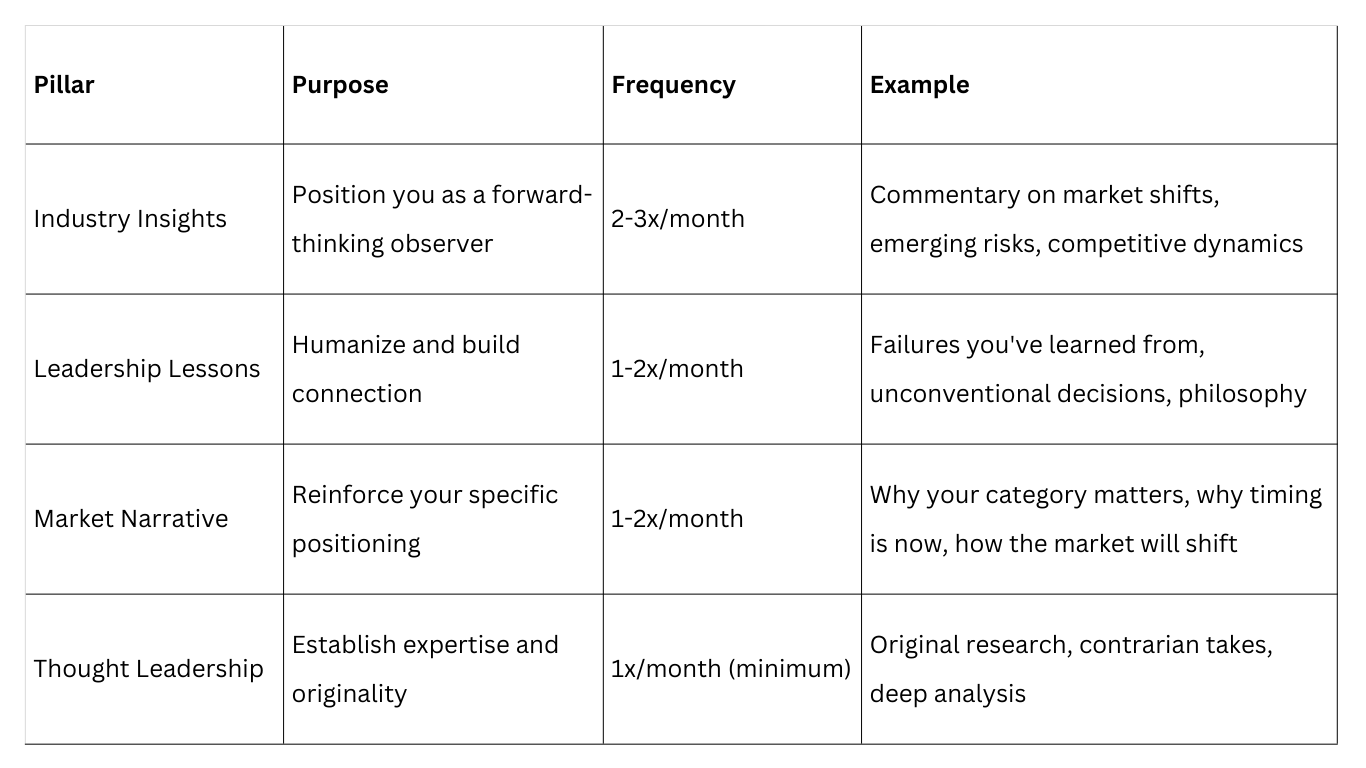
Content does not need to be constant. Quality beats frequency. A single well-researched LinkedIn article or published piece in a respected publication outperforms dozens of generic posts.
Step 4: Execute With Consistency (Distribution Phase)
Consistency is what turns sporadic visibility into compounded authority. Establish a publishing rhythm you can sustain:
- LinkedIn: 1 to 2 posts per week.
- Articles: 1 major piece per quarter.
- Speaking: 2 to 4 speaking engagements per year.
- Podcast: 1 appearance per quarter.
Do not overcommit. A CEO who publishes consistently every month will build more authority than one who posts intensely for 3 months, then disappears. The algorithm rewards consistency, and so do investors who monitor your presence over time.
Many CEOs work with a LinkedIn ghostwriter to maintain consistency without consuming their time. Agencies like Ohh My Brand specialize in this. They extract your thinking in strategic interviews, maintain your voice and perspective, and handle drafting and publication so you stay visible without sacrificing core business responsibilities.
Step 5: Measure and Amplify What Works (Optimization Phase)
Not all content performs equally. Track what resonates. Which LinkedIn posts generate comments? Which topics attract investors and industry peers to your DMs? Which articles drive the inbound pipeline? Which speaking opportunities lead to meaningful conversations?
Double down on what works. If posts on product strategy generate 10x the engagement of company announcements, publish more on strategy. If bylined articles in specific publications lead to investor introductions, pitch those publications more aggressively. Personal branding is iterative. Your first positioning might shift as you learn what resonates.
Real-World CEO Scenarios: How Different Founders Built Brands That Attracted Investment
Scenario 1: The SaaS Founder in a Crowded Market
The Challenge: Sarah founded a compliance SaaS in a market with 50+ competitors. Her product was solid, but investors saw it as incremental. They wanted to understand what made her unique.
The Personal Brand Solution: Rather than talk about her product, Sarah utilized personal branding through storytelling to position herself as the founder rethinking regulatory burden. She published a quarterly research report analyzing how regulation was stifling innovation. She spoke at compliance conferences not about her product, but about the future of regulation. She published bylined articles in Forbes and Entrepreneur about this exact tension.
Within 12 months, investors began to see Sarah not as a “SaaS founder” but as a “regulatory futurist.” Her personal brand elevated her company’s perception from commodity to category leader. She closed her Series A at a 40% higher valuation than comparable startups, and investors specifically cited her thought leadership as a confidence factor.
Scenario 2: The Technically Brilliant Founder Who Hated Talking
The Challenge: Marcus built groundbreaking deep-tech AI IP but was deeply introverted. He would rather code than attend events or give talks. His company was invisible to institutional investors despite having superior technology.
The Personal Brand Solution: Rather than force Marcus into a CEO-personality mold, his advisor suggested a different approach. They utilized Bestselling frameworks for personal brands tailored to introverts: LinkedIn ghostwriting plus strategic speaking. A ghostwriter worked with Marcus quarterly to extract his core insights, publish them thoughtfully, and build his profile. Simultaneously, they booked him on 3 to 4 podcasts per year where he could discuss technical challenges in depth.
This approach played to his strengths. He did not have to perform. He just had to think deeply. Within 18 months, his LinkedIn had 8,000+ followers in his niche. He received inbound inquiries from strategic investors and two acquisition approaches. His personal brand had positioned him as a technical authority, which is exactly what serious deep-tech investors were looking for.
Scenario 3: The Second-Time Founder Leveraging Past Success
The Challenge: Jennifer exited her first company successfully but was largely unknown outside her immediate network. Her second company was in a different vertical, and early fundraising conversations were lukewarm.
The Personal Brand Solution: Jennifer’s advisor suggested she lean into her founder narrative, proving that Authors make better personal brand strategists by turning her experience into a story. She published a long-form essay on her first exit covering what went right, what she would do differently, and what she learned about building for scale. She gave talks at founder conferences about founder psychology during growth stages. She started a monthly newsletter sharing unfiltered lessons for other founders.
Her personal brand positioned her not as a first-time founder but as a battle-tested operator with institutional knowledge. When she fundraised for her second company, investors already knew her thinking. She had proof of her ability to build and scale. Her personal brand accelerated due diligence and reduced investor skepticism. Her Series A closed in half the typical timeline.
Where Personal Branding Agencies Help: The Ohh My Brand Model
For many busy executives, building a personal brand alone is impossible. You are already leading a company, fundraising, hiring, and managing a crisis. Where do you find time to develop thought leadership? This is where personal branding agencies become invaluable.
Agencies like Ohh My Brand specialize in exactly this. They build authentic, strategic personal brands for CEOs and founders without requiring them to sacrifice core business responsibilities. Here is how.
CEO Positioning & Strategy
A branding agency does not just publish content. They develop your positioning first. They interview you deeply. They analyze your market, competitors, and unique perspective. They craft a clear, differentiated positioning that becomes your north star. This strategic foundation ensures every piece of content, every speaking opportunity, and every media mention aligns with your broader goals.
LinkedIn Ghostwriting & Content Management
This is the workhorse of modern CEO branding agencies. A ghostwriter does not write for you. They write from you. They conduct strategic interviews to understand your thinking, maintain your authentic voice, and publish content under your name that builds visibility. Ohh My Brand clients see 300%+ increases in LinkedIn engagement once ghostwriting is active because the content is consistent, strategic, and grounded in real thinking.
Media Relations & PR
Personal branding compounds when it extends beyond social. Agencies pitch your thinking to major publications. They secure you bylined articles in Forbes, Entrepreneur, and industry trades. They get you on podcasts with relevant audiences. Each external mention acts as Backlink Building for your reputation, adding authority that social media alone cannot replicate. An SEO Consultant within the agency often helps optimize this footprint.
Thought Leadership Development
Your first instinct might be to write about your company. Instead, agencies help you identify timely, original insights about your market using Content system from book based strategies. They help you develop proprietary research, frameworks, or analysis that positions you as an expert beyond your company’s walls. This third-party authority is what moves investor needles.
Speaking & Event Strategy
Being asked to speak is not random. Agencies have relationships with conference organizers, event directors, and podcast hosts. They pitch you strategically for opportunities aligned with your positioning and audience. More importantly, they coach you on how to use speaking strategically to reinforce your brand positioning.
Board & Opportunity Leverage
A strong personal brand opens doors to board positions, advisory roles, and strategic partnerships. Agencies help you navigate these opportunities strategically, ensuring new roles reinforce rather than dilute your core brand.
The output? Within 6 to 12 months, a CEO typically sees:
- 5 to 10 media placements in recognized publications.
- 50 to 100% growth in LinkedIn followers and engagement.
- Inbound investor interest traceable to content.
- Speaking invitations from top-tier events.
- Clear positioning that differentiates them from peers.
- Visibility that translates into strategic opportunities.
This is not vanity. It is business acceleration. The investment in personal branding compounds across fundraising timelines, valuation negotiations, talent attraction, and market credibility.
Implementation Checklist: What You Need to Start Building Your Personal Brand Today
If you are convinced but unsure where to begin, here is a practical checklist. Work through this in order.
Clarity Phase (Week 1-2)
- Define your core positioning in 3 to 4 sentences.
- Identify 2 to 3 specific, defensible perspectives you have that others do not.
- List your proof points (degrees, exits, results, recognition).
- Identify 3 to 5 thought leaders in your space you want to learn from.
Content Foundation (Week 3-4)
- Choose your primary platforms (LinkedIn is non-negotiable for most).
- Develop your 4 to 5 content pillars relevant to your positioning.
- Decide on publishing frequency (realistic, sustainable rhythm).
- If outsourcing, vet and hire a LinkedIn ghostwriter or use **Ebook Writing Services** to capture your manifesto.
Month 1-3: Launch Phase
- Optimize your LinkedIn profile with clear headline, strategic about section.
- Publish your first 4 to 8 pieces of content.
- Reach out to 3 to 5 publications/podcasts to pitch speaking/writing opportunities.
- Build a list of your top 100 strategic connections and start engaging with their content.
Month 4-6: Amplification Phase
- Aim for at least one external media placement.
- Double down on content that is generating meaningful engagement.
- Actively engage with industry peers’ content 3 to 4x per week.
- Track what is resonating. Adjust content mix accordingly.
Month 7-12: Optimization & Scale
- Aim for 3 to 5 media placements across the year.
- Maintain consistent publishing rhythm without burnout.
- Evaluate impact. Has inbound increased? Has visibility improved? Are investors mentioning your thought leadership?
- Refine positioning based on 6 months of data.
Ongoing: Sustain & Evolve
- Publish consistently. Month in, month out.
- Track metrics: LinkedIn growth, publication placements, speaking invites, pipeline impact.
- Evolve your positioning as the market and business evolve.
- Add new formats (video, research, events) as capacity allows.
Frequently Asked Questions About CEO Personal Branding and Investor Attraction
Q1. Does personal branding actually attract investors, or is it just marketing?
Investors will tell you they invest in people, not just products. Research backs this up. 87% of CEOs say personal reputation helps attract investors, and 44% of a company’s market value is attributable to CEO reputation. When a founder has built visible credibility, investors perceive lower execution risk. They see someone capable of navigating complexity, attracting talent, and commanding respect. Personal branding is a direct signal of those capabilities.
Q2. I’m worried personal branding is too self-promotional. How do I do it authentically?
The 5:3:2 content ratio is your guardrail: 50% industry insights, 30% leadership philosophy, 20% personal professional journey. This mix positions you as a thought leader first and a self-promoter second. Focus on sharing perspectives on your market, lessons from your journey, and original insights. People are drawn to leaders with clear thinking, not leaders with big egos.
Q3. How long before I see results from personal branding?
Compounding takes time. You will see initial engagement within weeks. You will see meaningful visibility within 3 to 4 months of consistent effort. But serious investor perception shifts take 6 to 12 months. This is why starting early matters. By the time you fundraise, your brand is already established.
Q4. I’m a technical founder with no interest in being a public figure. Do I still need personal branding?
Yes. Even technical founders benefit from personal branding. You just position differently. Instead of being a personality, position yourself as a technical authority. Marcus’s deep-tech example above demonstrates this. You do not need to be charismatic. You need to be credible, consistent, and visible in your niche.
Q5. Should I hire an agency or do it myself?
If you have 5 to 10 hours per month to dedicate to content, LinkedIn posting, and PR outreach, you can do it yourself. If not, agencies create leverage. They turn your thinking into publishable content, manage relationships, and handle the operational side so you focus on what only you can do: developing original insights.
Q6.What’s the difference between CEO’s personal branding and corporate marketing?
Corporate marketing promotes your company. CEO’s personal branding establishes you as a thought leader independent of the company. They are complementary but distinct. Corporate marketing talks about your product. CEO’s personal branding talks about their market perspective. Investors read your personal brand to evaluate you as a leader. They read corporate marketing to evaluate your product market fit.
Q7.How much should I invest in personal branding?
For a founder actively fundraising, $3,000 to $8,000 per month for agency support is typical. This might sound like a lot, but consider the alternative. If personal branding helps you close your Series A at a higher valuation or 6 months faster, it pays for itself many times over. The ROI is significant, especially if you have experienced help.
Q8. Can personal branding hurt you?
Yes, if you are not thoughtful. Inconsistent messaging, overly promotional content, controversial takes without backing, or content that contradicts your company’s narrative can backfire. This is why working with experienced professionals or having a clear strategy matters. You are building long-term credibility, not chasing viral moments.
Q9.How do I measure if personal branding is working?
Track LinkedIn growth, external placements, and pipeline impact. Monitor sentiment in conversations with investors, customers, and employees that reference your thought leadership. Qualitatively, ask yourself: Are you getting asked to speak? Are investors mentioning your articles? Are journalists reaching out for commentary?
Q10. Where does LinkedIn ghostwriting fit into this strategy?
LinkedIn ghostwriting is the operational engine of modern CEO personal branding. A ghostwriter handles the content creation burden, allowing you to maintain visibility without consuming your time. They interview you to understand your thinking, write from your voice, and publish consistently. This consistency is what allows your brand to compound.
Q11:What’s the most underrated aspect of CEO’s personal branding?
Consistency. Not brilliance, not viral moments, not massive follower counts. Consistency. A CEO who publishes thoughtfully every month for a year will build more authority than one who goes viral once. Investors notice founders they see regularly, building credibility incrementally using book frameworks for linkedin brand building.
Q12.How does personal branding tie into company valuation?
The link is direct. A strong CEO reputation contributes to 44% of a company market value. Better valuations in funding rounds, premium pricing for products, faster customer acquisition, and easier talent hiring are all influenced by CEO visibility and credibility. The personal brand is not separate from the company value. It is a core component of it.
Conclusion: Your Brand Is Your First Pitch
Before your pitch deck lands on an investor’s desk, they have already done diligence on you. They have checked your LinkedIn. They have read articles you have published. They have asked mutual connections about your background and character. Your personal brand precedes you.
This is why building it strategically matters so much. You are not chasing attention for vanity. You are establishing the credibility, clarity, and vision that will determine whether investors see you as a founder worth betting on.
The CEOs and founders who will lead in 2026 and beyond are those who master personal branding. They are visible founders without being promotional, credible without being boastful, and strategic without losing authenticity. They understand that building a personal brand is building a business asset. They know that investor confidence comes from more than a product or metric. It comes from believing in the person leading the mission.
If you are ready to move from invisible to indispensable to build a personal brand that attracts serious investors and establishes you as a founder worth following, your first step is clarity. Define your positioning. Identify what makes your perspective valuable. Then, commit to consistency.
If you want expert guidance through this process, Ohh My Brand specializes in positioning, ghostwriting, and thought leadership strategy for CEOs and founders globally. They have worked with founders across SaaS, deep-tech, fintech, and enterprise software to build personal brands that translated into better valuations, inbound investor interest, and market leadership. From CEO positioning to LinkedIn growth to media placements, they handle the strategic and operational sides so you can focus on building your business.
Explore partnership with Ohh My Brand, if you are ready to build a personal brand that moves money, opens doors, and positions you as a founder investors actually want to back. Your brand is your competitive advantage. Make it count.